AP Exam Practice
Full Practice Exam
Multiple-Choice Questions
Questions 1 and 2 refer to the passage below.
“I will give you my father’s words just as I received them; royal griots [storytellers] do not know what lying is. . . . Fear enters the heart of him who does not know his destiny, whereas Sundiata knew that he was striding towards a great destiny. . . . There is one that will make a great king. He forgets nobody. . . . In the same way as light preceded the sun, so the glory of Sundiata, overleaping the mountains, shed itself on all the Niger plain. . . . The arms of Sundiata had subdued all the countries of the savanna. . . . With Sundiata peace and happiness entered Niani. . . . Every king wants to have a singer to perpetuate his memory, for it is the griot who rescues the memories of kings from oblivion, as men have short memories. . . . The prophets did not write and their words have been all the more vivid as a result. . . . But whoever knows the history of a country can read its future. . . . Kings are only men, and whatever iron cannot achieve against them, words can.”
Epic of Sundiata, the story of the founding of the Mali Empire
1. Which of the following best describes the most likely purpose of telling these details about Sundiata?
- (A) To persuade listeners that his rule over the Mali Empire was justified
- (B) To prove that words matter more than deeds
- (C) To compare him to the current ruler of the Mali Empire
- (D) To assess his positive qualities and his flaws
2. The best evidence to support the claim in the excerpt that Sundiata “was striving towards a great destiny” is that Mali became
- (A) the protector of pilgrimage routes to Mecca
- (B) linked to the Americas in an Atlantic system
- (C) a kingdom of prosperous Muslim farmers
- (D) wealthy from trans-Saharan trade conducted by Muslims
Questions 3 and 4 refer to the passage below.
“South-eastern China was also the chief centre [center] of porcelain production, although china [Chinese] clay is found also in North China. The use of porcelain spread more and more widely. The first translucent porcelain made its appearance, and porcelain became an important article of commerce both within the country and for export. Already the Muslim rulers of Baghdad around 800 used imported Chinese porcelain, and by the end of the fourteenth century porcelain was known in Eastern Africa. Exports to South-East Asia and Indonesia, and also to Japan gained more and more importance in later centuries. Manufacture of high-quality porcelain calls for considerable amounts of capital investment and working capital; small manufacturers produce too many second-rate pieces; thus we have here the first beginnings of an industry that developed industrial towns such as Ching-te, in which the majority of the population were workers and merchants, with some 10,000 families alone producing porcelain. Yet, for many centuries to come, the state controlled the production and even the design of porcelain and appropriated most of the production for use at court or as gifts.”
Wolfram Eberhard, A History of China, 1969
3. Which of the following conclusions about porcelain is best supported by the passage?
- (A) People in the Middle East preferred luxury items made in Persia.
- (B) Proto-industrialization in the manufacture of luxury goods led to urbanization in China.
- (C) Much of the porcelain manufacturing industry in China was controlled by foreign merchants.
- (D) Japan was a leading consumer of Chinese porcelain in the 1300s.
4. What development most aided the growth in the labor supply needed for the increasing production of porcelain and other manufactured goods?
- (A) The use of the magnetic compass and other transportation improvements enabled peasants to travel to Chinese cities more easily.
- (B) The invention of inexpensive paper created an easier way to communicate and to advertise for job openings in the porcelain factories.
- (C) The spread of gunpowder weapons allowed landlords to force rebellious peasants to end their revolts and move into the cities to work in porcelain factories.
- (D) The changes in agriculture, including the introduction of a fast-growing variety of rice known as champa, increased food production.
Questions 5 and 6 refer to the passage below.
“2. Leaders of a religion, preachers, monks, persons who are dedicated to religious practice, the criers of mosques, physicians and those who bathe the bodies of the dead are to be freed from public charges [duties].
3. It is forbidden under penalty of death that anyone, whoever he be, shall be proclaimed emperor unless he has been elected previously by the princes, khans, officers and other Mongol nobles in a general council.
4. It is forbidden chieftains of nations and clans subject to the Mongols to hold honorary titles.
5. [It is] forbidden ever to make peace with a monarch, a prince or a people who have not submitted.”
Excerpt from Yassa, The Laws of Genghis Khan, early 13th century
5. The passage most strongly supports the idea that the Mongols
- (A) promoted Islam, which was the faith of the Mongol khan
- (B) created a loose confederation of local kings, sultans, and caliphs
- (C) formed alliances with rival empires that had successfully resisted Mongol invasions of their territories
- (D) developed a decentralized government in which Mongol khans ruling conquered lands elected the emperor 6. Which of the following was the most immediate political change in the Mongol Empire after the death of Genghis Khan? (A) Descendants of Genghis Khan each took control of part of the empire. (B) Trade along the Silk Roads stopped for almost a century. (C) Mongol rulers quickly lost control of China. (D) Russian rulers in Moscow became more powerful.
6. Which of the following was the most immediate political change in the Mongol Empire after the death of Genghis Khan?
- (A) Descendants of Genghis Khan each took control of part of the empire.
- (B) Trade along the Silk Roads stopped for almost a century.
- (C) Mongol rulers quickly lost control of China.
- (D) Russian rulers in Moscow became more powerful.
Questions 7 to 9 refer to the passage below.
“Apart from his navigational skills, what most set Columbus apart from other Europeans of his day were not the things that he believed, but the intensity with which he believed in them and the determination with which he acted upon those beliefs. . . . Columbus was, in most respects, merely an especially active and dramatic embodiment of the European—and especially the Medi- terranean—mind and soul of his time: a religious fanatic obsessed with the conversion, conquest, or liquidation of all non-Christians; a latter-day crusader in search of personal wealth and fame, who expected the enormous and mys- terious world he had found to be filled with monstrous races inhabiting wild forests, and with golden people living in Eden.”
David E. Stannard, American Holocaust: Columbus and the
Conquest of the New World, 1992
7. Which of the following best explains the ideas expressed by the author in the title and contents of the passage?
- (A) Stannard is critical of the motives and impact of Columbus.
- (B) Stannard believes Columbus was an unselfish explorer.
- (C) Stannard thinks Columbus was motivated primarily by his hopes to spread Christianity in the Americas.
- (D) Stannard respects Columbus for searching for a Northwest Passage to the East Indies.
8. Spanish goals diverged from those Stannard attributed to Columbus in the passage with the
- (A) beginning of the fur trade in the northern part of the Americas
- (B) realization that enslaved Africans could be used to raise cash crops
- (C) discovery of precious metals in the Inca and Aztec Empires
- (D) development of a profitable tobacco industry
9. European exploration at the end of the 15th century was motivated most strongly by a desire to
- (A) avoid the Ottoman-controlled trade routes in the eastern Mediterranean
- (B) revive the Crusades to take control of Jerusalem
- (C) sell European ship-building technology to the Arabs and Chinese
- (D) acquire natural resources such as coal and oil to support industrialization
Questions 10 and 11 refer to the timeline below.
States in South Asia
800
1000
1200
1400
1600
1800
Chola Kingdom
Mughal Empire
Delhi Sultanate
850–1267
1526–1857
1206–1526
10. What factor is most responsible for the trend of increasing trade in the Indian Ocean during the period shown on the timeline?
- (A) The participation of European merchants
- (B) The growth of Dar al-Islam
- (C) The journeys of Zheng He
- (D) The advances in Chinese silk manufacturing
11. The Mughals consolidated rule of South Asia as a
- (A) Hindu empire
- (B) gunpowder empire
- (C) maritime empire
- (D) trading post empire
Questions 12 and 13 refer to the image below.
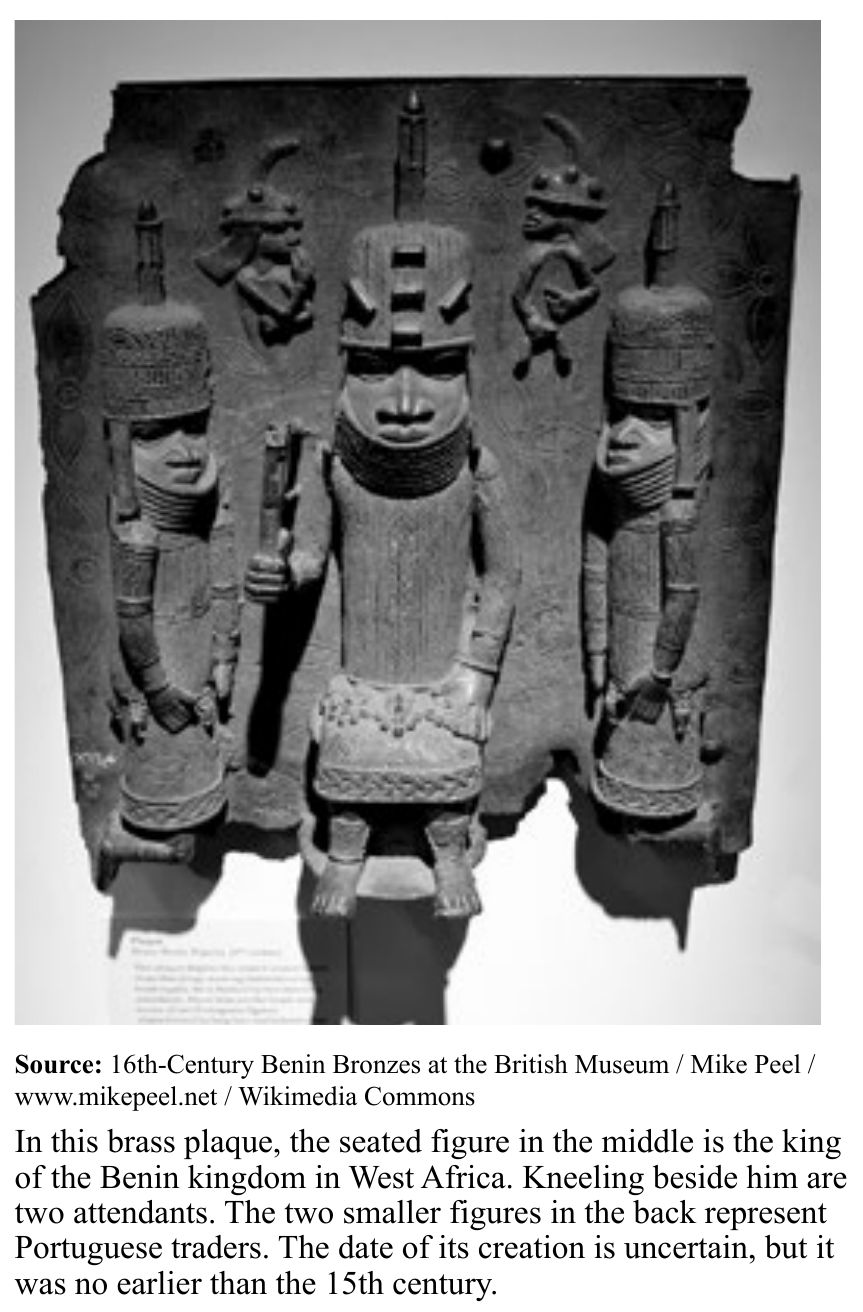
12. As shown by the Benin Bronze above, the most influential context shaping West Africa in the 16th century was the
- (A) adoption of European political structures by West African rulers
- (B) diffusion of European art styles to West African artists
- (C) power of West African Empires to maintain authority
- (D) preference of West African people for European governance
13. The Benin Bronze shown above could best be used as evidence for a historian studying
- (A) hierarchy in West African society
- (B) technology in Western Europe
- (C) the use of monumental architecture to consolidate ruling authority
- (D) the spread of Islam to West Africa
Questions 14 and 15 refer to the map below.
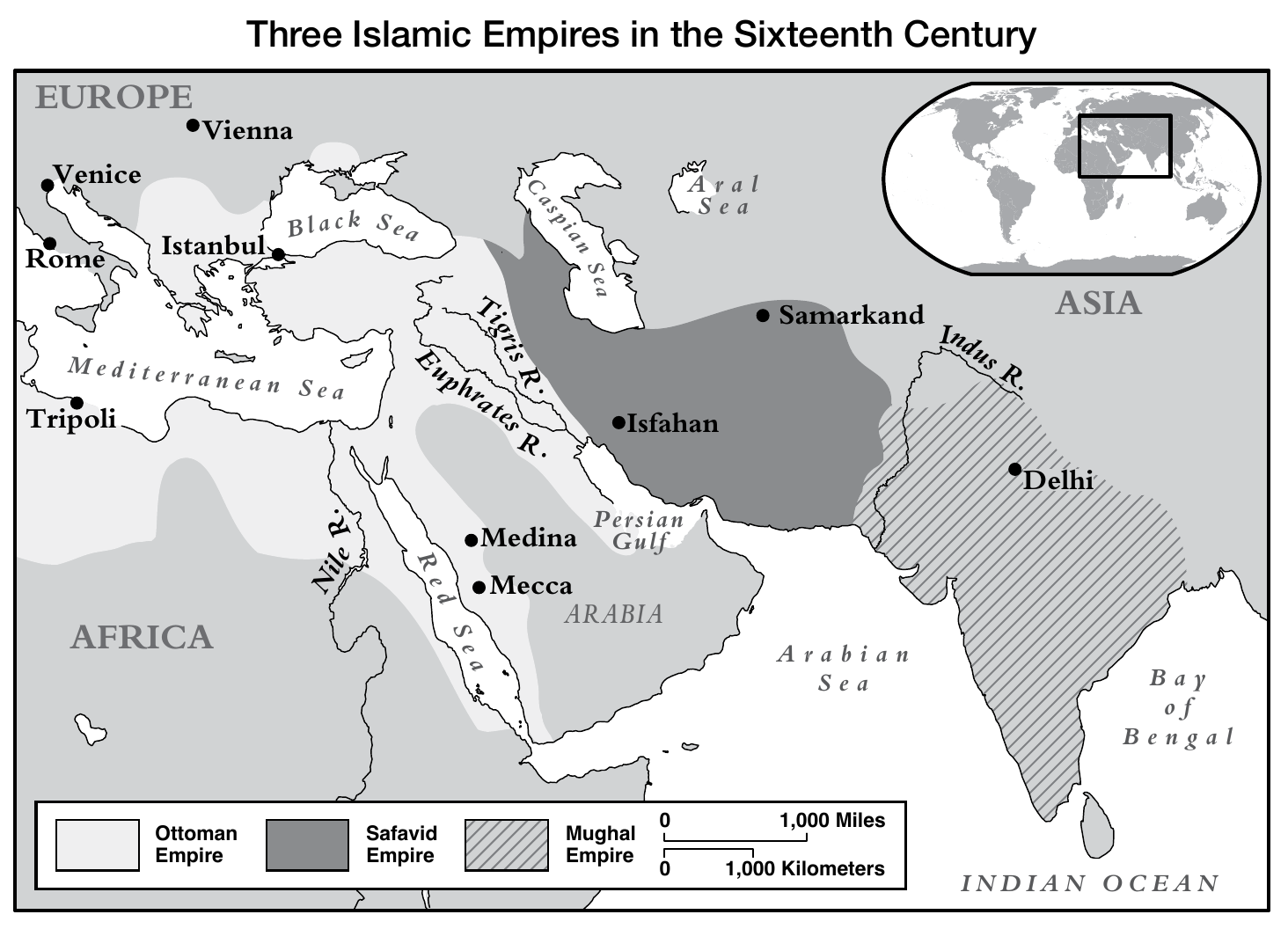
14. The empires shown on the map expanded during the 15th and 16th centuries mostly as a result of diffusion of technology of
- (A) printing
- (B) gunpowder
- (C) mapmaking
- (D) transportation
15. Which of the following arguments about empires in the 16th century is best supported by the evidence shown on this map?
- (A) Shi’a Muslims were more successful at uniting people than were Sunni Muslims.
- (B) The influence of Turkic culture was strong in southern and southwestern Asia.
- (C) Mongol khans ruled southern and southwestern Asia for over 250 years.
- (D) Political unity characterized Dar al-Islam after the Abbasid Caliphate.
Questions 16 and 17 refer to the passages below.
Source 1
“Montezuma, who with one of his sons and many other chiefs who had been captured at the beginning, was still a prisoner, asked to be carried to the roof of the fort where he could speak to the captains and the [Aztec] people, and cause the war to cease. I had him taken there, and when he reached the parapet on the top of the fort, intending to speak to the people who were fighting there, one of his own subjects struck him on the head with a stone with such force that within three days he died. I then had him taken out, dead as he was, by two of the Indian prisoners, who bore him away to his people; but I do not know what they did with him.”
Hernán Cortés, letter to King Charles V of Spain, circa 1520
Source 2
“The ‘Chronicle’ tells us that once the Spanish had fled from Mexico [a temporary setback] and those who had remained behind had been killed, the Aztecs entered the chambers of Montezuma in order to treat him more cruelly than they had dealt with the Spaniards. There they found him dead with a chain about his feet and five dagger wounds in his chest. Near him lay many noblemen and great lords who had been held prisoner with him. All of them had been slain shortly before the Spaniards abandoned the building.”
Diego Durán, Spanish Roman Catholic priest, c. 1580
16. The views expressed in Source 1 and Source 2 are best used as evidence of which of the following?
- (A) Colonization spread European religion to North America.
- (B) Economic disputes led to conflict between states.
- (C) Europeans used mercantilist policies to claim overseas territories.
- (D) State expansion was resisted by local groups.
17. An important context of the successful Spanish conquest was that
- (A) the Aztec population grew after the introduction of Spanish technology
- (B) the Aztec rulers viewed the Spanish as their allies against other Europeans
- (C) the Aztec people shared culture inherited from earlier Mesoamerican societies
- (D) the Aztec empire collected tribute from the people and regions they conquered
Questions 18 to 20 refer to the table below.
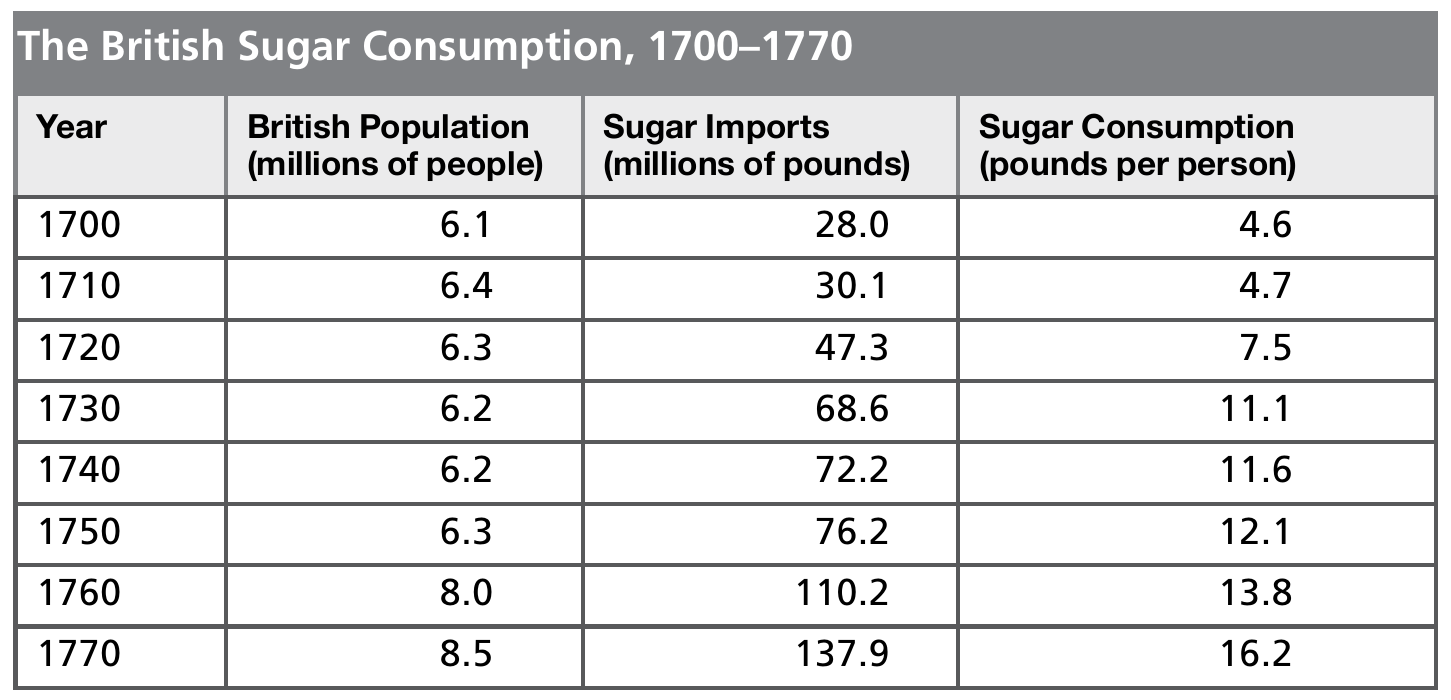
18. Which of the following contributed most to the trend in British population shown in the table in the years from 1750 to 1770?
- (A) The end of imperial wars with rival European nations
- (B) The migration of laborers from British colonies to Britain
- (C) The spread of disease pathogens along trade routes
- (D) The changes in how people lived as a result of the industrial revolution in Britain
19. Which of the following statements describes developments in the Americas that contributed to the changes in British sugar imports?
- (A) Sugar was an American crop that was introduced to Europeans as part of the Columbian Exchange.
- (B) Europeans adopted the system of chattel slavery practiced by American societies that used it for growing sugar.
- (C) Plantations in the Caribbean and Brazil produced large amounts of sugar.
- (D) British primarily relied on indentured servants to work on their sugar colonies in the Caribbean.
20. Which of the following ideologies led to the British economic interactions with their American colonies that are shown in the table?
- (A) free-trade
- (B) mercantilism
- (C) socialism
- (D) laissez-faire capitalism
Questions 21 to 23 refer to the passage below.
“As a rich man is likely to be a better customer to the industrious people in his neighborhood than a poor, so is likewise a rich nation. . . . [Trade restrictions,] by aiming at the impoverishment of all our neighbors . . . , tend to render that very commerce insignificant and contemptible. . . .
The statesmen who should attempt to direct private people in what manner they ought to employ their capital, would not only load himself with a most unnecessary attention, but assume an authority which could safely be trusted, not only to no single person, but to no council or senate whatever, and which would nowhere be so dangerous as in the hands of a man who had folly and presumption enough to fancy himself fit to exercise it.”
Adam Smith, The Wealth of Nations, 1776
21. Which of the following was the most important broader context in which the above passage was written?
- (A) The beginning of the Industrial Revolution
- (B) The emergence of nationalism
- (C) The rise of socialism
- (D) The increase in silver production in the Americas
22. A government enacting policies based on Adam Smith’s ideas would be most likely to
- (A) subsidize agricultural production
- (B) regulate membership in skilled trades
- (C) limit the amount of shoe imports
- (D) reduce tariffs on goods entering the country
23. Adam Smith disagreed with mercantilism because of his belief that good governments should
- (A) sponsor state industries to achieve regional economic development
- (B) nationalize communications and transportation infrastructures
- (C) reduce their interventions aimed at controlling trade
- (D) limit the extension of colonial rule to new territories
Questions 24 and 25 refer to the passage below.
“We find that your country is [far] from China. Yet there are barbarian ships that strive to come here for trade for the purpose of making a great profit. The wealth of China is used to profit the barbarians. That is to say, the great profit made by barbarians is all taken from the rightful share of China. By what right do they then use the poisonous drug to injure the Chinese people? Even though the barbarians may not necessarily intend to do us harm, yet in coveting profit to an extreme, they have no regard for injuring others. Let us ask, where is your conscience? I have heard that the smoking of opium is very strictly forbidden by your country; that is because the harm caused by opium is clearly understood. Since it is not permitted to do harm to your own country, then even less should you let it be passed on to the harm of other countries—how much less to China!”
Lin Zexu, Chinese official, letter to Queen Victoria, 1839
24. All of the following contributed to causing the situation described by the passage EXCEPT
- (A) The highly organized imperial bureaucracy of Qing Dynasty China
- (B) Chinese demands for European manufactured goods
- (C) The Chinese concept of China as the civilized “middle kingdom”
- (D) European demands for Chinese goods such as tea and silk
25. Which of the following developments was most immediately caused by the circumstances described in the passage?
- (A) The British switched from selling opium to selling tea in China.
- (B) The British defeated China in a war and exanded their opportunities to trade in China.
- (C) The Chinese formed an anti-British alliance with France.
- (D) Japan used the conflict between China and Great Britain to justify the Sino-Japanese War.
Questions 26 to 28 refer to the image below.
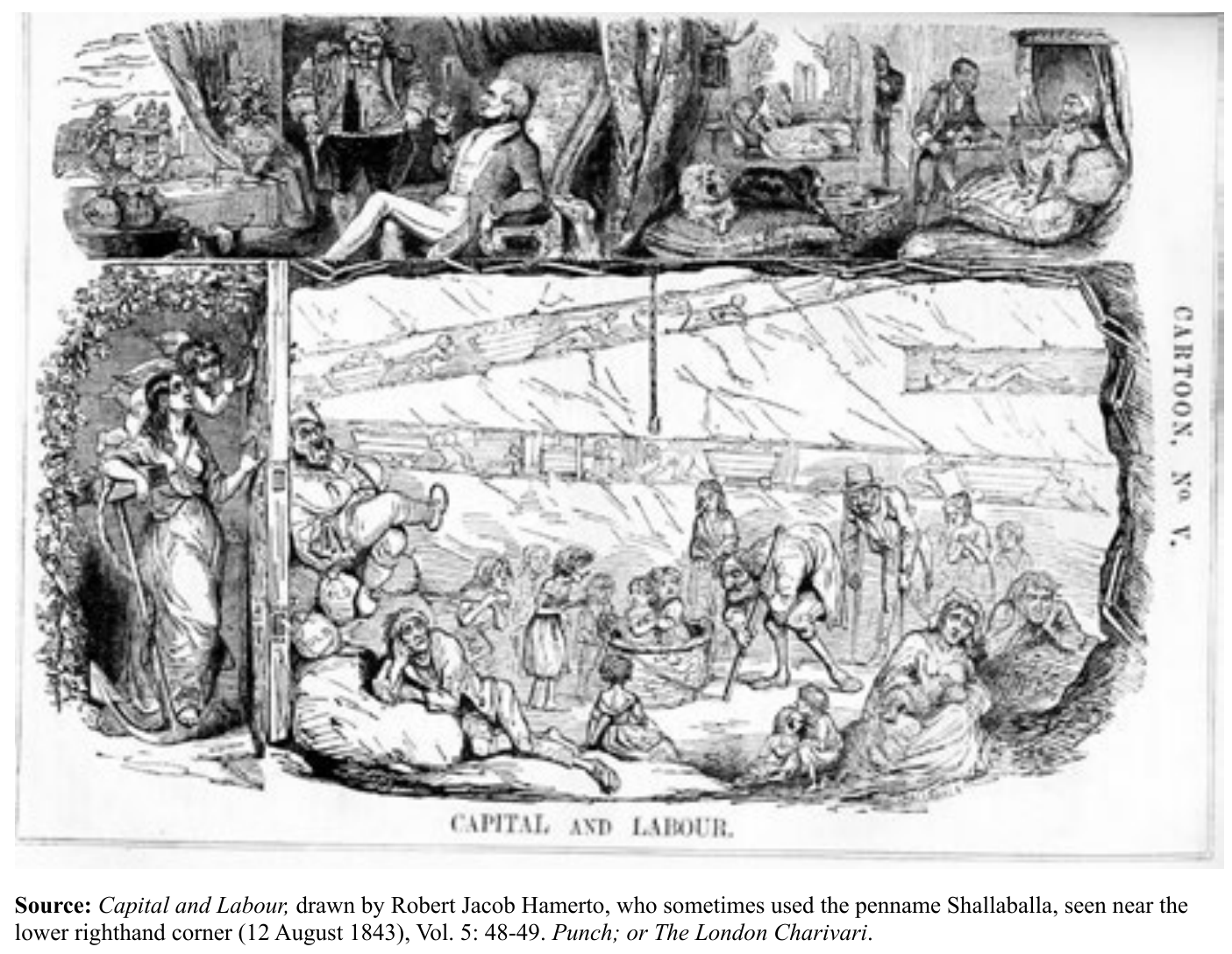
26. The image’s message indicates that the artist would most likely support
- (A) the abolition of slavery
- (B) the organization of labor unions
- (C) the policies of laissez-faire economics
- (D) the end of serfdom
27. Which group was most likely to agree with the artist in the 1840s?
- (A) socialists
- (B) land-holding nobles
- (C) colonial governors
- (D) bureaucratic elites
28. The image was most likely produced in the context of the early decades of the Western European transition from
- (A) feudalism to capitalism
- (B) artisan production to factory manufacturing
- (C) absolutism to constitutional monarchy
- (D) imperial states to those founded in ethnic nationalism
Questions 29 to 31 refer to the passages below.
Source 1
“The Communists disdain to conceal their views and aims. They openly declare that their ends can be attained only by the forcible overthrow of all existing social conditions. Let the ruling classes tremble at a Communistic revolution. The proletarians have nothing to lose but their chains. They have a world to win. Working men of all countries, unite!”
Karl Marx and Friedrich Engels, The Communist Manifesto, 1848
Source 2
“Even in interpreting the psychology of the worker of the transitional period, Marx exhibited a rationalistic bias. The worker’s opposition to the capital- ist order is a total opposition to its laws, its factories, and its government. But this revolutionary consciousness of the worker is to take him next to Marxist socialism, where he will accept the factory system and the state, the only difference being the abolition of capitalism. Why shouldn’t the revolutionary protest of the worker flow into other channels: into rejection of industrialism as well as capitalism, into rejection of the socialist as well as the capitalist state?”
Adam B. Ulam, The Unfinished Revolution: Marxism Interpreted, 1960
29. The ideas expressed in Source 1 most directly emerged out of
- (A) desires to convert native peoples in colonies to Christianity
- (B) unsuccessful attempts in Russia to end rule of the tsars
- (C) appeals for equality in the ideology of the Enlightenment
- (D) popular movements for decolonization
30. The ideas expressed in Source 2 could be used most directly to explain why workers might
- (A) leave industrial jobs to develop self-sufficient agricultural communities
- (B) take over factories, mines, and other means of industrial production
- (C) demand fewer regulations on manufacturing industries
- (D) support tax breaks for profit-oriented high-tech industries
31. One similarity between Source 1 and Source 2 is that both
- (A) believe that capitalism is the final stage of economic development
- (B) recognize why workers might support a revolution
- (C) argue that industrialization was a mistake
- (D) criticize the rationalism of the Enlightenment
Questions 32 and 33 refer to the passages below.
Source 1
“It is widely stated that . . . if only the [government would] permit trade there will be no further difficulty. However, it is their practice first to seek a foothold by means of trade and then to go on to propagate Christianity and make other unreasonable demands. . . . We must never choose the policy of peace.”
Tokugawa Nariaki, message to the Japanese Tokugawa Shogunate,
August 14, 1853
Source 2
“We must construct new steamships, especially powerful warships, and these we will load with goods not needed in Japan. For a time, we will have to employ Dutchmen as masters and mariners, but we will put on board with them Japanese of ability and integrity. . . . [The ships] will in fact have the secret purpose of training a navy.”
Ii Naosuke, message to the Japanese Tokugawa Shogunate,
October 1, 1853
32. The ideas expressed in the Source 1 and Source 2 correspondence share the most similarity in goals to those of nineteenth-century reformers seeking modernization in the
- (A) Ottoman Empire
- (B) United States
- (C) Mughal Empire
- (D) Germany
33. Source 1 was most directly influenced by which of the following developments?
- (A) The American independence movement
- (B) The Haitian Revolution
- (C) The Japanese colonization of the Korean peninsula
- (D) The opening of foreign trade ports in China after the Opium War
Questions 34 and 35 refer to the image below.
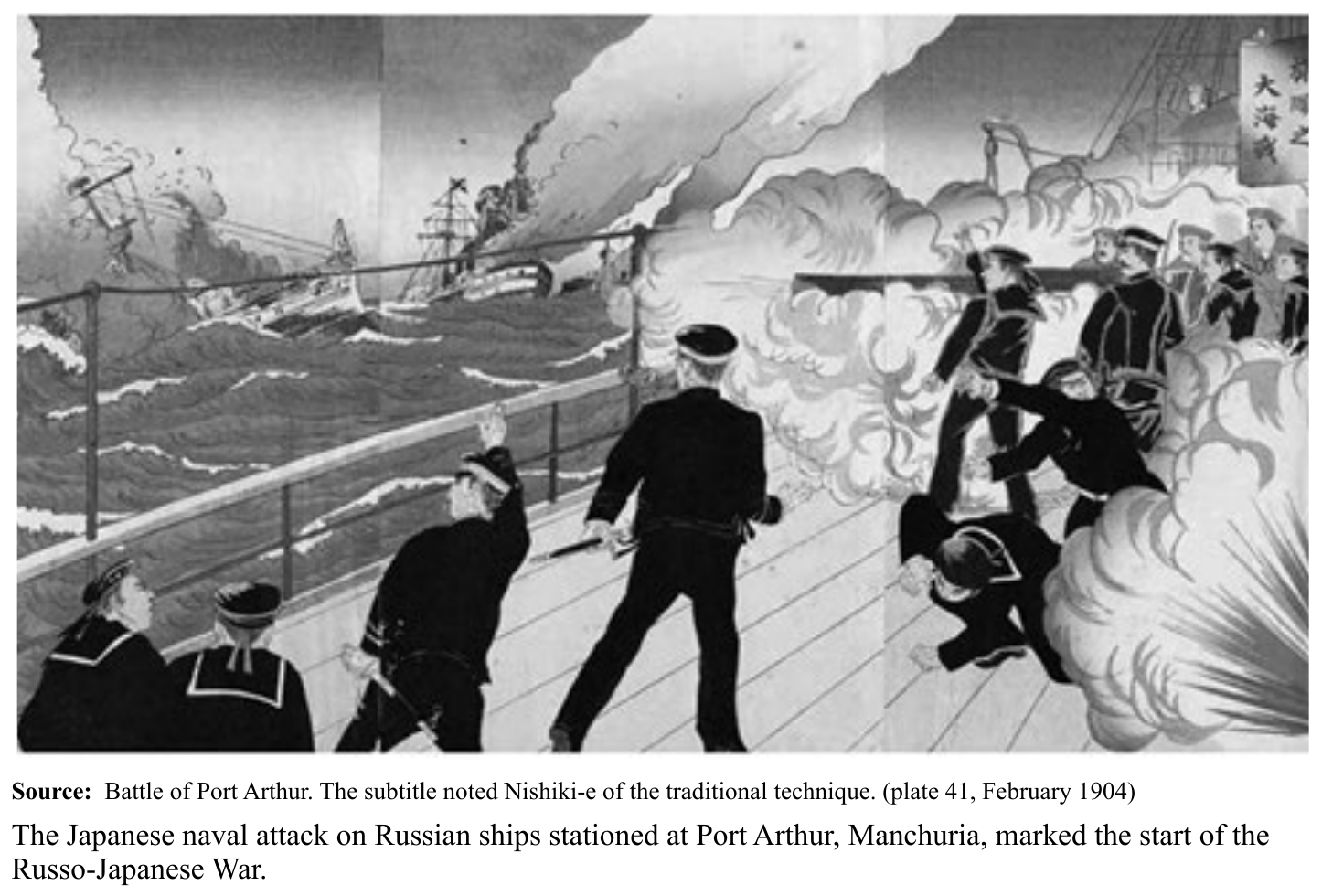
34. Which of the following best describes the results of the events depicted in the image?
- (A) They exposed Japanese weakness and demonstrated the growing power of Russia.
- (B) They marked the first victory in the modern era of Europeans over an Asian nation.
- (C) They revealed Russian weaknesses and illustrated the growing power of Japan.
- (D) They prompted both Russia and Japan to begin industrialization in their countries.
35. Which of the following statements best describes the results of Western influence in East Asia between 1750 and 1900?
- (A) East Asians converted to Christianity in large numbers.
- (B) Meiji Japan copied western economic development.
- (C) Qing Dynasty rulers embraced European political reform.
- (D) East Asian nations rejected westernization.
Questions 36 and 37 refer to the map below.
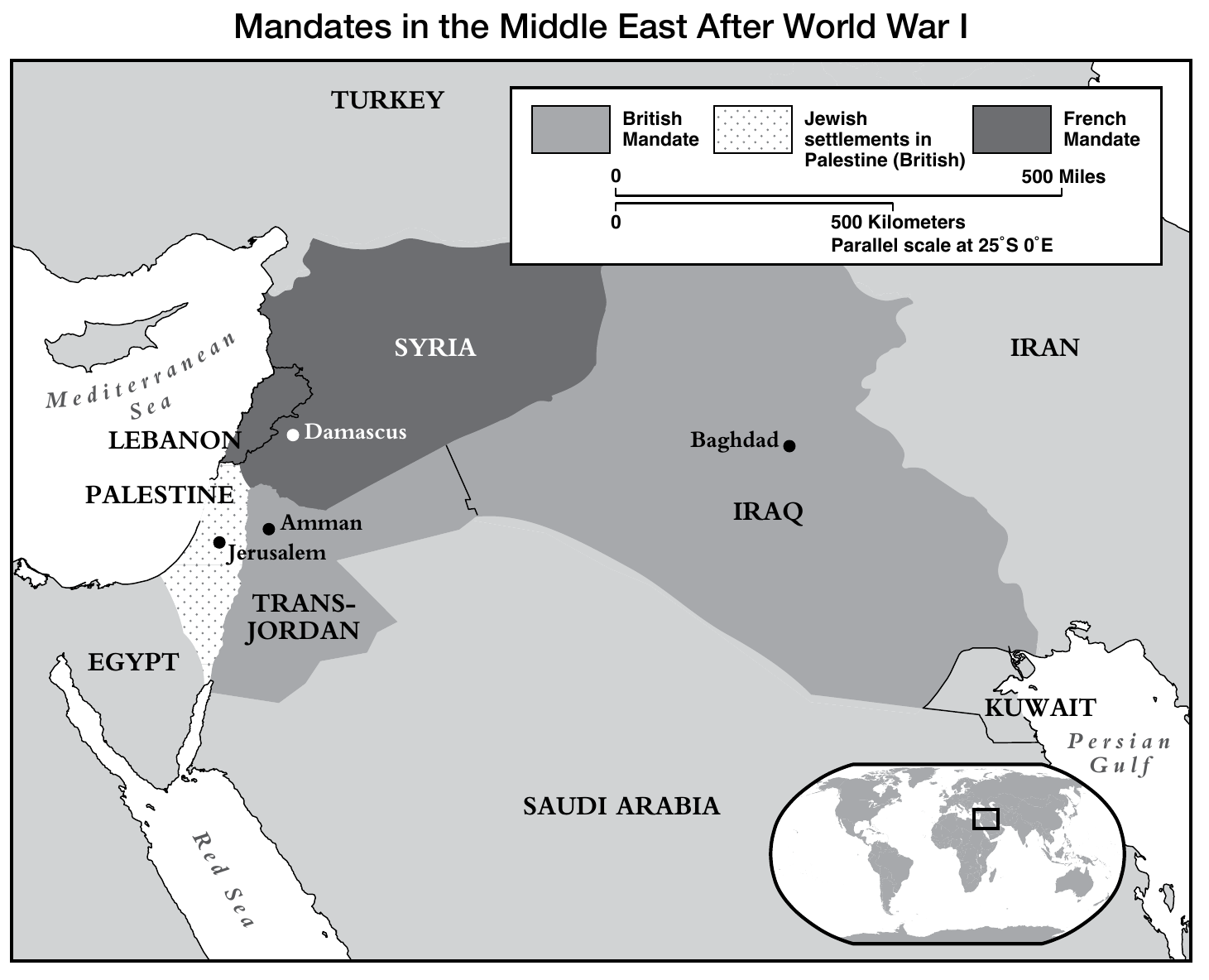
36. Which of the following most directly led to the political rule of territory shown on the map?
- (A) The victory by the Allies (Triple Entente) in World War I
- (B) The rise of nationalist movements in former colonies and territories
- (C) The enactment of United States President Wilson’s principle of self-determination
- (D) The hopes for greater self-government to be established after World War I
37. Which of the following factors contributed most to changing the political rule of territory in the Middle East in the period from 1920 to 1945?
- (A) Successful movements for self-rule
- (B) Pan-Arabism seeking the unification of Arab lands
- (C) Jewish Zionism establishing a new nation in the Middle East
- (D) International organizations such as the United Nations facilitating international cooperation
Questions 38 to 40 refer to the passage below.
“The absolute equality of races, physical, political and social, is the founding stone of World Peace and human advancement. . . . The beginning of Wisdom in interracial contact is the establishment of political institutions among suppressed Peoples. The habit of democracy must be made to encircle the earth. . . . Surely . . . there can be found in the civilized world enough of altruism, learning and benevolence to develop native institutions for the native’s good rather than continuing to allow the majority of mankind to be brutalized and enslaved. . . .
It is to the shame of the world that today the relations between the main groups of mankind and their mutual estimate and respect is determined chiefly by the degree in which one can subject the other to its service,—enslaving labor, making ignorance compulsory, uprooting ruthlessly religion and custom and destroying government so that the favored few may luxuriate in the toil of the tortured many. . . . It is shameful, irreligious, unscientific and undemocratic that the estimate that half the peoples of the earth put on the other half, depends mainly on their ability to squeeze money out of them.”
Pan-African Congress, “The London Manifesto,” 1921
38. The reference to a system that is “shameful, irreligious, unscientific and undemocratic” is best understood as a challenge to
- (A) fascism
- (B) economic nationalism
- (C) socialism
- (D) communism
39. The sentiments expressed in this passage contributed most strongly to which of the following developments?
- (A) Civil wars in post-colonial African states that led to dictatorships
- (B) Land reforms led by Europeans to divide colonial-era land titles
- (C) The migration of former colonial subjects to European metropoles
- (D) The beginning of decolonization and African self-rule
40. The situation described in the second paragraph was most similar to which of the following?
- (A) The sixteenth-century trading-post empire of the Portuguese in the Indian Ocean basin
- (B) The spread of the United States population west to the Pacific Ocean in the last half of the nineteenth century
- (C) The seventeenth-century Spanish colonial empire in North America
- (D) The settler colonialism of the British in Canada in the last half of the eighteenth century and the first half of the nineteenth century
Questions 41 to 43 refer to the passage below.
“We are making out a full and detailed report but it takes time to collate the enormous amount of information which we have collected. The trouble started early on the morning of the 16th and both sides were equally responsible. The Hindus started putting up barricades at Tala Bridge and Belgachia Bridge and other places to prevent Muslims processions coming into the town and Muslims goondas [gang members] went round forcing Hindus to close their shops. As previously mentioned in my D.O. [daily orders] of the 15th the air was electric and this caused crowds to gather, lathis [heavy stick used as a weapon by Indian police] were produced and in no time North Calcutta was a scene of mob riot. By 1100 hours there were brick bat fights all over North Calcutta. . . .
Soon after midnight on the 16/17th these gangs fought out the most desperate battles, murder and butchery of a worst type were carried on in the side lanes and byways of North Calcutta. Round Vivekananda Road/ Central Ave., crossing, about 50 Hindu Behari rickshaw pullers were caught in a cul-de-sac and butchered. Further up Central Ave., round the temple which stands in the middle, a party of some 30 Mohamedans [Muslims] were killed. It was during the period midnight 16/17th and 0700 hours on the 17th that most of the casualties occurred. All the roads in the affected areas were red with bricks. . . . The result of this riot has been complete mistrust between the two communities.”
Excerpts from a British military report on the Calcutta riots, India, 1946
41. The events described in the passage are best understood in the context of which of the following?
- (A) Inter-religious competition fueled by colonial missionary efforts
- (B) The spread of fascist ideology in South Asia
- (C) Resistance to the British military draft during World War II
- (D) Tensions during negotiations over the British withdrawal from India
42. The conflict described in the passage resulted most directly in which of the following?
- (A) The establishment of the Non-Aligned Movement
- (B) The outbreak of a Communist revolution in South Asia
- (C) The partition of South Asia into India and Pakistan
- (D) The strengthening of British rule over the Indian subcontinent
43. The passage best illustrates which of the following causes of global conflict in the 20th century?
- (A) The challenge of redrawing inherited colonial boundaries
- (B) The promotion of proxy wars during the Cold War
- (C) The destructiveness of total war
- (D) The influence of transnational ideologies
Questions 44 to 46 refer to the passage below.
“The ruling circles of the U.S.A., striving for world supremacy, openly declared that they could achieve their aims only from ‘positions of strength.’ The American imperialists unleashed the so-called cold war, and sought to kindle the flames of a third world war. In 1949, the U.S.A. set up an aggressive military bloc known as the North Atlantic Treaty Organization (NATO). As early as 1946, the Western States began to pursue a policy of splitting Germany, which was essentially completed in 1949 with the creation of a West German State. Subsequently they set out to militarize West Germany. This further deepened the division of Germany and made her reunification exceptionally difficult. A dangerous hotbed of war began to form in Europe. In the Far East the United States strove to create a hotbed of war in Japan, stationing its armed forces and building military bases on her territory.”
B. N. Ponomaryov et al., History of the Communist Party of
the Soviet Union, 1962
44. NATO as described in the passage is best understood as
- (A) an economic agreement encouraging free trade among its members
- (B) a political body promoting international cooperation
- (C) a compact of nations that threatened peace in Europe and elsewhere
- (D) a transnational agreement founded to oppose extremist groups
45. Which of the following would most likely be cited by someone who viewed U.S. actions in creating NATO more favorably than Ponomaryov did?
- (A) The United States and the Soviet Union were allies in World War II.
- (B) The United States was the first country to use atomic weapons.
- (C) The U.S. army was much better equipped than the Soviet army.
- (D) U.S. policy was to contain communism, not let it spread.
46. Which of the following U.S. actions best supports a counterargument to the claim that “the American imperialists unleashed the so-called cold war”?
- (A) Accepting the creation of Soviet-style Communist governments in Eastern Europe after World War II rather than deploy troops
- (B) Continuing to recognize the Nationalists as China’s rulers even after they lost their war against Chinese Communists
- (C) Supporting South Korea against North Korea in the Korean War
- (D) Stockpiling hundreds of atomic weapons before other states developed similar technology
Questions 47 to 49 refer to the passage below.
“National integration shall be actively encouraged, whilst discrimination on the grounds of place of origin, sex, religion, status, ethnic or linguistic association or ties shall be prohibited. . . .
[The Constitution shall] encourage
inter-marriage among persons from different places of origin, or of different religious, ethnic or linguistic association or ties. . . .
[It shall be the duty of the State to] promote or encourage the formation of associations that cut across ethnic, linguistic, religious and or other sectional barriers.”
The Nigerian Constitution, 1999
47. Which of the following trends in the last half of the twentieth century most clearly led to the the writing of the passage above?
- (A) The establishment of a world led by the United States and the Soviet Union
- (B) The integration of economies through globalization
- (C) The spread of emerging diseases from one place to another
- (D) The need to settle issues caused by the drawing of colonial boundaries
48. Which of the following best explains the reason for including a statement in the Nigerian Constitution encouraging “inter-marriage among” people of diverse backgrounds?
- (A) The objective of reducing the socioeconomic gap between classes
- (B) The desire to promote a unified state
- (C) The support for cultural pluralism
- (D) The goal of countering the spread of European religions
49. The ideas of the passage are most similar to the ideas expressed by the
- (A) founding document of the International Monetary Fund
- (B) Universal Declaration of Human Rights of the United Nations
- (C) apartheid laws of South Africa
- (D) leaders of the Bolshevik Revolution in Russia
Questions 50 to 52 refer to the graph below.
World Population and Cereal Crops, 1961–2014
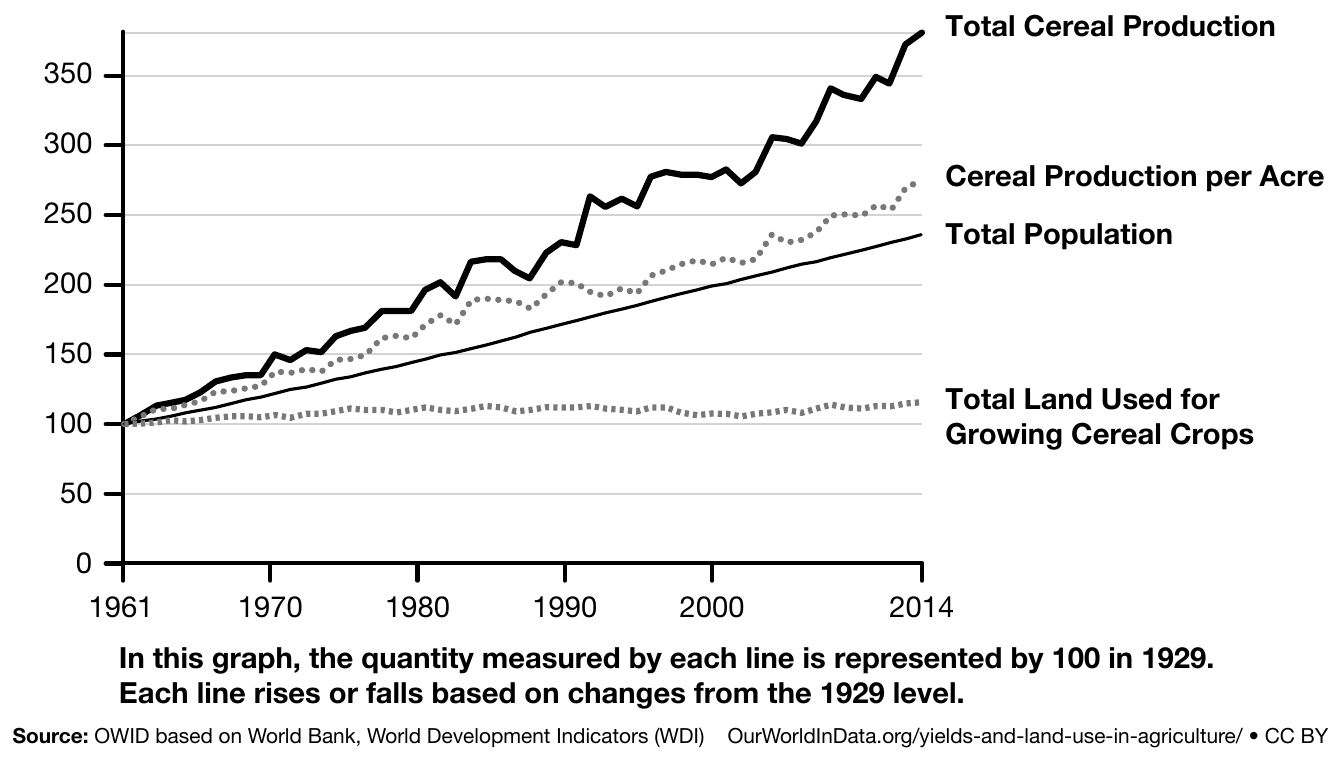
50. Which of the following best explains the overall cereal production trend shown in the graph?
- (A) Mechanization of agriculture during the Industrial Revolution
- (B) Expansion of women’s participation in the workforce
- (C) Innovations of the Green Revolution
- (D) Increasing use of nuclear energy
51. Which of the following best explains the population trend shown in the graph in the period from 1961 to 2014?
- (A) The expansion of social welfare programs after World War II
- (B) Medical advances such as vaccines and antibiotics
- (C) Improved methods of transportation and communication
- (D) Rising birth rates in highly industrialized countries
52. Which of the following conclusions about cereal production is best supported by the data in this graph?
- (A) It supported a growing world population.
- (B) It failed to eliminate starvation and food insecurity.
- (C) It led to increased deforestation and water pollution.
- (D) It resulted from globalization.
Questions 53 to 55 refer to the passage below.
“The beauty of globalization is that it can free people from the tyranny of geography. Just because someone was born in France does not mean they can only aspire to speak French, eat French food, read French books, visit museums in France, and so on. . . . Globalization not only increases individual freedom, but also revitalizes cultures. . . . Thriving cultures are not set in stone. . . .
It is a myth that globalization involves the imposition of Americanized uniformity, rather than an explosion of cultural exchange. For a start, many archetypal ‘American’ products are not as all-American as they seem. Levi Strauss, a German immigrant, invented jeans by combining denim cloth . . . with Genes, a style of trousers worn by Genoese sailors. So Levi’s jeans are in fact an American twist on a European hybrid. Even quintessentially American exports are often tailored to local tastes. MTV in Asia promotes Thai pop stars and plays rock music sung in Mandarin. CNN en Español offers a Latin American take on world news. . . . Britain’s favorite takeaway is a curry, not a burger: Indian restaurants there outnumber McDonald’s six to one. . . . Trendy Americans wear Gucci, Armani, Versace, Chanel. . . . Nike shoes are given a run for their money by Germany’s Adidas, Britain’s Reebok, and Italy’s Fila.”
Philippe Legrain, “Cultural Globalization is Not Americanization,”
Chronicle of Higher Education, 2003
53. The author’s most likely purpose is to show that the spread of American culture is
- (A) a form of imperialism spreading under the label of globalization
- (B) a cause of a fundamentalist religious backlash against globalization
- (C) the foundation on which globalized culture is created
- (D) one influence among many leading to globalized syncretic cultures
54. Which of the following statements provides the strongest evidence to support the argument of the author in the passage?
- (A) McDonald’s operates restaurants in over 100 countries.
- (B) Films from Hollywood dominate the global movie market.
- (C) Soccer, the world’s most popular sport, was spread by the British.
- (D) About one billion people are fluent in English.
55. Which of the following historical developments during the second half of the 20th century is best conveyed by the passage?
- (A) Popular culture increasingly reflected a globalized society.
- (B) As culture became more globalized, women had more freedom.
- (C) New ways to communicate reduced the role of geographic distance.
- (D) New international organizations fostered international cooperation.
Short-Answer Questions
1. Use the chart below to answer all parts of the question that follows.
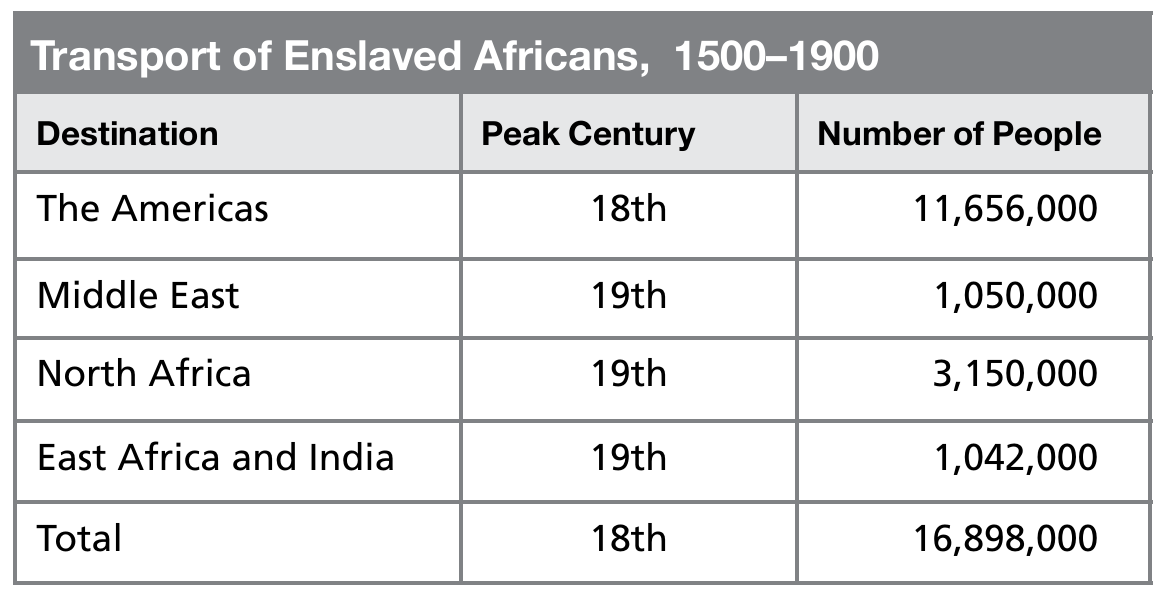
Source: Adapted from Paul Lovejoy, Transformations in Slavery: A History of Slavery in Africa, 1983
2. Use the passage below to answer all parts of the question that follows.
“45. Christians are to be taught that he who sees a needy man and passes him by, yet gives his money for indulgences, does not buy papal indulgences but God’s wrath.
81. This unbridled preaching of indulgences makes it difficult even for learned men to rescue the reverence which is due the pope from slander or from the shrewd questions of the laity [non-clerical members of a religion].”
Martin Luther, The 95 Theses, 1517
3. Answer all parts of the question that follows.
4. Answer all parts of the question that follows.
Document-Based Questions
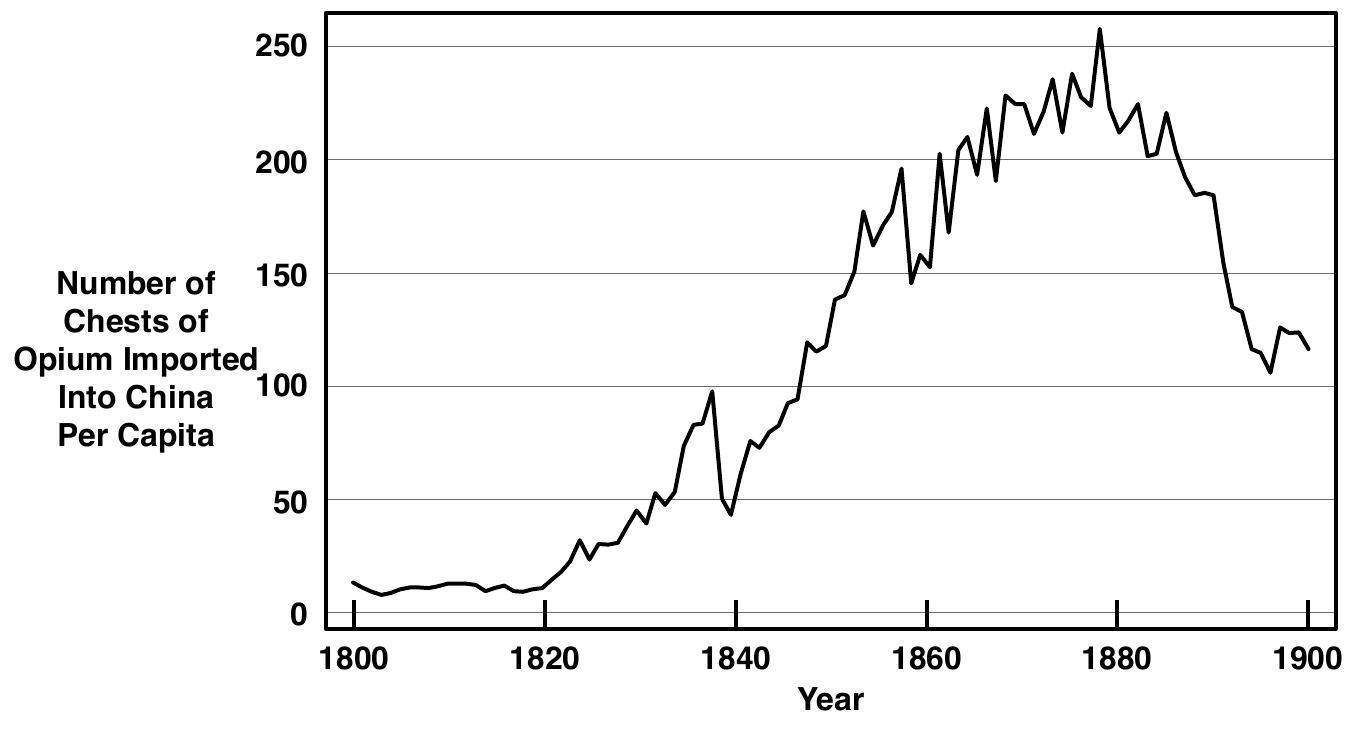
1. Evaluate the continuities or changes in the relationship between China and Great Britain between 1792 and 1864.
Historical Background: In the late 18th century, Europeans who wanted to trade with China were limited to the city of Canton (Guangzhou). In 1792, Lord Macartney, a British statesman and foreign diplomat, became the first British envoy to China and met briefly with Chinese Emperor Qianlong. At the time, opium was grown in great quantities in British India and the Ottoman Empire. The British East India Company, a joint-stock company chartered in 1600, represented the interests of the British government in Asia.
Document 1
Document 1
Source: Chris Feige and Jeffrey A. Miron, “The Opium Wars, Opium Legalization, and Opium Consumption in China,” Applied Economics Letters 15(12): 911–913.
Opium Imports by China, 1800–1900
Document 2
Document 2
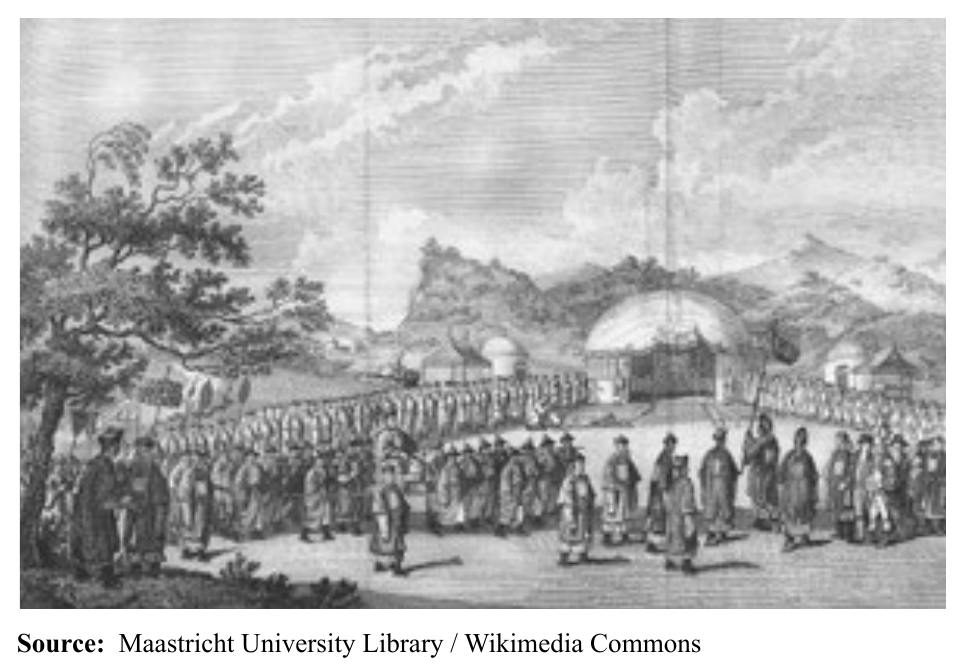
Source: A Dutch version of a British cartoon showing the Chinese receiving Lord Macartney in 1792.
Document 3
Document 3
Source: Chinese Emperor Qianlong, letter to Britain’s King George III, 1793.
The Celestial Court has pacified and possessed the territory within the four seas. Its sole aim is to do its utmost to achieve good government and to manage political affairs, attaching no value to strange jewels and precious objects. The various articles presented by you, O King, this time are accepted by my special order to the office in charge of such functions in consideration of the offerings having come from a long distance with sincere good wishes. As a matter of fact, the virtue and prestige of the Celestial Dynasty having spread far and wide, the kings of the myriad nations come by land and sea with all sorts of precious things. Consequently there is nothing we lack, as your principal envoy and others have themselves observed. We have never set much store on strange and ingenious objects, nor do we need any more of your country’s manufactures.
Document 4
Document 4
Source: Lord Macartney, describing his first visit to China, 1793.
Thus, then, have I seen “King Solomon in all his glory.” I use this expression, as the scene recalled perfectly to my memory a puppet show of that name which I recollect to have seen in my childhood, and which made so strong an impression on my mind that I then thought it a true representation of the highest pitch of human greatness and felicity.
Document 5
Document 5
Source: Lin Zexu, Imperial Commissioner stationed in Canton, letter to Queen Victoria, 1839.
We find that your country is sixty or seventy thousand li from China. Yet there are barbarian ships that strive to come here for trade for the purpose of making a great profit. The wealth of China is used to profit the barbarians . . . . By what right do they use this poisonous drug to injure the Chinese people? I have heard that the smoking of opium is very strictly forbidden by your country; that is because the harm caused by opium is very clearly understood. Since it is not permitted to do harm in your country, then even less should you allow it to be passed on to do harm in other countries. Of all that China exports to other countries, there is not a single thing that is not beneficial to people: they are of benefit when eaten, or of benefit when used, or of benefit when resold: all are beneficial. This is for no other reason than to share the benefits with the people of the whole world . . . . We have heard heretofore that your honorable ruler is kind and benevolent. Naturally you would not wish to give unto others what you yourself do not want.
Document 6
Document 6
Source: Lord Palmerston, British Foreign Secretary, letter to the Chinese government, 1840.
It appeared that the Laws of the Chinese Empire forbid the importation of Opium into China, and declare that all Opium which may be brought into the Country is liable to confiscation. The Queen of England desires that Her Subjects who may go into Foreign Countries should obey the Laws of those Countries; and Her Majesty does not wish to protect them from the just consequences of any offenses which they may commit in foreign parts. But, on the other hand, Her Majesty cannot permit that Her Subjects residing abroad should be treated with violence, and be exposed to insult and injustice; and when wrong is done to them, Her Majesty will see that they obtain redress.
Document 7
Document 7
Source: Sir George Staunton, speech in the House of Commons on British trade with China, 1840.
The course which I hope and believe Her Majesty’s Government are about to take, is to make rational proposals to China—such proposals as China may accept without national dishonour [dishonor] or disgrace. But, considering the character of its Government, and all the events that have already taken place, no man can doubt the necessity of accompanying and supporting such propositions with a competent physical force (hear). The armament destined for this service has been condemned on account of its being supposed to be intended to support the trade in opium. On the contrary, I call on all those who would wish to see that detestable traffic really and effectually put down, to support a measure by which, alone, I am convinced, such a wished-for consummation can ever be accomplished. Without a national treaty between the Governments of England and China, such as this armament may be hoped to lead to, and which it would be hopeless to expect otherwise, providing a plan of cordial co-operation between them for this end, it is but too certain that this detestable opium traffic must, in spite of every effort, not only flourish, but become every day more and more piratical and buccaneering in its character.
Long Essay Questions
2. In the 13th century, various belief systems and practices infiltrated South and Southeast Asia.
Develop an argument that evaluates the extent to which Hinduism, Islam, and Buddhism changed political or social structures in South and Southeast Asia.
3. In the 15th century, growth of interregional trade and innovation promoted the growth of new trading cities.
Develop an argument that evaluates the extent to which Indian Ocean trading contributed to the development of new states.
4. In the 20th century, a variety of internal and external factors contributed to state decline.
Develop an argument that evaluates the extent to which challenges to colonial rule changed South Asian society in the period between 1750 and 2001.