Economic Continuities and Changes
The Industrial Revolution transformed the production and consumption of goods. In Western Europe, access to abundant natural resources, transoceanic trade routes, and financial capital combined with an increasing population resulted in a leadership role in industrialization. The Scientific Revolution, begun in the previous era and influenced by scientific knowledge transferred to the West from the Islamic world, helped to bring about inventions that would lead to the establishment of the factory system and the mass production of goods. However, the invention of the machines used to mass produce goods meant a change from the era of skilled artisans working at their own pace to craft unique and well-built products. With automation, many factory jobs required only unskilled labor working on an assembly line doing repetitive tasks to produce identical goods. As a result, many consumer goods were now more readily available, more affordable, and in greater variety than ever before.
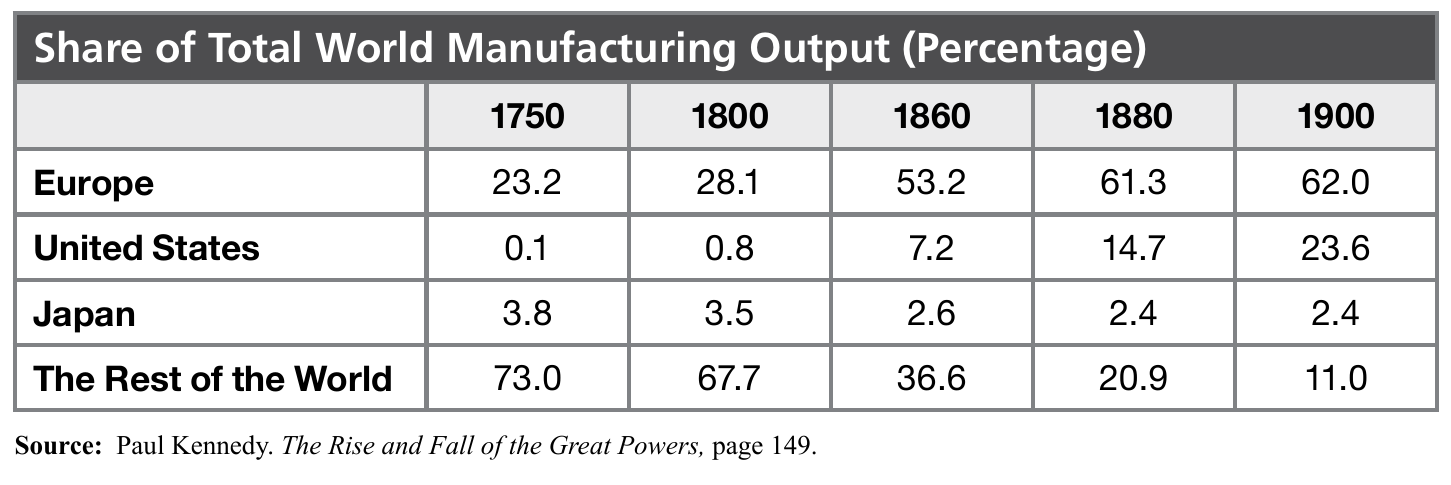
Industrialization Around the World New methods of industrial production associated with the Industrial Revolutions spread and changed the economies of other areas of the world outside of Western Europe. As a result, the United States, Russia, and Japan experienced increased industrial production and built more railroads. In the cases of Japan and Egypt, industrialization was encouraged through state sponsored efforts to modernize their economies with varying degrees of success. However, the industrial economies of Western Europe and the United States continued to dominate the global economy while the manufacturing output of Middle Eastern and Asian economies declined.
Sources of Raw Materials Some regions of the world continued to produce minerals, crops, and other resources as they had done in previous eras. Latin America and Africa were important sources of minerals and metals used in industrial processes. Cotton from Egypt, South Asia, and the Caribbean was grown and exported to Great Britain and other European countries. Southeast Asian areas continued to be sources for spices but also for rubber, tin, and timber.
New sources of raw materials were also made possible by the invention of the steam ship and steam locomotive. Maritime trade was made faster and cheaper due to steam power, and railroads built in interior regions helped to access and exploit previously untapped natural resources. Other inventions such as the telegraph helped to improve communication across these far flung and sometimes remote areas. These and other technological innovations made the movement of goods and people easier and cheaper and led to an increase in global trade.
Western Europe Western Europe began to change from a mercantilist economic system designed to make a country wealthy through tightly regulated trade to a capitalist system in which private companies were freer to pursue their own profits. Philosopher and political economist Adam Smith believed that the private pursuit of profit would result in general prosperity.
While industrialization and capitalism produced great wealth overall, many people had hard, short lives. In response to this suffering, many reformers argued for changes. One of these was the German philosopher Karl Marx. He argued that the working class, whom he called the proletariat, were being exploited by the capital class, or bourgeoisie. He called for workers to unite and take control of the means of production, a change that would revolutionize society.