Social Structures of Sub-Saharan Africa
In Sub-Saharan Africa, strong central governments ruling over large territories were uncommon. Instead, Sub-Saharan Africa’s small communities were organized around several structures: kinship, age, and gender. Kinship connections allowed people to identify first as members of a clan or family. Age was another significant social marker. An 18-year-old could do more hard labor than a 60-year-old, but younger people often relied on the advice of their elders. Thus, communities divided work according to age, creating age grades or age sets. Finally, gender had an influential role in social organization.
• Men dominated most activities that required a specialized skill. For example, leather tanners and blacksmiths were typically men.
• Women generally engaged in agriculture and food gathering. They also took the primary responsibilities for carrying out domestic chores and raising their family’s children.
Slavery in Sub-Saharan Africa and Southwest Asia Slavery had a long history in Africa. Prisoners of war, debtors, and criminals were often enslaved. Most men and some women did agricultural work. Most women and some men served in households. In many kin-based societies, people could not own land privately, but they could own other people. Owning a large number of enslaved people increased one’s social status. Slavery existed in many forms.
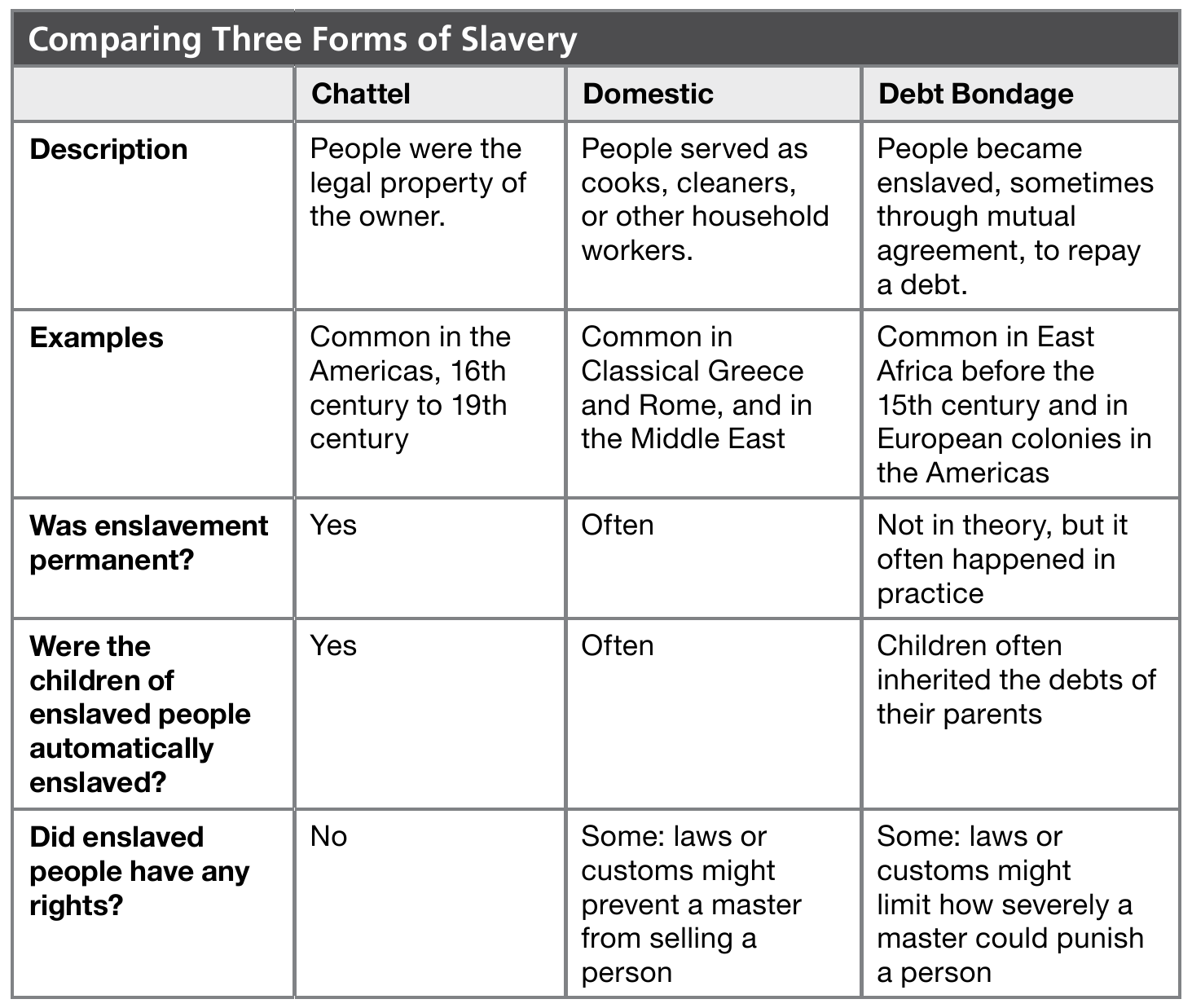
A strong demand in the Middle East for enslaved workers resulted in an Indian Ocean slave trade between East Africa and the Middle East. This trade started several centuries before the Atlantic Ocean slave trade between West Africa and the Americas. In some places, it lasted into the 20th century.
The enslaved East Africans, known in Arabic as zanj, provided valuable labor on sugar plantations in Mesopotamia. However, between 869 and 883, they and many Arab workers mounted a series of revolts known as the Zanj Rebellion. About 15,000 enslaved people successfully captured the city of Basra and held it for ten years before being defeated. The large size and long length of time before it was defeated make the Zanj Rebellion one of the most successful slave revolts in history.