The Haitian Revolution
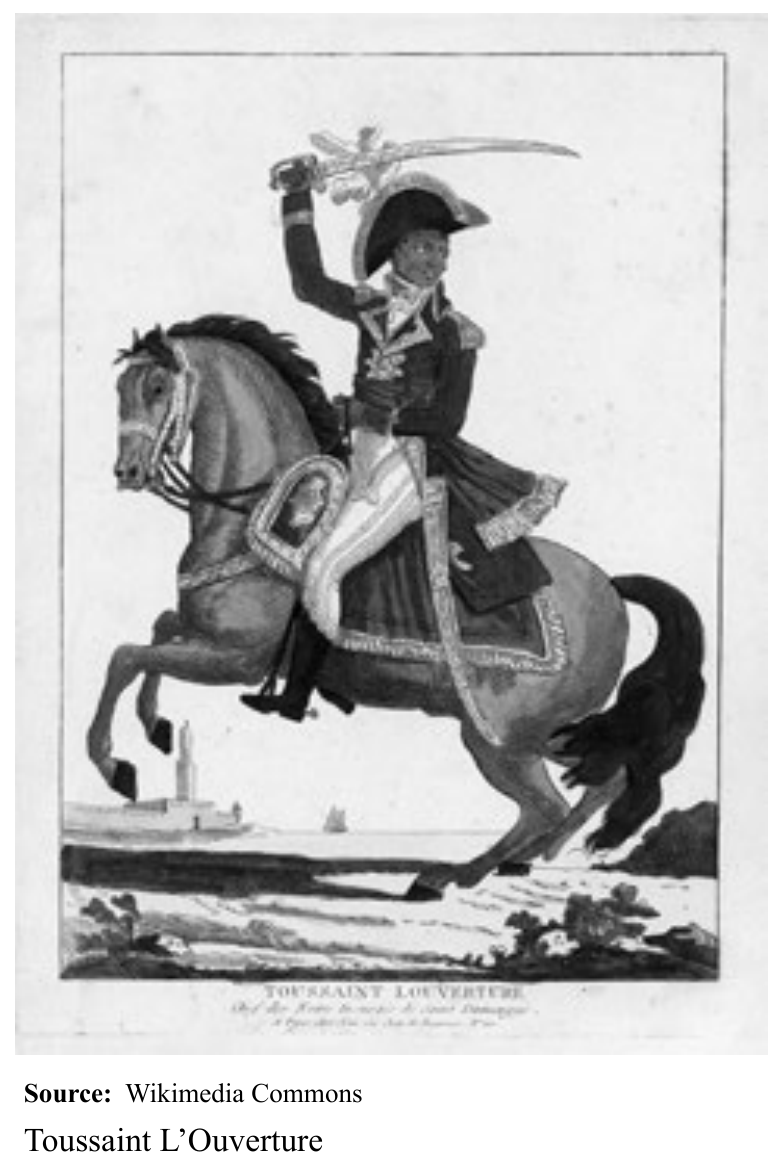
At the end of the 18th century, revolutionary forces were also at work in the rich French sugar and coffee colony of Haiti on the western third of the island of St. Domingue, also known as Hispaniola. Enslaved Africans began the rebellion by killing their masters and burning their homes. They were soon joined by Maroons, individuals who had already escaped slavery in Haiti. The examples of the recent American and French revolutions led formerly enslaved Toussaint L’Ouverture to join the revolts in 1791 and then to lead a general rebellion against slavery. Besides being well-read in Enlightenment thought, L’Ouverture proved to be a capable general. His army of enslaved Africans and Maroons established an independent government and played the French, Spanish, and British against each other.
Haiti In 1801, after taking control of the territory that would become the independent country of Haiti, L’Ouverture produced a constitution that granted equality and citizenship to all residents. He also declared himself governor for life. Haiti next enacted land reform: plantations were divided up, with the lands being distributed among formerly enslaved and free black people.
L’Ouverture worked with the French but they betrayed and imprisoned him. He died in France in 1803. But he had cemented the abolition of slavery in Haiti, which he set on the road to independence from France.
In 1804, L’Ouverture’s successor, Jean-Jacques Dessalines, orchestrated a Haitian declaration of permanent independence. Thus, Haiti became the first country in Latin America to win its independence and the first black-led country in the Western Hemisphere. It was also the only country to become permanently independent as a result of a slave uprising.
Comparing the Haitian and French Revolutions Both
the Haitian and French revolutions grew out of the Enlightenment’s insistence that men had natural rights as citizens, and that legal
the restraints were
limiting freedom of people by forcing them into various estates (social classes). However, in the case of the Haitians, the restraints were more severe—the rebellion was led by people who had no rights at all.