New Ideas and Their Roots
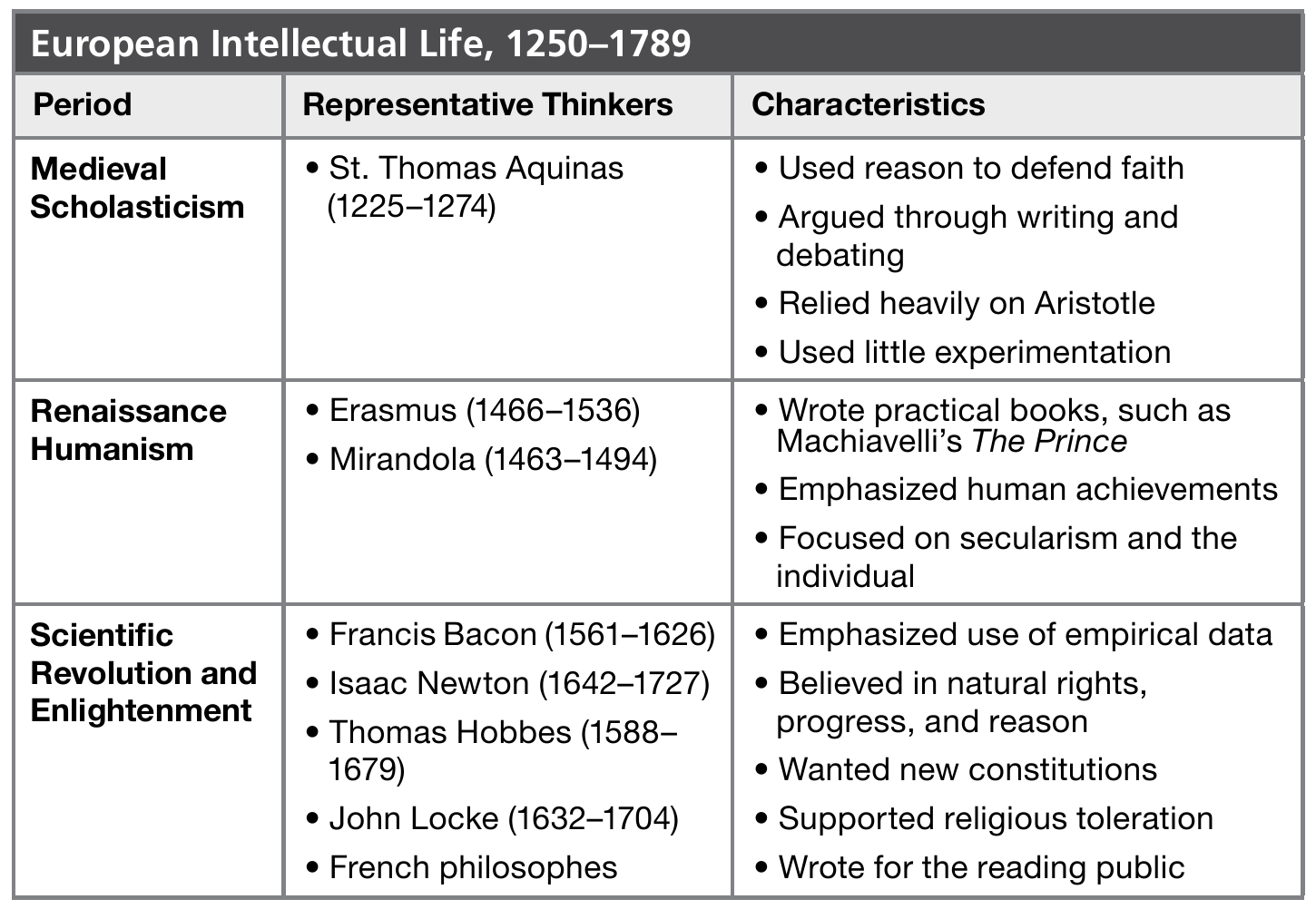
In the 17th century, Francis Bacon emphasized empirical methods of scientific inquiry. Empiricism is the belief that knowledge comes from sensed experience, from what you observe through your experience, including through experiments. Rather than relying on reasoning about principles provided by tradition or religion, Bacon based his conclusions on his observation of natural data.
Hobbes and Locke In the same century, philosophers Thomas Hobbes (author of Leviathan, 1651) and John Locke (author of Two Treatises of Government, 1690) viewed political life as the result of a social contract. Hobbes argued that people’s natural state was to live in a bleak world in which life was “nasty, brutish, and short.” However, by agreeing to a social contract, they gave up some rights to a strong central government in return for law and order.
Locke, on the other hand, argued that the social contract implied the right, even the responsibility, of citizens to revolt against unjust government. Locke thought that people had natural rights to life, liberty, and the pursuit of property. Another of Locke’s influential ideas is found in An Essay Concerning Human Understanding (1690), in which he proposed that a child was born with a mind like a “blank slate” (tabula rasa) waiting to be filled with knowledge. In a world in which most people believed that an individual’s intelligence, personality, and fate were heavily determined by their ancestry, Locke’s emphasis on environment and education in shaping people was radical.
The Philosophes In the 18th century, a new group of thinkers and writers who came to be called the philosophes explored social, political, and economic theories in new ways. In doing so, they popularized concepts that they felt followed rationally upon those of the scientific thinkers of the 17th century. Taking their name from the French word philosophe (“philosopher”), these writers included Thomas Jefferson and Benjamin Franklin from America, Adam Smith from Scotland, and several French thinkers
Of particular importance to writers of the new constitutions in France and America in the 18th and 19th centuries were the ideas of Baron Montesquieu. His famous work The Spirit of Laws (1748) praised the British government’s use of checks on power because it had a Parliament. Montesquieu thus influenced the American system, which adopted his ideas by separating its executive branch (the president) from its legislative branch (Congress) and both from its third branch (the federal judiciary).
Francois-Marie Arouet, pen name Voltaire, is perhaps best known for his social satire Candide (1762). He was famous during his lifetime for his wit and for his advocacy of civil liberties. Exiled for three years due to a conflict with a member of the French aristocracy, Voltaire lived in England long enough to develop an appreciation for its constitutional monarchy and a regard for civil rights. He brought these ideas back to France, where he campaigned for religious liberty and judicial reform. His correspondence with heads of state (such as Catherine the Great of Russia and Frederick the Great of Prussia) and his extensive writings, including articles in Diderot’s Encyclopedia, are still quoted today. His idea of religious liberty influenced the U.S. Constitution.
A contemporary of Voltaire was the writer Jean-Jacques Rousseau, who expanded on the idea of the social contract as it had passed down through the work of Hobbes and Locke. One of Rousseau’s early works was Emile, or On Education (1762) in which he laid out his ideas on child-rearing and education. A later work, The Social Contract (1762), presented the concept of the General Will of a population and the obligation of a sovereign to carry out that General Will. An optimist who believed that society could improve, Rousseau inspired many revolutionaries of the late 18th century.
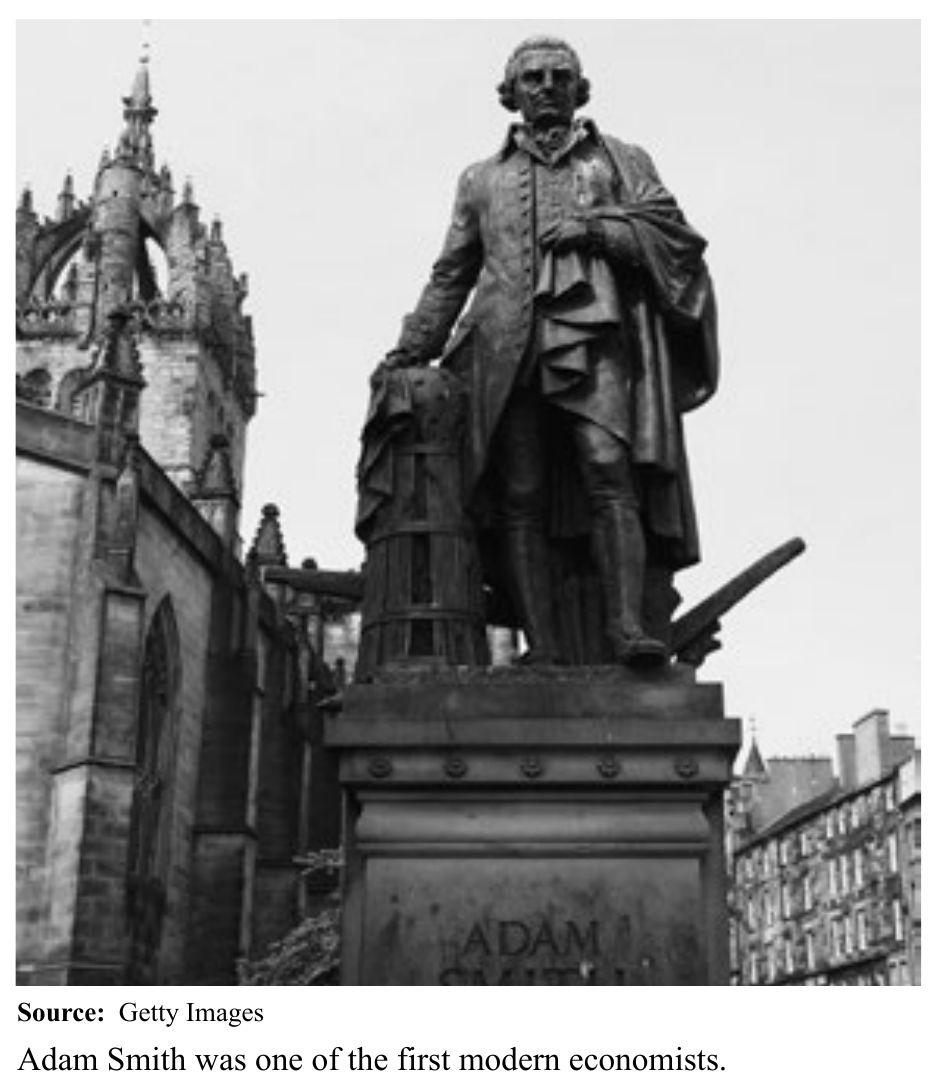
Adam Smith One of the most influential thinkers of the Enlightenment was Adam Smith. In his book The Wealth of Nations (1776), Smith responded to mercantilism by calling for freer trade. While Smith did support some government regulations and saw the benefits of taxes, he generally advocated
a
laissez-faire, for French phrase for “leave alone.” This approach meant that governments
their
reduce should intervention in economic decisions. Smith believed that if businesses and consumers were allowed to make
in
choices their own interests, the “invisible hand” of the market would guide them to make choices beneficial for society. His
ideas provided a foundation for capitalism, an economic system
the
in which means of production, such as factories and
resources, are natural
privately owned and are operated for profit. (Connect: Create a chart or Venn diagram that compares and contrasts mercantilism and the free market. See Topics 4.4 and 4.5.)
Deism The Enlightenment’s emphasis on reason led some thinkers to reexamine the relationship of humans to God. Some adopted Deism, the belief that a divinity simply set natural laws in motion. Deists compared the divinity to a watchmaker who makes a watch but does not interfere in its day- to-day workings. Deists believed these laws could be best understood through scientific inquiry rather than study of the Bible. Despite their unorthodox ideas, many Deists viewed regular church attendance as an important social obligation and a way people received moral guidance.
Thomas Paine, never one to shrink from conflict, was militant in his defense of Deism in the book The Age of Reason (1794). Paine’s previous work, Common Sense (1776), made him popular in America for advocating liberty from Britain, but his anti-church writings damaged much of his popularity.