Breakdown of Empires
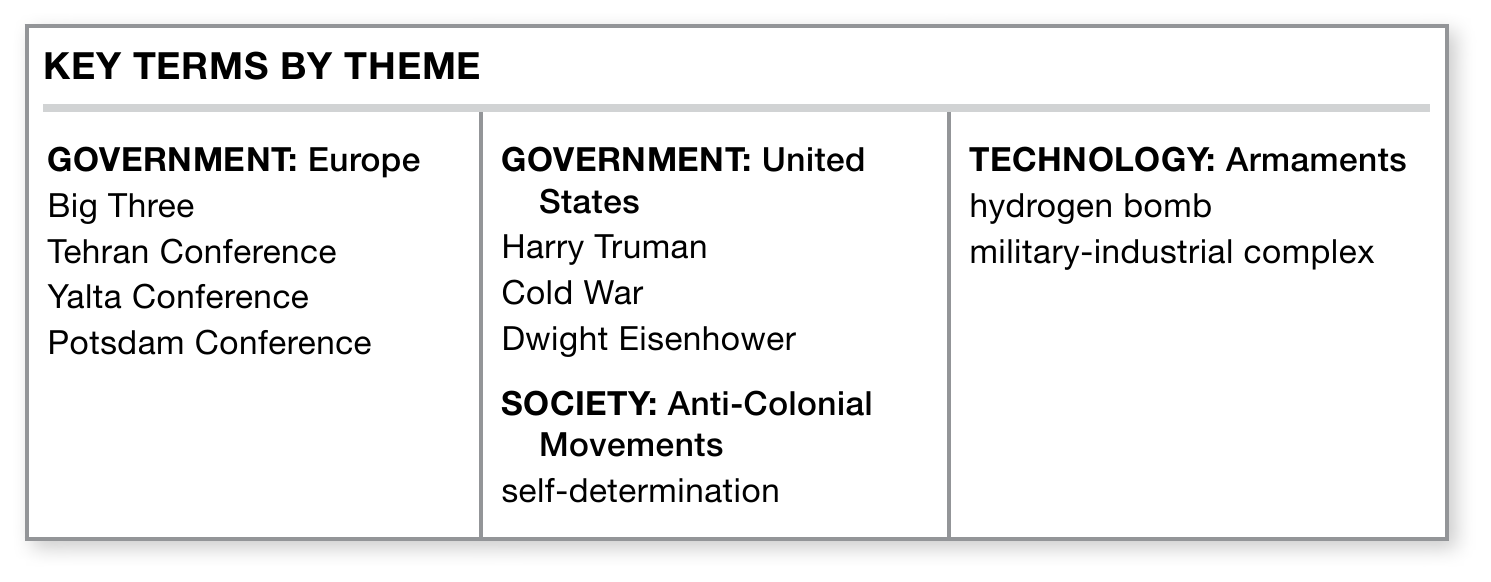
After World War II, efforts resumed to undermine colonialism. The start of World War I had marked the high point of colonial empires. The British, the French, and other Europeans had colonized almost all of Africa, India, and Southeast Asia, and they dominated China. Empires based in Austria, Turkey, and Russia were multiethnic states, but each was dominated by one group, leaving others feeling discriminated against. After World War I, the demand for self-determination, the idea that each country should choose its own form of government and leaders, was spreading. The Austro-Hungary Empire and the Ottoman Empire crumbled, restructured into multiple new countries. However, in China, India, and throughout Africa, Europeans generally maintained their power, even expanding it over territories that had been part of the Ottoman Empire.
During World War II, the leading colonial powers focused on stopping Hitler. As a result, the anti-colonial movements probably grew stronger, but actual independence made little progress. However, after World War II, the foundation was set for the dismantling of colonial empires:
• In the colonized world, movements for self-determination grew. Often, they included both advocates of greater self-rule and proponents of full independence.
• World War II had so weakened Great Britain, France, and the other colonial powers that they had fewer resources to resist independence.
• The Cold War between the United States and the Soviet Union gave anti-colonial activists two superpowers to recruit as supporters.
The successful efforts of people to undermine colonial empires are described in Topics 8.5 and 8.6.