The Path to War
Out of the context of the broad economic and political trends emerged Adolf Hitler. His extreme views on the superiority of the Aryan race and his vision of a great German civilization led him to persecute Jews and other minorities and to systematically seize land.
Rise of Nazism Following Germany’s defeat in 1918, the democratically elected Weimar Republic replaced the monarchical rule of the kaiser. Under the terms of the Treaty of Versailles, the new German government not only had to pay billions in war reparations, but it also was not allowed to have an army. The Weimar Republic, appearing weak to the demoralized German people, became especially unpopular during the Great Depression.
The rolls of the unemployed swelled due to the weak German economy. Large numbers of young men, including many World War I veterans, found themselves with few job prospects. Such an environment fostered alienation and bitterness. Many Germans perceived the Weimar Republic to be too weak to solve the country’s problems, so they looked to right-wing political parties that promised strong action.
Hitler had declared his extreme anti-Semitic views in his book Mein Kampf (“My Struggle”), which he began writing in 1924 while in a Bavarian prison after a failed coup attempt. The National Socialist German Worker’s Party, or the Nazis, came to power legally after the party did well in the 1932 parliamentary elections. In early 1933, the president of Germany, Paul von Hindenburg, invited Adolf Hitler to form a government as chancellor, which he did. Hindenburg died in 1934, giving Hitler the opening he needed to declare himself president.
Through manipulation, the Nazi Party instilled fear and panic in the German people, making them believe that they were in a state of emergency. For example, the Nazis staged a burning of the Reichstag, the German parliament building, and blamed radical extremists for the act. Using domestic security as justification, Hitler outlawed all other political parties and all forms of resistance to his rule.
Hitler openly promoted ultranationalism and scientific racism, a pseudoscientific theory that claimed that certain races were genetically superior to others. He also advanced an extreme form of anti-Semitism, or hostility toward Jews. He filled his speeches with accusations against German Jews, whom Hitler claimed were responsible for the nation’s domestic problems. Nazi propaganda emphasized a need for a “pure” German nation of “Aryans,” purged of “outsiders”—not only Jews, but also Slavs, communists, Roma (also known as Gypsies), and gay men and women. Hitler suggested that the only way for Germany to live up to its potential was to eliminate the corrupting influence of these groups, particularly the Jews.
Nuremberg Laws Hitler’s anti-Jewish campaign began with laws designed to disenfranchise and discriminate against them. The Nuremberg Laws, passed in 1935, forbade marriage between Jews and gentiles (people who are not Jewish), stripped Jews of their citizenship, and unleashed a series of subsequent decrees that effectively pushed Jews to the margins of German society. German Jews, many of whom were successful in their careers and felt assimilated into German society, were shocked by the way they were being treated. Some Eastern European nations, such as Romania and Bulgaria, also passed laws discriminating against their Jewish citizens.
The Axis Powers Hitler then sought new allies to help him acquire Lebensraum (living space) for the new German empire. He did not try to hide his ambition to conquer the entire continent. Hitler’s lust for land eventually brought the international community to the brink of war. He first formed a military pact with Fascist Italy, the Rome-Berlin Axis, in October 1936. In addition to their need for military support, the two countries shared a political ideology and economic interests. Germany then created a military alliance with Japan based on mutual distrust of communism, known as the Anti-Comintern Pact. The alliances among these three nations created the Axis Powers.
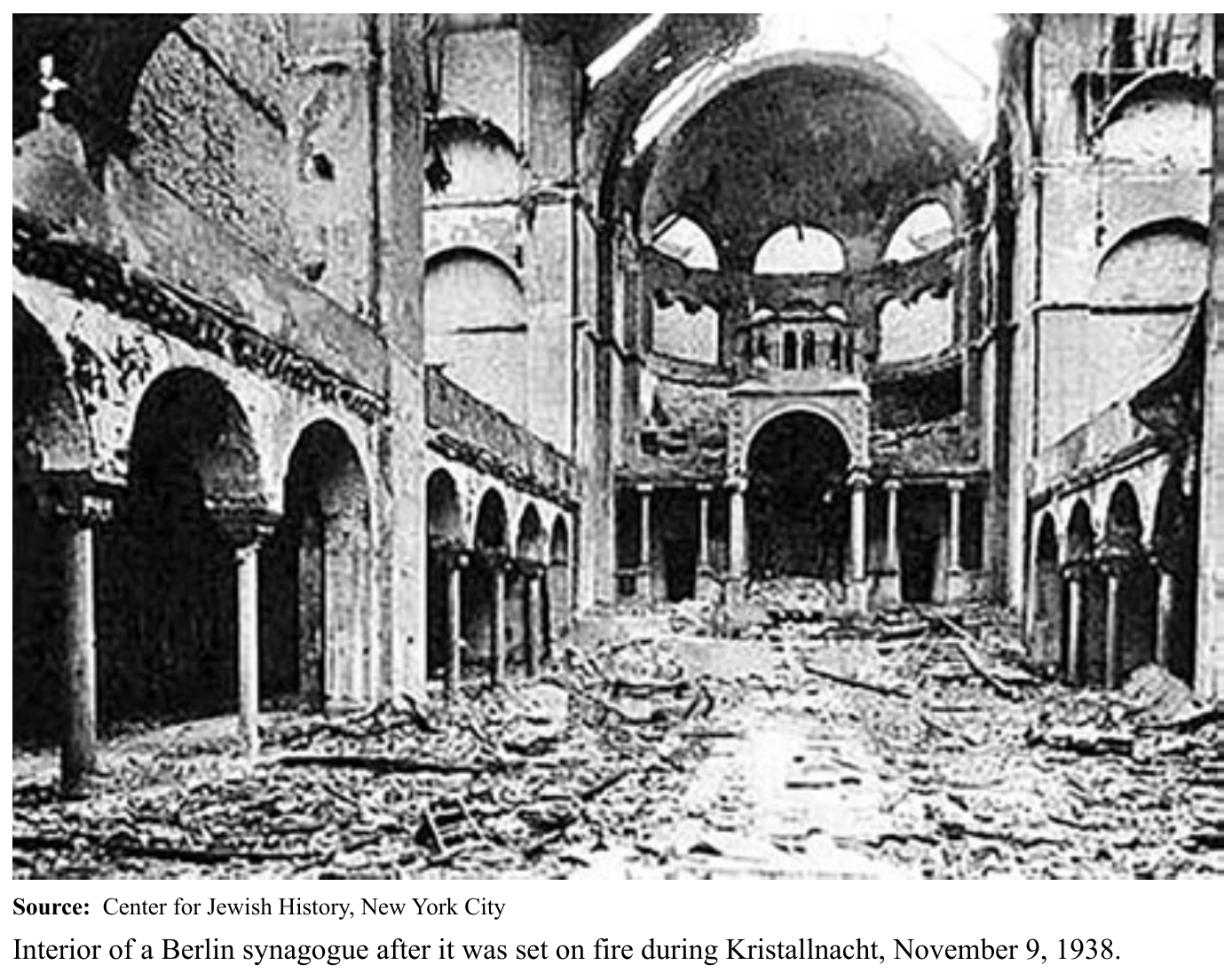
Kristallnacht Hitler’s campaign to rid Germany of Jews predated his aggressive land grabs in Europe. His propaganda and the Nuremberg Laws successfully created an atmosphere of hostility, hatred, and distrust within Germany. This tension erupted one night in early November 1938. Kristallnacht, the “Night of the Broken Glass,” produced anti-Jewish riots that ostensibly occurred in response to the assassination of a German diplomat by a Jewish teenager. Although it appeared to be a spontaneous burst of outrage on the part of the German citizenry, Nazi leaders had actually engineered the entire operation. The riots resulted in the deaths of more than 90 German Jews and the destruction of nearly every synagogue in Germany and some 7,000 Jewish shops. More than 30,000 Jews were dragged from their homes, arrested, and sent to concentration camps. Most of these prisoners were eventually released on orders to leave Germany, an option not given to later concentration camp prisoners.