Topic 2 AP Exam Practice
Multiple-Choice Questions
Questions 1 to 3 refer to the passage below.
“When the Portuguese go from Macao, the most southern port city in China, to Japan, they carry much white silk, gold, perfume, and porcelain and they bring from Japan nothing but silver. They have a great ship that goes to Japan every year, and brings back more than 600,000 coins’ worth of Japanese silver. The Portuguese use this Japanese silver to their great advantage in China. The Portuguese bring from China gold, perfume, silk, copper, porcelain, and many other luxury goods.”
Ralph Fitch, a British merchant, in an account
of his travels to the East Indies, 1599
1. Which conclusion about the Portuguese is best supported by the passage above?
- (A) They manufactured luxury goods that they could sell in China.
- (B) They made great profits transporting goods between Asian countries.
- (C) They primarily wanted to accumulate silver.
- (D) They preferred to trade with China rather than Japan.
2. Which statement best describes the point of view of the source, Ralph Fitch?
- (A) He was ridiculing the Portuguese for working so hard for so little profit.
- (B) He was embarrassed that the Portuguese were taking advantage of the Chinese and Japanese.
- (C) He was hoping to make profits just as the Portuguese were doing.
- (D) He was criticizing the Portuguese for being so focused on acquiring wealth.
3. Which statement best explains why Portugal established a trading post empire?
- (A) It had a large navy and was able to conquer nearby lands.
- (B) It was a landlocked country and could not expand except by sea.
- (C) It had only enough people and power to maintain trading posts rather than a large empire.
- (D) It was ahead of other European states in developing navigational innovations.
Short-Answer Questions
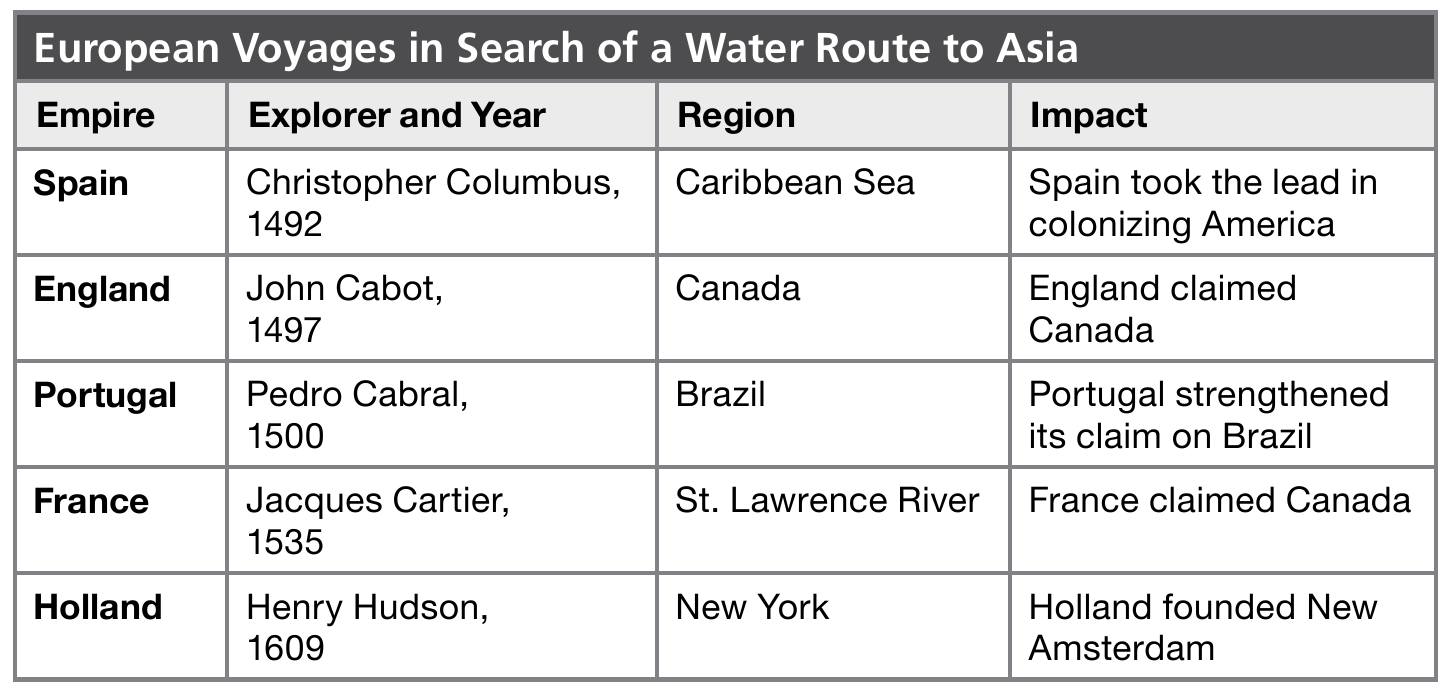
1. Use the chart below to answer all parts of the questions that follow.
2. Answer all parts of the question that follows.