Steps toward Racial Equality
In the United States, African Americans won major victories against discrimination and segregation. Through the 1965 Civil Rights Act, which outlawed discrimination based on race, color, religion, sex, or national origin, and the 1965 Voting Rights Act, which banned discrimination in voting, the federal government stepped in to protect the rights of all citizens. African Americans also sought equality of education through desegregation of schools.
South Africa’s Colonial Legacy South Africa’s system of apartheid, instituted in 1948, enforced the segregation of people based on race. Although white South Africans made up only 15 percent of South Africa’s population, apartheid reserved good jobs and other privileges for them. So-called pass laws required black South Africans to carry identity documents when entering areas set aside for whites, which they often had to do when traveling to their jobs. They were banned from living in certain areas of the country. Mixed marriages were prohibited. Although South Africa had 11 major languages, classes for blacks were taught only in Afrikaans, the language of many of the white South Africans who ruled the nation. These dehumanizing decrees marginalized the 85 percent of South Africans who were black, South Asian, or mixed race.
The white-dominated South African government had its basis in European colonization of Africa in general and the Dutch and British colonization of South Africa in particular. The colonizers pushed the native people off the fertile lands and gave them no say in government. South Africans began to demand equal treatment. “I am not interested in picking up crumbs of compassion,” said Desmond Tutu, Anglican Archbishop of Cape Town, South Africa, and human rights activist. “I want the full menu of rights.”
Challenges to Apartheid In 1964, Nelson Mandela, a leader of the African National Congress (ANC), was imprisoned for life for agitating against apartheid. The ANC’s primary goals were to end white domination and create a multiracial South Africa. Mandela’s imprisonment throughout the 1960s, 1970s, and 1980s inspired a global movement to end apartheid. Black protests in South Africa, which were often peaceful, were crushed violently by the government’s forces. South Africa’s reputation grew worse in the eyes of the global community. Musicians staged concerts calling for Mandela’s release from prison, college students urged universities and corporations to divest from South Africa, and many countries voted for strict economic sanctions against the country. The United Nation expelled South Africa in 1974 because of its apartheid,
As South Africa became a pariah state (undesirable state) in the 1980s, its leadership began to take notice. Mandela himself began negotiations with the government in 1986 while still in prison. In 1989, F. W. de Klerk became the nation’s acting president. He recognized the need for change. Within six months, de Klerk announced Nelson Mandela’s release from prison.
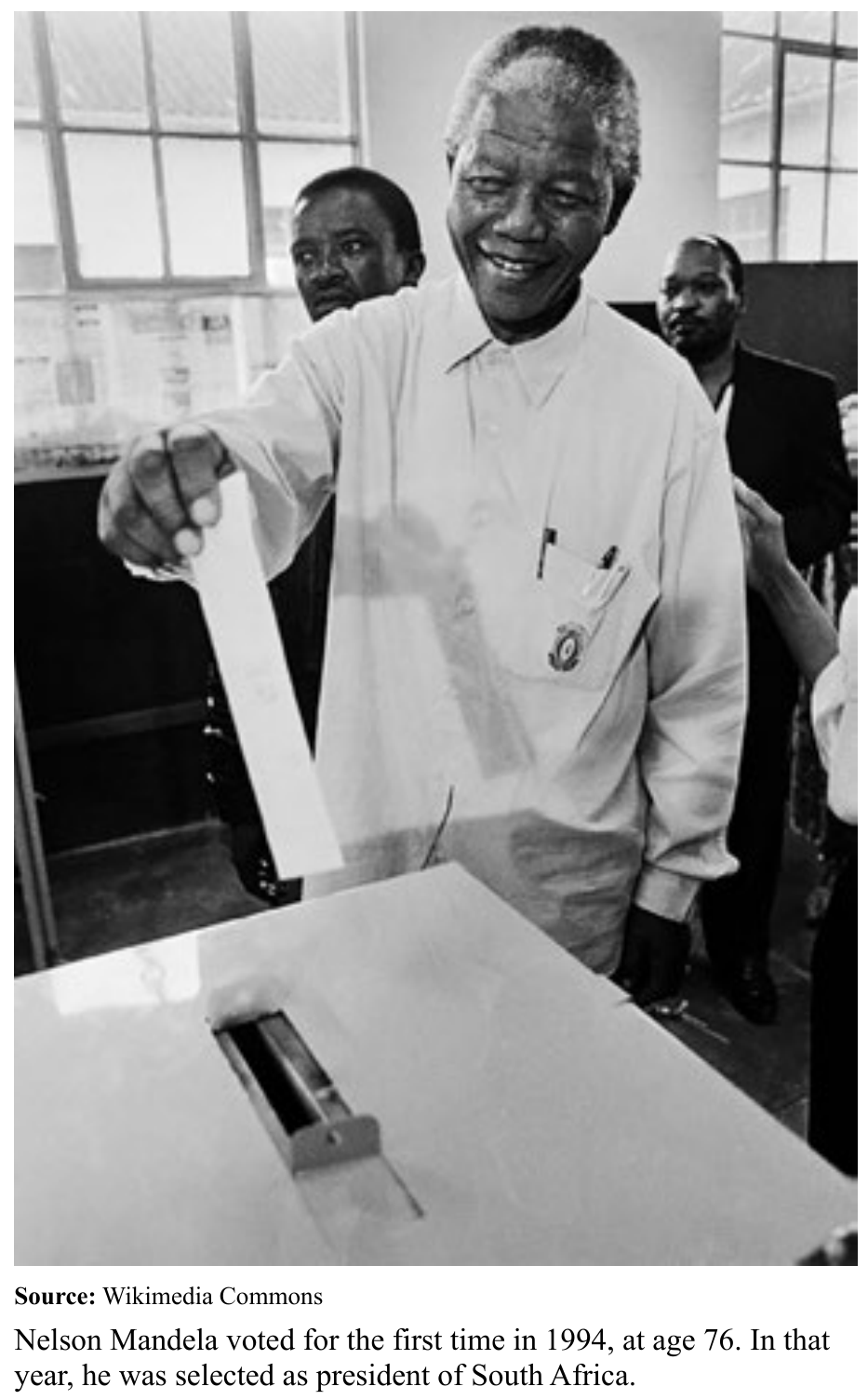
Although euphoria was high in the weeks following Mandela’s release, apartheid remained the law of the land. Police violence against protesters persisted, which stalled negotiations between Mandela and de Klerk. However, a series of reforms in the 1990s ended apartheid. In 1994, South Africa held its first free elections and rejoined the United Nations. The African National Congress won the majority of the seats in the Parliament. The Government of National Unity was established with ANC members in the majority. On May 10, 1994, Nelson Mandela was sworn in as president, South Africa’s first black leader.
Uniting South Africa Immediately the Government of National Unity set up the Truth and Reconciliation Commission (TRC). Unlike the Nuremberg Trials that sought retribution for crimes against humanity committed by Nazis during World War II, the TRC sought to restore and establish an atmosphere of trust in the new multiracial South Africa. The TRC organized a series of 19 public hearings designed to expose the truth of human rights violations that had occurred during apartheid, while at the same time granting amnesty to members of the apartheid regime who agreed to testify.
Caste Reservation in India The fight for civil rights was also a global effort as people from different races and social classes began to demand equality. In India, the 1949 Constitution outlawed discrimination against the Dalits, also known as untouchables. Pakistan outlawed discrimination against Dalits in 1953. Before then, many people believed that being touched by a Dalit required the person who was touched to undergo a cleansing ritual. People in India and Pakistan continued to discriminate against Dalits until well into the 21st century.
To open doors of opportunity to social groups or castes that had faced historical discrimination, the government of India established the caste reservation system. Through this system, the government guaranteed that a certain percentage of government and public sector jobs and enrollment in higher education would be set aside for people whose caste had conferred an underprivileged life.