Power Shifts in Mexico
Mexico entered the 20th century as an independent nation firmly under the control of a dictator, Porfirio Díaz. He oversaw a period of stability and some economic progress. However, he had allowed foreign investors, particularly those from the United States, control over many of the country’s resources. Additionally, the wealthiest 1 percent of the population controlled 97 percent of the land. Typical Mexican peasants were landless.
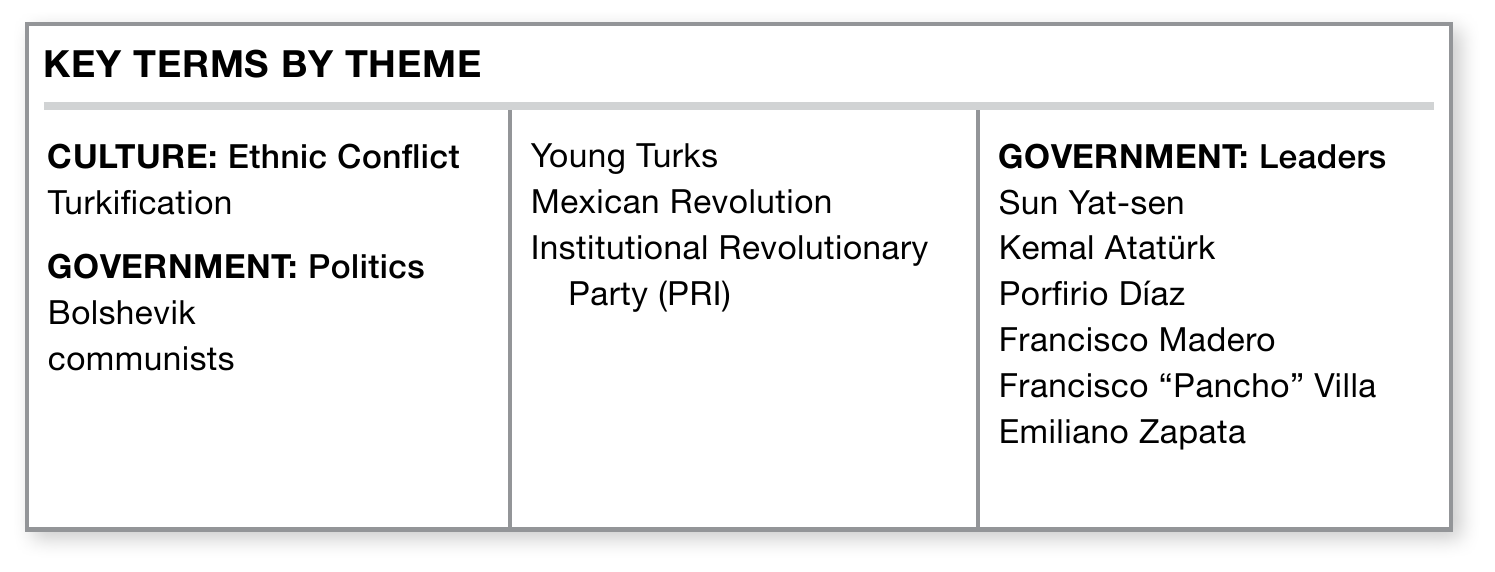
Revolution In 1910, Díaz jailed Francisco Madero, the opposition candidate for president. This act, combined with the growing opposition to Díaz’s strong-armed policies, accommodation to foreign powers, and opposition to land reform, ignited the Mexican Revolution. Madero escaped and set up revolutionary offices in El Paso, Texas. Then, in 1911, Madero’s troops, under the command of Francisco “Pancho” Villa, defeated Mexican troops, sending Díaz into exile. One revolutionary leader, Emiliano Zapata, began the actual process of redistributing land to impoverished peasants.
Until 1920, Mexico suffered from political instability and devastating violence. Between 1910 and 1920, conflict resulted in around 2 million deaths, out of a population of around 15 million people. Political violence continued for another decade. However, two results came out of conflicts between 1910 and 1930 that provided Mexico with stability for the rest of the century:
• Mexico adopted a new constitution in 1917. It included the goals of land redistribution, universal suffrage, and public education. These principles continued to guide Mexico’s government.
• The Institutional Revolutionary Party, or PRI, was formed in 1929. Though widely criticized as corrupt, the PRI dominated Mexican politics. Until 2000, all presidents were PRI members.