Effects of Environmental Changes
While humans have always competed for raw materials and natural resources, this competition became more intense as industrialization spread. With an ever- growing population, humans grappled with hunger, environmental damage, and global epidemics.
Resource Depletion Since the mid-1800s, when petroleum extraction began in earnest and oil pumped energy into the Industrial Revolution, about half of the earth’s finite resources of this vital resource have been used up. With the rapidly growing urban and industrial population, some experts predict the remaining half could be used up at a much faster rate, within the next 30 to 40 years. While supplies of coal will last longer, if coal is used to make up for the loss of petroleum, coal reserves could also be depleted in 60 years.(Connect: Evaluate the claim that the Industrial Revolutions have created dependency on natural resources that will soon lead to their depletion. See Topic 5.5.)
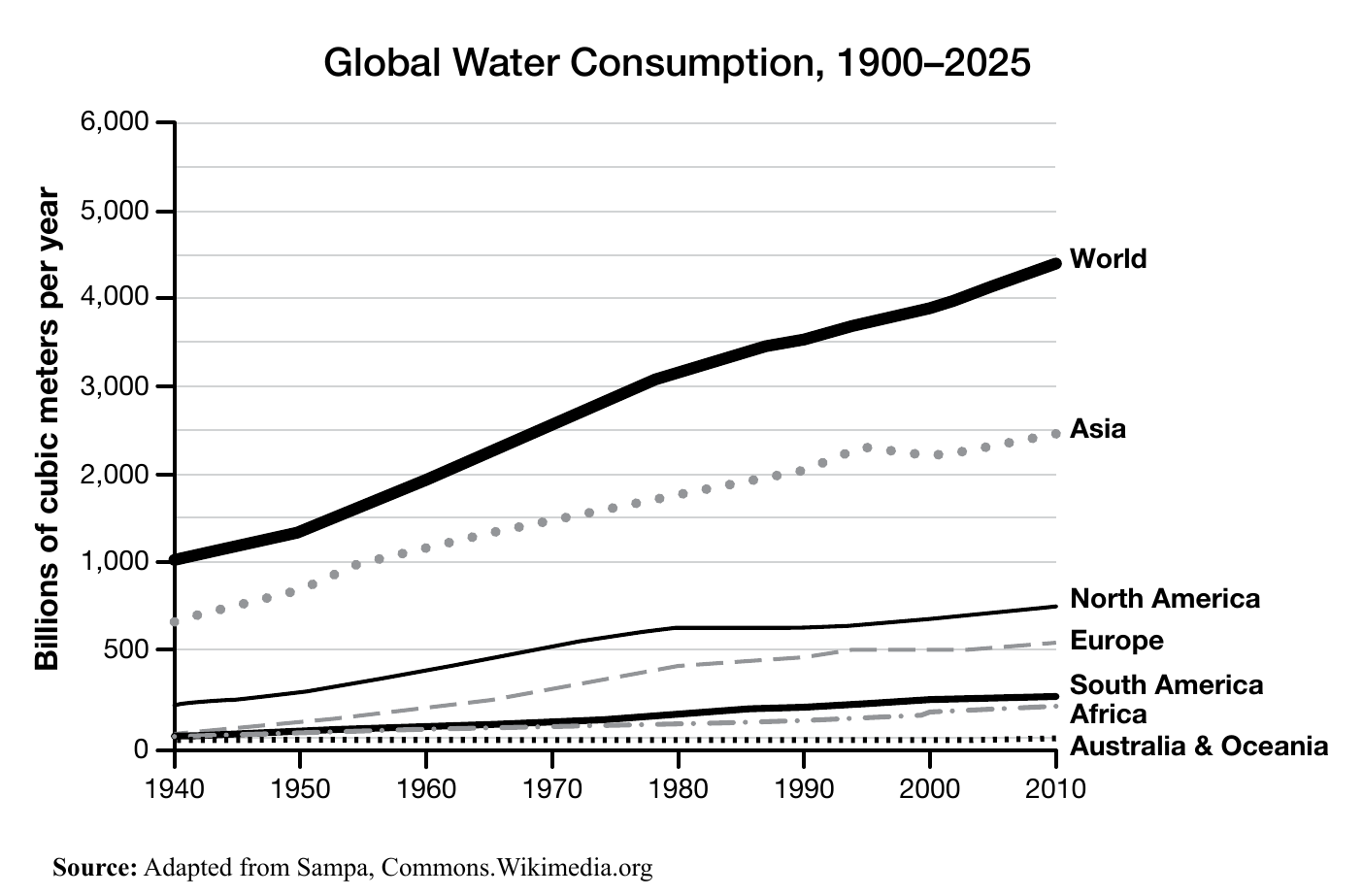
Inequality and Scarce Resources According to the United Nations, 31 countries are facing water scarcity and more than 1 billion people lack clean, accessible drinking water. As water consumption continues to increase, some corporate interests are depleting, polluting, and exploiting water sources. The World Health Organization predicts that by 2025, half of the world’s population will lack clean and safe drinking water.
Water scarcity is also linked to other inequalities. Surveys from 45 developing countries show that women and children bear the primary responsibility for water collection in most households. This is time not spent working at an income-generating job or attending school. A study in Ghana found that a 15-minute reduction in water collection time increases the proportion of girls attending school by 8 percent to 12 percent.
In 2015, world leaders agreed to 17 goals for a better world by 2030. Many of these global goals address the environmental problems the world faced after 1900 that relate to extreme poverty, inequalities and injustice, and climate change.
Changes in the Atmosphere Factories, automobiles, airplanes, and many other products and processes of industrialization have emitted huge amounts of pollutants, including carbon dioxide and other greenhouse gases—those that build up in the atmosphere and let the heat of the sun reach Earth but trap it from escaping Earth. At the same time, some of Earth’s natural carbon trapping resources, including forests and ground cover for unused farmlands, are shrinking.
Development of Renewable Energy Sources Concerned about unsustainable demands for energy through fossil fuels (coal, oil, petroleum, and natural gas), companies and nations began to invest in renewable energy, energy derived from resources that are continuously replenished, such as wind, solar, tidal, and geothermal power. At first, high costs slowed development of such sources. However, as new techniques and technologies reduced costs, these sources became increasingly attractive options. Renewable energy provides only about 7 percent of the world’s energy needs. However, a 2018 study predicted that by 2050, half the world’s electricity will come from wind power and solar power.
Increasing Environmental Awareness In 1968, the “Club of Rome”— an organization of scientists, industrialists, diplomats, and others—formed in Europe to promote solutions to global challenges facing humanity. It called attention to concerns that resource depletion would limit economic growth. In many countries, people joined a Green Party that focused on environmental issues. Some supported the Green Belt Movement to protect wilderness areas from urban growth. (See Topic 9.5.) By the 21st century, the Green Belt Movement had planted more than 51 million trees in Kenya. The trees help to preserve ecosystems and lessen the effects of greenhouse gases. Planting trees also created employment and the improved soil quality.