Social Continuities and Changes
Industrialization caused significant changes to social structures of Western Europe and, later, the United States. Prior to industrialization, the population of Western Europe was primarily rural and involved in farming. As factories were built in urban centers in greater numbers, mainly due to a new steam engine design invented by James Watt, agricultural workers soon migrated to find employment in these industrial cities.
Physical Labor As the Industrial Revolution spread, the need for factory labor increased. An industrial working class emerged. Members of this class were paid low wages, worked long hours in poor conditions, lived in squalid housing, and resided in crowded and polluted parts of the new industrial cities. Much of their daily lives revolved around their jobs in the factories. This was a change from the agricultural economy of the previous era, when farmers and farm laborers could more or less set their own work schedule based on the seasons. In response to their working and living conditions, the working class formed worker associations, or labor unions, that used labor strikes and collective bargaining to win concessions on wages, working conditions, and hours from the factory owners.
Office Labor Along with the emergence of the industrial working class, the Industrial Revolution also changed the size and make-up of the middle class. In pre-industrial society, the middle class was often made up of professionals such as doctors and lawyers as well as local merchants or shopkeepers. As industrialization occurred, while these pre-industrial occupations continued to be part of the middle class, other occupations were added to it, including the middle-management of factories, banks, insurance companies, shipping agents, and, of course, trading companies.
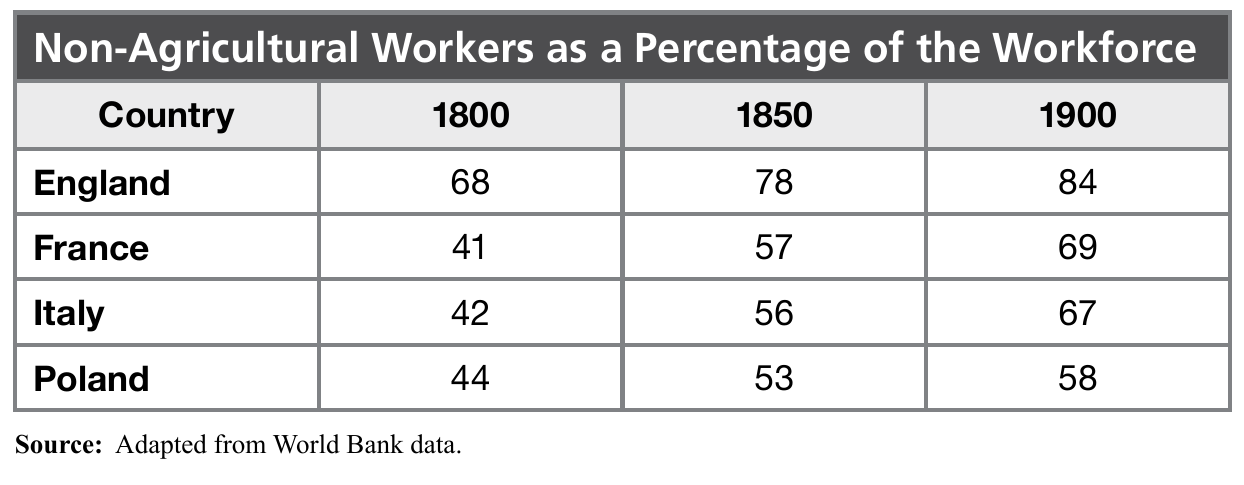
The Wealthy The Industrial Revolution also
transformed social hierarchies in the period from 1750 to 1900. Wealthy owners of industrial companies who made money from investments rather than from land overtook the aristocracy in wealth and prestige. These capitalists soon made up the highest of the upper class in industrial societies.
Gender and Industrialization The role of women changed significantly during the Industrial Revolution. In an agricultural economy, women provided labor at critical times during the planting and harvesting season but were rarely paid for their labor. In a proto-industrial system, women were able to earn some extra money in the manufacturing of textiles.
Despite these activities, women were still mainly supported by the labor and income of their male family members. This pattern began to change with the Industrial Revolution. Due to the low wages paid by the factories, all family needed to work. Hence, a woman’s income was just as important to the welfare of the family as a man’s. Despite the importance of female labor, women were often paid less than men for the same work and denied high-wage jobs.