Southeast Asia
Like China, South Asia strongly influenced its neighbors, particularly the lands of Southeast Asia—today’s Indonesia, Malaysia, Cambodia, Thailand, Laos, and Vietnam. Indian merchants had contact with these Southeast Asian lands as early as 500 B.C.E. The merchants sold gold, silver, metal goods, and textiles in the region and brought back its fine spices. Trade voyages introduced the Indian religions of Hinduism and Buddhism to Southeast Asia. Much of the region became and remains today mostly Buddhist. The region, like Southwest Asia, was strategically significant. Whoever controlled this region could influence the valuable trade between South Asia and East Asia.
Sea-Based Kingdoms Because Southeast Asia was so important, several kingdoms emerged there. Two were particularly long-lasting:
• The Srivijaya Empire (670–1025) was a Hindu kingdom based on Sumatra. It built up its navy and prospered by charging fees for ships traveling between India and China.
• The Majapahit Kingdom (1293–1520) based on Java had 98 tributaries at its height. Like Srivijaya, Majapahit sustained its power by controlling sea routes. Unlike Srivijaya, Majapahit was Buddhist.
Land-Based Kingdoms Other kingdoms in Southeast Asia drew power from their control over land. The Sinhala dynasties in Sri Lanka had their roots in the arrival of early immigrants, most likely merchants, from north India. Buddhists arrived in the 3rd century B.C.E. and the island became a center of Buddhist study. Monasteries and nunneries flourished. Both men and women found a life of contemplation and simple living attractive.
Buddhism was so deeply embedded that Buddhist priests often served as advisors to the monarchs. The government of one of the kingdoms oversaw the construction of a network of reservoirs and canals to create an excellent irrigation system, which contributed to economic growth. However, attacks by invaders from India and conflicts between the monarchy and the priests ultimately weakened the kingdoms.
The Khmer Empire, also known as the Angkor Kingdom (802–1431), was situated near the Mekong River and also did not depend on maritime prowess for its power. The kingdom’s complex irrigation and drainage systems led to economic prosperity, making it one of the most prosperous kingdoms in Southeast Asia. Irrigation allowed farmers to harvest rice crops several times a year, and drainage systems reduced the impact of the heavy monsoon rains.
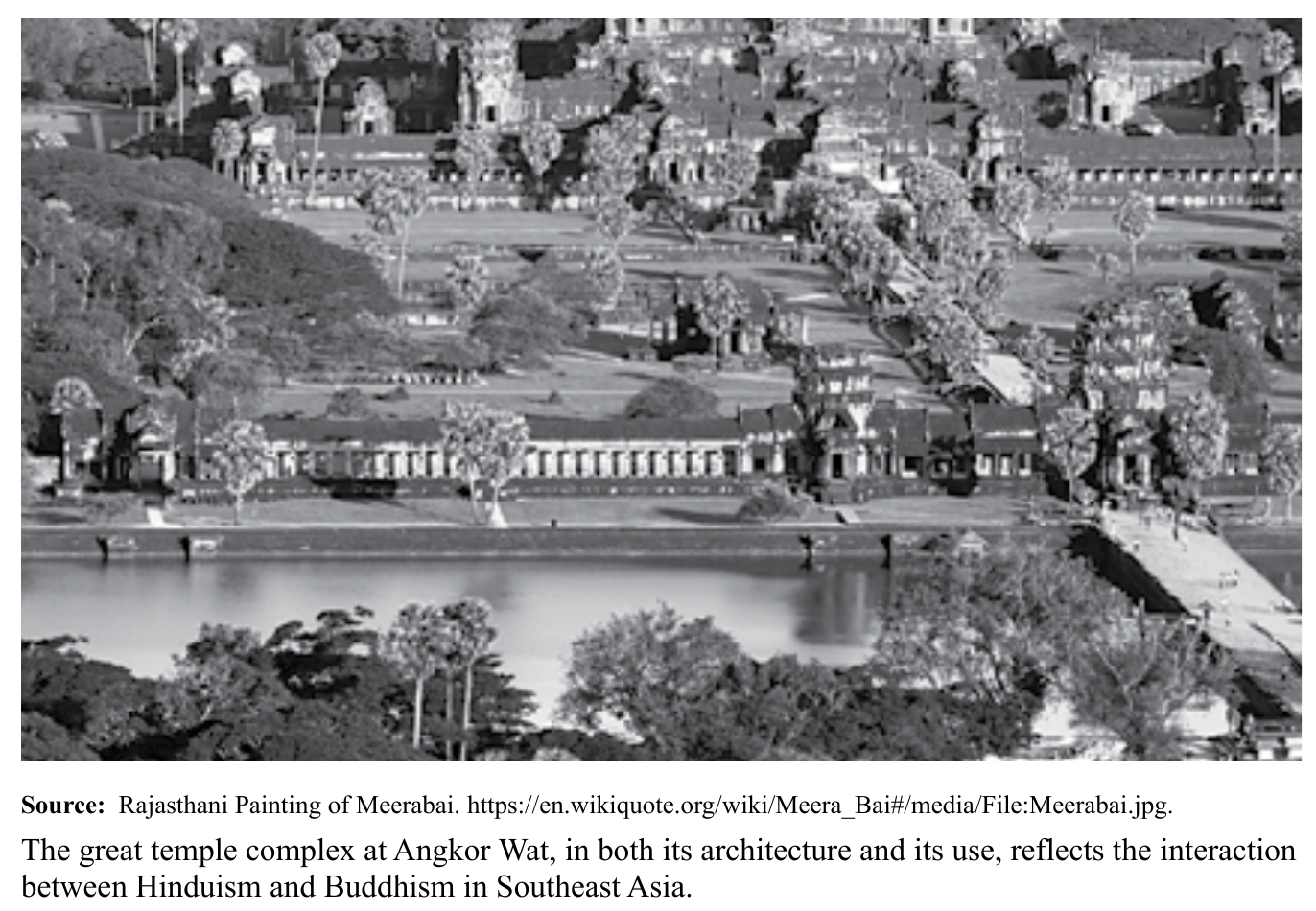
The Khmer capital was at Angkor Thom. The temples there showed the variety of Indian cultural influences on Southeast Asia. Hindu artwork and sculptures of deities abounded. But at some point the Khmer rulers became Buddhist. Starting in the 12th and 13th centuries, they added Buddhist sculptures and artwork to the temples without destroying any of the Hindu artwork.
During the same period and only one-half mile from Angkor Thom, rulers constructed the ornate and majestic Buddhist temple complex of Angkor Wat. In 1431, the Thais of the Sukhothai Kingdom invaded the area, forcing the Khmers out. Nevertheless, ruins of the magnificent structures in Angkor Thom and Angkor Wat still stand, testifying not only to the sophistication of Southeast Asian culture but also to the powerful influence of Indian culture on the region.
Islam Islam’s movement into the Indian Ocean region paralleled its expansion elsewhere. The first Southeast Asian Muslims were local merchants, who converted in the 700s, hoping to have better trading relations with the Islamic merchants who arrived on their shores. Islam was most popular in urban areas at the time. Islam spread to Sumatra, Java, and the Malay Peninsula. Today, Indonesia includes more Muslims than any other country.
Sufis Sufis also did missionary work in Southeast Asia. (See Topic 1.2.) Because of their tolerance for local faiths, people felt comfortable converting to Islam. They could be Muslims and still honor local deities.