Israel’s Founding and Its Relationships with Neighbors
The Zionist movement originated in the 1890s from reaction to the Dreyfus Affair. (See Topic 5.1.) Theodore Herzl, a Hungarian Jewish intellectual and journalist, used the affair as evidence that assimilation of Jews into European society was failing to provide safety and equal opportunity. At the First Zionist Congress in 1897, he urged the creation of a separate Jewish state.
Birth of Israel Zionists hoped that the new state could be established in Palestine because that was where their ancestors had lived. In modern times, Palestine was part of the Ottoman Empire, and most of its inhabitants were Arabs who practiced Islam. In a new state, Zionists argued, Jews could be free of persecution. In 1917, during World War I, the British government issued the Balfour Declaration, which favored the establishment in Palestine of a “national home” for the Jewish people. However, British Foreign Secretary Arthur James Balfour wrote that “nothing shall be done which may prejudice the civil and religious rights of existing non-Jewish communities in Palestine.”
The situation was complicated because British officer T. E. Lawrence, known as “Lawrence of Arabia,” promised certain Arabs an independent state as well. The British Foreign Office hoped that Arabs would rise up against the Ottoman Empire, which would make it easier to defeat during World War I. The Balfour Declaration promised civil and religious rights to non-Jews in Palestine, but the supporters of the Arabs did not trust the British.
In 1918, after World War I, Britain was given a mandate over former Ottoman lands in the Middle East. Soon Zionists began to immigrate to Palestine from Europe and from other Middle Eastern areas. As immigration increased, the Arabs in the area protested their loss of land and traditional Islamic way of life.
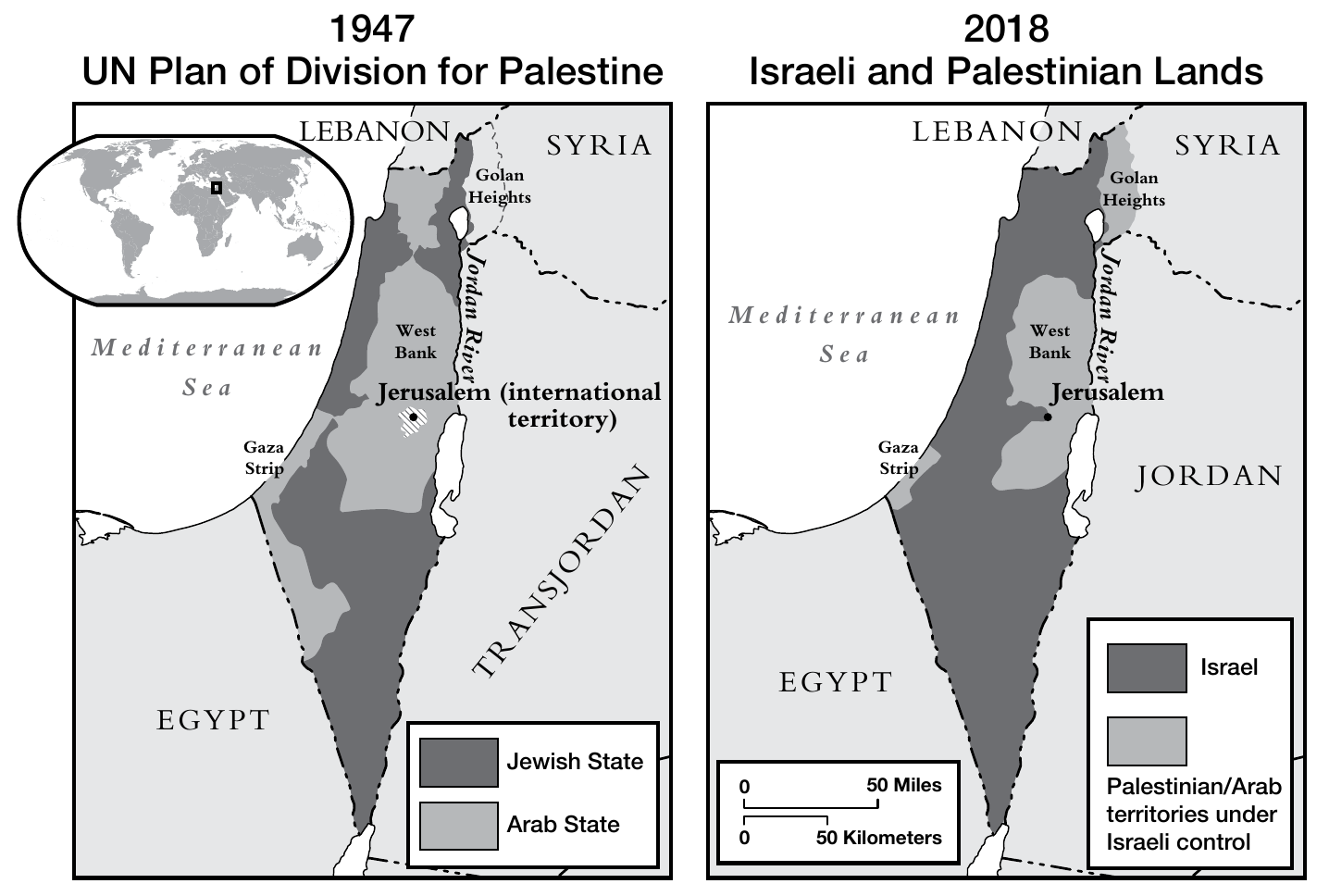
World War II and the deaths of six million Jews in the Holocaust provided another impetus for Jewish immigration. The fate of the European Jews brought worldwide sympathy for the survivors. Britain, trying to hold the line on Jewish immigration in the face of Arab opposition, turned the matter over to the United Nations. As in India, leaders hoped that partition would bring peace and stability. In 1948, after the UN divided Palestine into Jewish and Arab sections, the Jewish section declared itself to be a new country: Israel.
Multiple Wars War broke out immediately between Israel, which had support from the United States, and the Palestinians, who had support from neighboring Arab countries. Arab forces from Syria, Jordan (then called Transjordan), Lebanon, and Iraq invaded Israel. After several cease-fires, the Israeli army won, and an armed truce was declared. Immediately after the truce, about 400,000 Palestinians became refugees, living in camps near the Israeli border. Three other Israeli-Palestinian wars followed:
• In 1956, Israel, with support from France and Great Britain, invaded Egypt’s Sinai Peninsula, in part to liberate the Suez Canal, which the Egyptian government had nationalized under Gamal Abdel Nasser’s economic programs (See Topic 8.5.) Following international protests, Israel and its allied forces were ordered to withdraw from Egypt.
• In the Six-Day War of 1967, Israel fought on three fronts at once. Israel gained the Gaza Strip from Egypt, the West Bank and East Jerusalem from Jordan, and the Golan Heights from Syria.
• In the Yom Kippur War of 1973, Israel repelled a surprise invasion by Egypt and Syria.
Israeli-Egyptian Peace After 30 years of conflict between Israel and its Arab neighbors, U.S. President Jimmy Carter mediated the Camp David Accords, a peace agreement between Prime Minister Menachem Begin of Israel and President Anwar Sadat of Egypt. However, the Palestinians and several Arab states rejected the 1979 peace treaty. The Palestinian Liberation Organization (PLO) and its longtime leader Yasser Arafat wanted the return of occupied lands and the creation of an independent nation of Palestine.
Ongoing Violence In the 21st century, the peace process became more complicated when the Palestinians split into two factions. The Fatah faction controlled the West Bank. The Hamas faction controlled Gaza. Security concerns led the Israeli government to implement tighter border controls on the West Bank and on Gaza. These controls, amounting to economic sanctions, severely restricted normal activity for hundreds of thousands of Palestinians and fomented anger. Israel further angered Palestinians by approving new settlements on lands it had occupied during previous wars, lands Palestinians considered theirs.
Without a peace process, violence continued. Between 2000 and 2014, over 7,000 Palestinian and over 1,000 Israelis were killed. Many countries in the Middle East remained hostile to United States over its support of Israel.