Nazi Germany’s Aggressive Militarism
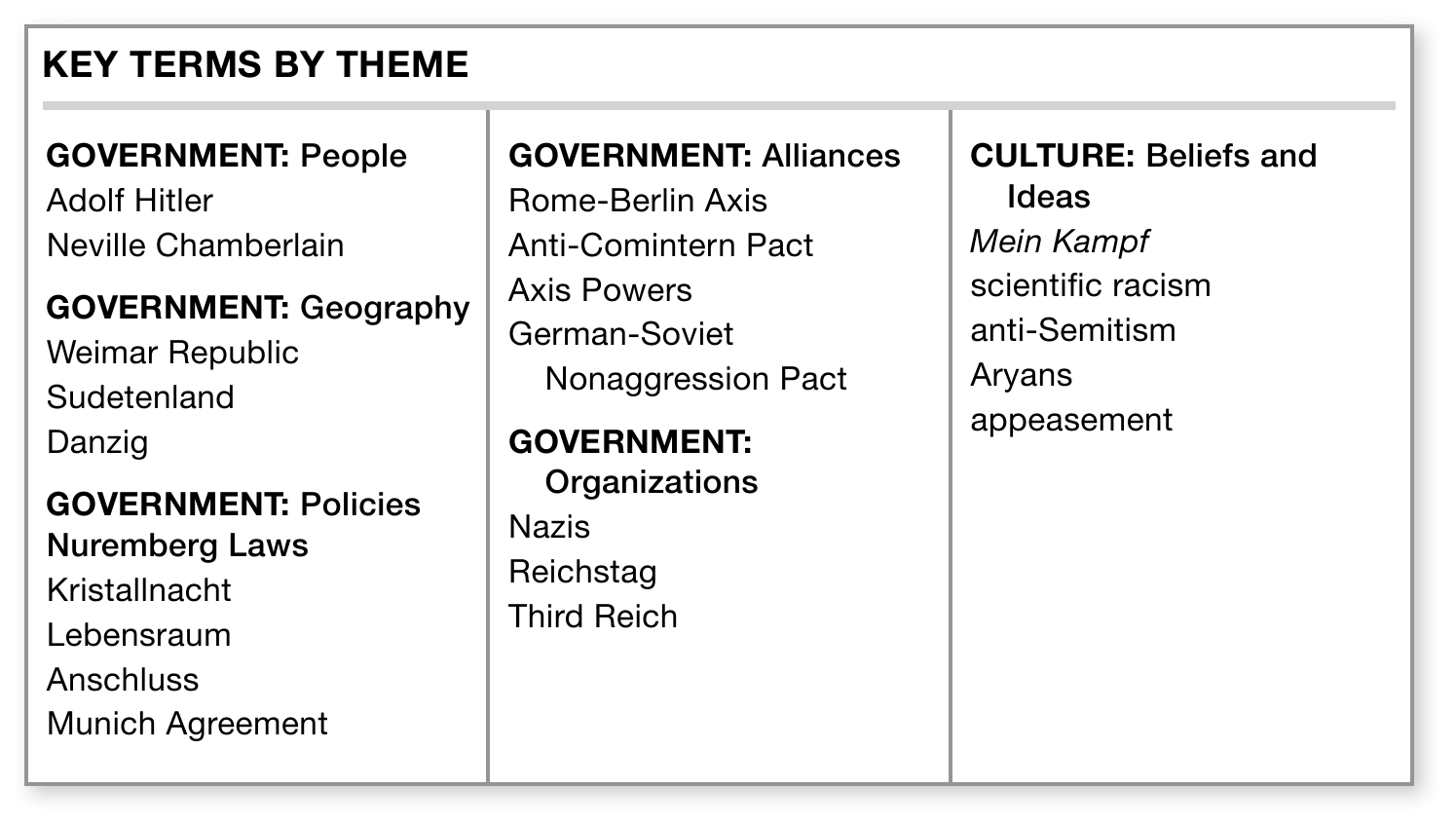
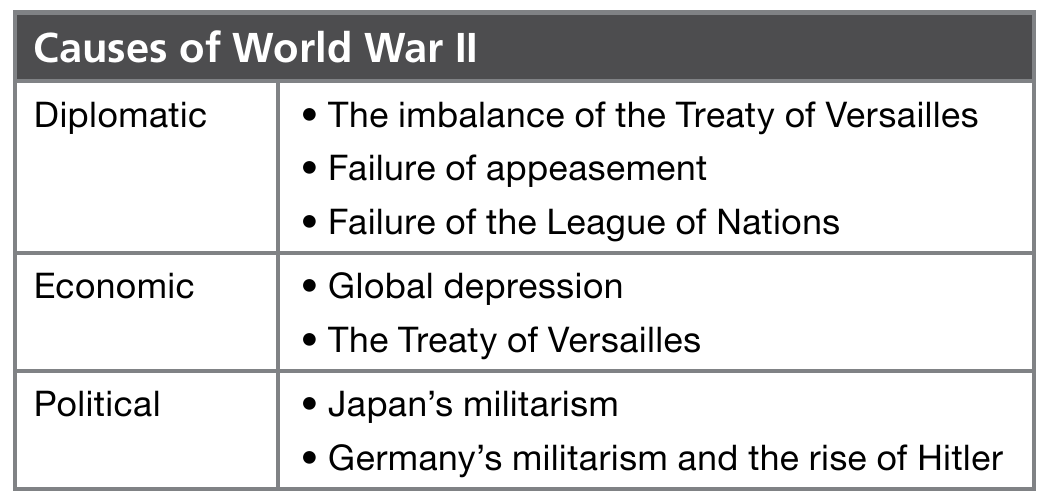
The terms of the Treaty of Versailles severely limited the German military after World War I. Yet Hitler wanted a stronger military to acquire more land. In March 1935, he broke the treaty when he announced the creation of a German air force and a policy of conscription to enlarge the size of the army.
The Treaty of Versailles Under the treaty, a strip of land in the Rhineland 31 miles wide was set up as a buffer zone between Germany and France. Germany was not allowed to station troops there. Hitler broke the agreement, sending German troops into the Rhineland on March 7, 1936. Both France and Britain protested this move, but they took no other action.
Some British believed that Hitler was the strong anticommunist leader that central Europe needed to keep order. Others were simply reluctant to return to war. So Britain followed a policy of appeasement, giving in to Germany’s demands in hopes of keeping the peace. However, Germany’s military expansion and its support of the fascist Spanish Nationalist government during the Spanish Civil War (1936–1939) indicated that Hitler was increasing his power. (Connect: Describe the connection between the militarism that led up to World War I and World War II. See Topic 7.2.)
German-Austrian Unification With his military revived and alliances in hand, Hitler felt confident about taking his next step in the creation of a new German empire, the Third Reich. His plan was to bring Austria, where he was born, under German rule. Hitler used the threat of invasion to pressure the Austrian chancellor into giving more power to the Austrian Nazi Party. As Hitler had planned, the Austrian Nazis then opened the door for German troops to occupy Austria with no resistance. With the Anschluss (political union), Austria officially became part of the Third Reich in March 1938.
Czechoslovakia The annexation of Austria was only the first step for Hitler. He wanted more. In September 1938, he issued a demand to Czechoslovakia for the border territory of the Sudetenland. Most of the people who lived in this region spoke German; Hitler argued that the area was a natural extension of his Aryan empire. The German leader met with the leaders of Britain, France, and Italy in Munich to discuss his demands. Neville Chamberlain, the British prime minister, again argued that a policy of appeasement would keep the peace and put an end to Hitler’s demands for more land. The Munich Agreement allowed Hitler to annex the Sudetenland in return for a promise that Germany would not take over any more Czech territory. This was a fateful miscalculation. Hitler saw that the British were not willing to stand up to his illegal land grabs, emboldening him to seize control of all of Czechoslovakia with an armed invasion in 1939.
The Conflict over Poland Hitler next set his sights on the Polish port of Danzig. Although Germany did have some historical claims to the port, in reality, Hitler was merely looking for an excuse to invade Poland. Britain, in the meantime, had reached the end of its policy of appeasement and agreed to protect Poland from a German attack. Britain and France also reached out to the Soviet Union to form a stronger alliance against Germany.
Germany, however, was already in negotiations with the Soviets. With the signing of the German-Soviet Nonaggression Pact on August 23, 1939, the two nations pledged not to attack one another. During the negotiations for the pact, Hitler secretly offered Stalin control of eastern Poland and the Baltic States if Stalin would stand by during a German invasion of western Poland. With this assurance in hand, Germany invaded Poland on September 1, 1939, claiming that Poland had attacked first. Britain and France honored their agreement to protect Poland and declared war on Germany. These actions marked the official start of World War II in Europe.
Japan’s Expansion in Asia
By the time Germany invaded Poland in 1939, Japan had already been moving aggressively against Korea and China for almost 50 years. In 1931, Japan had invaded Manchuria. After several months of fighting, it successfully created the state of Manchukuo under its control. Then, in 1937, a small incident in this region between Japanese troops and Chinese troops quickly escalated. Soon, Japan had launched a full-scale invasion of China. This marked the start of World War II in Asia.