UNIT 1: The Global Tapestry from c. 1200 to c. 1450
Context
Understand the Context
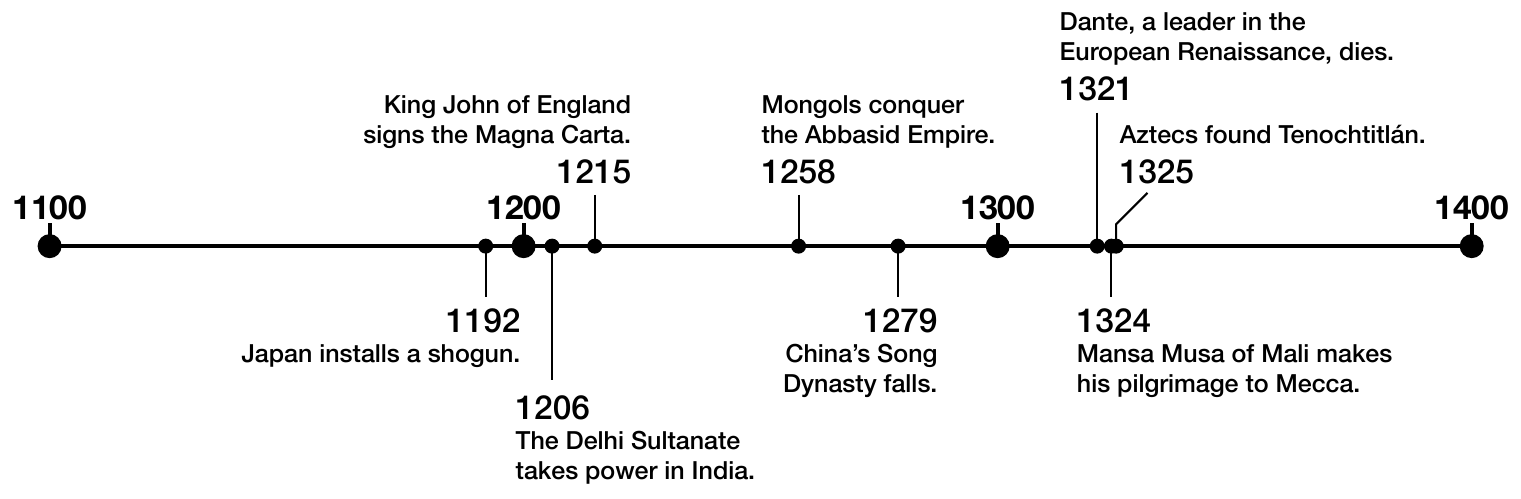
Between 1200 and 1450, several large empires emerged around the world. Some were modified revivals of earlier empires in their region. Others represented new developments. All were shaped by the context of regional trade, which had been increasing since around 600.
The Revival of Large Empires Between 1200 and 1450, the wealthiest and most innovative empire in the world was the Song Dynasty in China. It was the latest in a series of states that had ruled a unified and prosperous China. Similarly, in Mesoamerica, the rise of the Aztec was influenced by an earlier empire under the Mayans. Two other centers of great intellectual achievement, Baghdad and Spain, reflected the emphasis on learning in the Islamic world.
However, in parts of Africa and Southeast Asia, the growth of regional trade produced larger and more complex states than had previously existed in those regions. Trade across the Sahara resulted in the West African empires of Ghana and Mali. Trade in the Indian Ocean provided the context for large states in Zimbabwe in East Africa and various states in India and Southeast Asia.
Unity in Central Eurasia Shaping the context for events throughout Eurasia between 1200 and 1450 was the remarkable emergence of the Mongols. A group of nomads from Central Asia, the Mongols conquered lands from central Europe to the Pacific Ocean, creating the largest land empire in human history. The conquest came with great devastation. However, the unity of so much territory under the rule of one group allowed trade to flourish once again across Eurasia, with new ideas and technology spreading easily. These developments set the stage for the intensifying global interactions that helped define the period after 1450.
Topics
Historical Perspectives: HISTORICAL PERSPECTIVES: WHO DEvELOPED GUNS?
Read more →
Write As Historian: WRITE AS A HISTORIAN: CHECKLIST fOR A LONG ESSAY ANSWER
Read more →
AP Exam Practice
Start Practice →