UNIT 8: Cold War and Decolonization
Context
Understand the Context
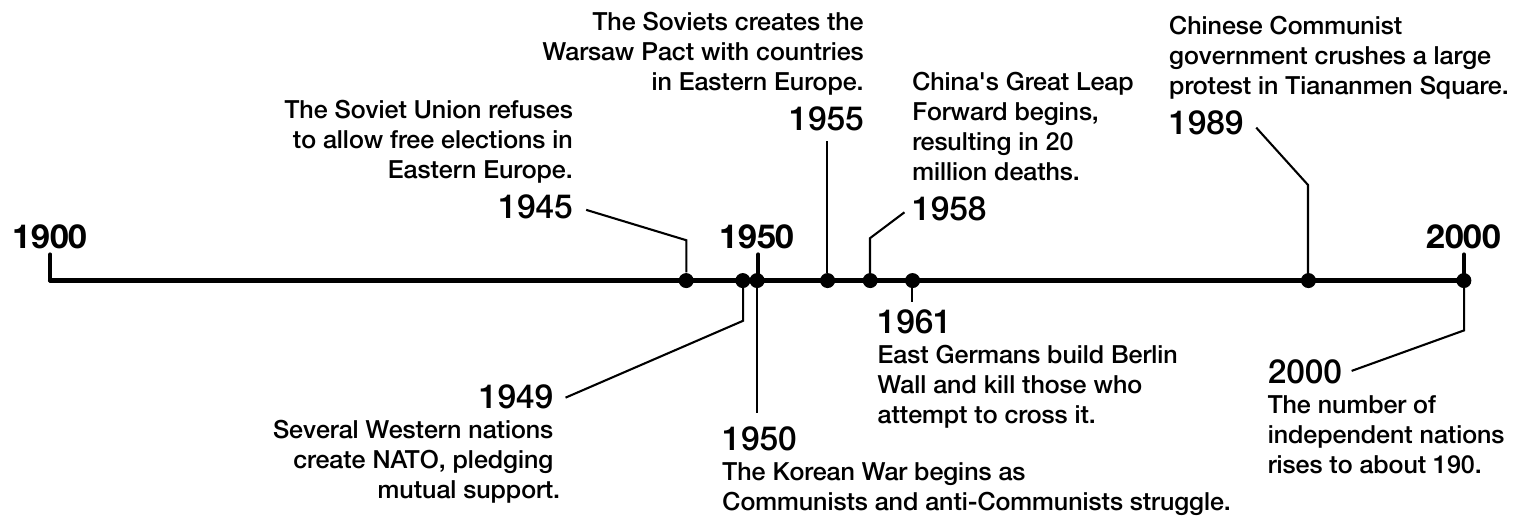
The aftermath of the world wars provided the context for two developments in the late 20th century: the decline of colonial empires and the rise of a tense conflict between capitalist and communist states known as the Cold War. These conflicts became intertwined, resulting in numerous wars.
Decolonization Against the backdrop of the world wars, nationalist movements in African and Asian colonies intensified. In the decades following World War II, colonies achieved independence through negotiation, and in some cases, armed struggle. The creation of independent states often resulted in population resettlements and challenges to inherited colonial boundaries.
In newly independent states, as in more established states, governments actively promoted economic development. Movements to redistribute land and wealth gained support in Africa, Latin America, and Asia. Some of these movements, such as the one in China, embraced a form of communism. Even after independence, connections between postcolonial states and former colonial empires continued through migration and economic relationships.
The Cold War After World War II, with Europe weakened, the United States and the Soviet Union (USSR) emerged as competing superpowers. The resulting Cold War was a power struggle between capitalism and communism, expressed through competing military alliances, a nuclear arms race, and proxy wars in postcolonial states in Latin America, Asia, and Africa.
While the Cold War heightened global tensions, movements advocating nonviolence and alternatives to the established order, such as the Non-Aligned Movement, also became influential. By the late 1900s, Soviet economic and military stagnation and public discontent contributed to the collapse of communist governments in Eastern Europe and the end of the Cold War.
Topics
Setting the Stage for the Cold War and Decolonization
4 Sections
The Cold War
5 Sections
Effects of the Cold War
4 Sections
Spread of Communism after 1900
4 Sections
Decolonization after 1900
7 Sections
Newly Independent States
6 Sections
Global Resistance to Established Power Structures
6 Sections
End of the Cold War
2 Sections
Causation in the Age of the Cold War and Decolonization
7 Sections
Historical Perspectives: HISTORICAL PERSPECTIVES: WHY ARE SOME COUNTRIES WEALTHY?
Read more →
Write As Historian: WRITE AS A HISTORIAN: WRITE THE CONCLUSION
Read more →
AP Exam Practice
Start Practice →