China
After the Han Dynasty declined in the 3rd century, China suffered three centuries of turmoil and disunity. However, after that, China experienced several centuries of growth.
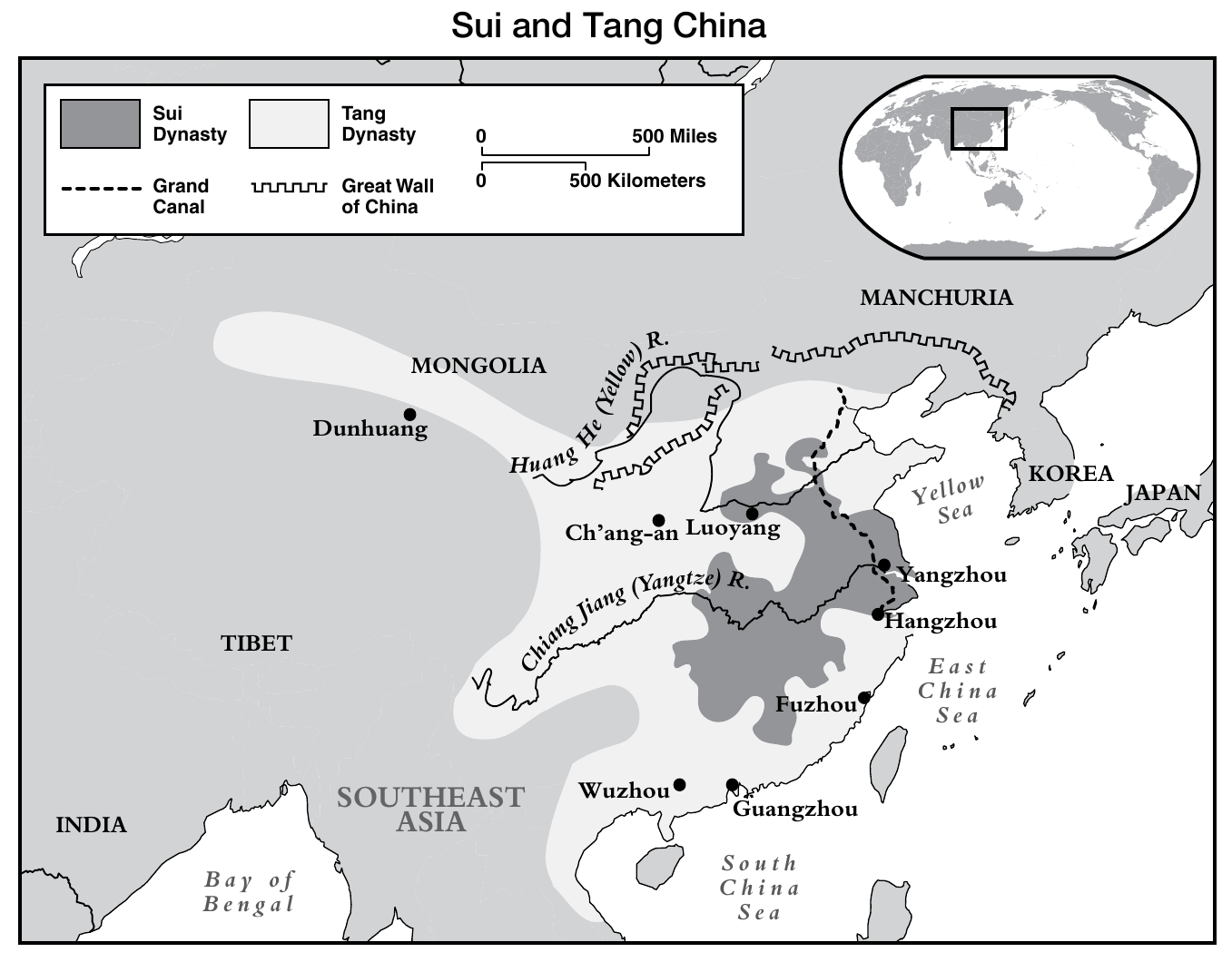
Sui Dynasty China’s period of troubles was ended by the short-lived Sui Dynasty (581–618). By reconstituting a centralized government, the Sui provided the foundation on which China again became prosperous. The dynasty’s most dramatic accomplishment was the construction of the Grand Canal. Stretching over 1,000 miles, it connected the agricultural south to the population centers in the north. Besides fostering economic growth, the Grand Canal helped unify the varied ethnic and cultural groups of China.
Tang Dynasty Building on the accomplishments of the Sui, the Tang Dynasty (618–907) extended China’s boundaries north into Mongolia, west into Central Asia, and south into Vietnam. China’s population grew significantly under the Tang. Learning to grow a fast-ripening variety of rice allowed peasants to produce more calories per acre, so the land could support more people.
The Tang expanded the civil service exam and the empire’s bureaucracy, which developed into an ongoing feature of the Chinese government. Under the Tang, the Chinese invented gunpowder and developed paper money, which facilitated trade. Political stability and steady demand for China’s silk, porcelain, and other goods ushered in a second golden age of the Silk Roads.
The Chinese had long viewed their country as the “Middle Kingdom,” possibly because they believed they were at the center of cultural advances in the world. Based on this viewpoint, they developed the tributary system, the idea that surrounding kingdoms should make payment, or tribute, to the Chinese and officially submit to their rule in exchange for trading privileges.
The strength of the Tang eventually declined. A combination of internal peasant uprisings and invasions from the west and north led to the downfall of the dynasty.
Song Dynasty After the Tang collapsed, a new dynasty, the Song Dynasty (960 –1279), was able to restore order. Under the Song, China continued its golden age. Chinese meritocracy allowed for more upward mobility than any other hiring system of its time. China became the leading manufacturer in the world, producing iron, steel, silk, and porcelain, and it had the largest cities in the world. Neo-Confucianism, a melding of Confucian, Buddhist, and Daoist philosophies that had begun under the Tang, became popular. It was during this time that paper money and the magnetic compass was exported from East Asia to other parts of the world.