Topic 4 AP Exam Practice
Multiple-Choice Questions
Questions 1 to 3 refer to the table below.
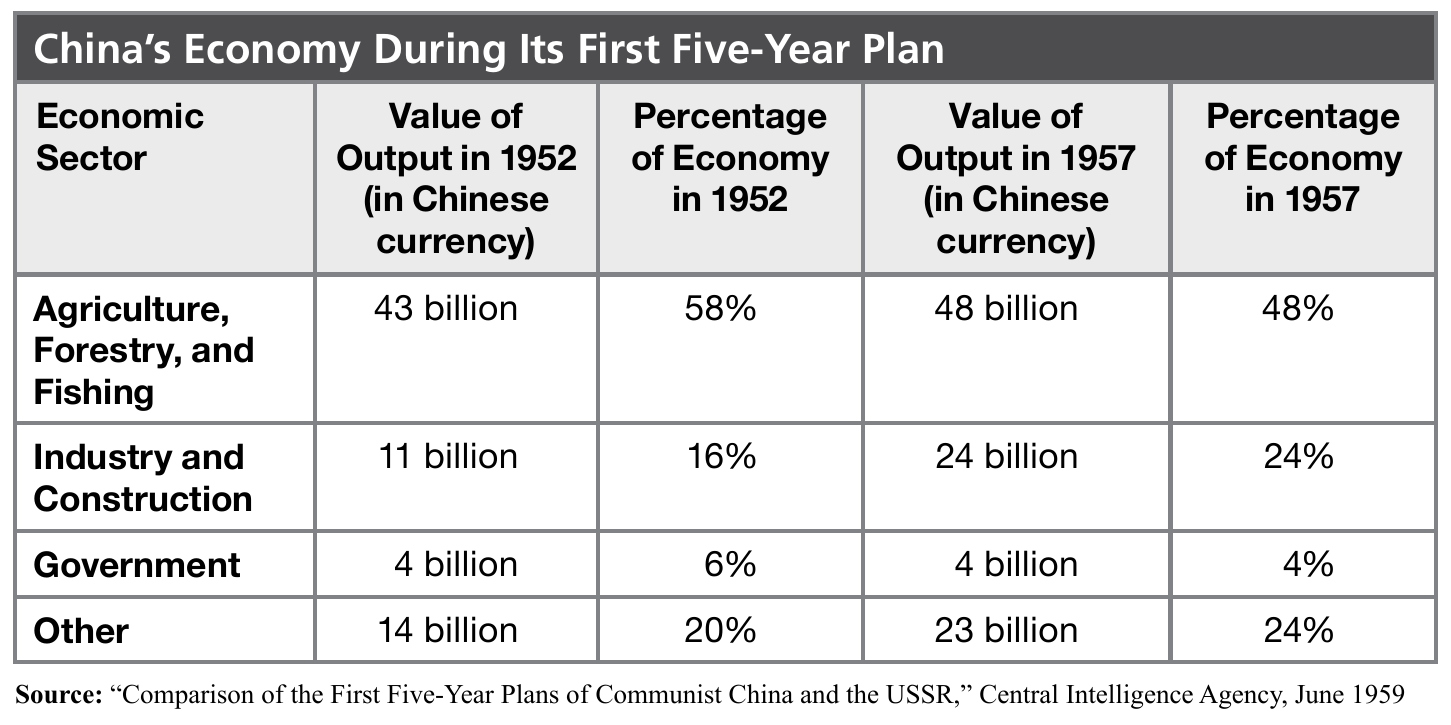
1. Which row in this table most clearly supports the argument that China’s Five-Year Plan from 1952 to 1957 was successful?
- (A) Agriculture, Forestry, and Fishing
- (B) Industry and Construction
- (C) Government
- (D) Other
2. Which of the following statements best describes the changes in the Chinese government between 1952 and 1957?
- (A) It remained the same size, but it became a larger part of the economy.
- (B) It remained the same size, but it became a smaller part of the economy.
- (C) It grew in size and became a larger part of the economy.
- (D) It shrank in size and bacame a smaller part of the economy.
3. Which statement provides the context for understanding this table?
- (A) China was following the path of Soviet economic development.
- (B) China viewed the United States as an economic model to follow.
- (C) China wanted consumer spending to lead economic growth.
- (D) China believed that it would soon move away from communism.
Short-Answer Questions
1. Use the passage below to answer all parts of the question that follows.
“Comrade Stalin: Concerning the telegram Comrade Mao Zedong sent to me on October 13 and your reply telegram of [October] 14, I would like to ask the following questions. Please give your instructions:
1. After the dispatch of the 16 regiments of jet planes, can the Soviet Volunteer Air Force dispatch bombers to North Korea to support the Chinese armies’ military operations?
2. Besides dispatching the Volunteer Air Force to participate in military operations in North Korea, can the Soviet government also dispatch protective air forces to be stationed near all large Chinese coastal cities?
3. To accelerate the building of airports . . . the Chinese government requests the Soviet government to supply steel plates to be laid at 4 airports.
4. Can the Soviet government provide us in half a year with 15,000 vehicles of all types, but, first of all, with 5,000 load-carrying vehicles?
5. When [the Chinese People’s Liberation Army] undertakes military operations in cooperation with the North Korean People’s Army, how should [the question of] the mutual command relationship be decided?
6. When the Soviet Volunteer Air Force participates in North Korean military operations, how should [the question of] the command relationship with the Chinese Volunteer Army be decided?
Attached is the Chinese government’s requisition list for the first batch of artillery of all types . . . . Please give approval. Bolshevik Greetings!”
Zhou Enlai, letter to Joseph Stalin, October 14, 1950
2. Answer all parts of the question that follows.