Cultural and Religious Motives for Imperialism
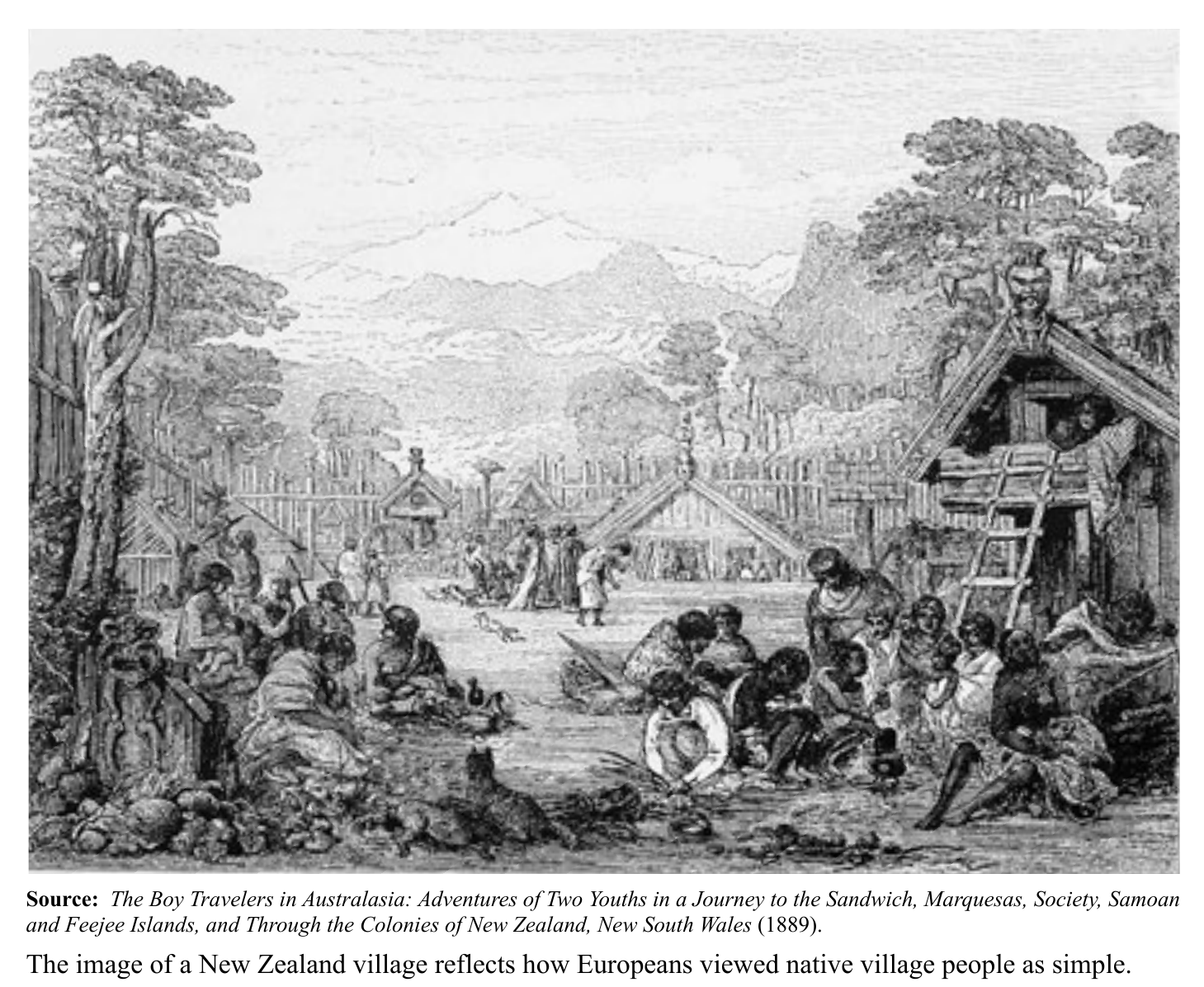
The Kipling quotation that opens this topic epitomized the condescending attitudes shared by imperialism’s proponents. Referring to colonized peoples as children reflected how colonizers saw themselves as benevolent protectors on a “civilizing mission” rather than invaders.
Racial Ideologies and the Misuse of Science The attitudes of whites toward others were a form of racism. Colonial powers generally believed that they were inherently superior to those they subjugated. Pseudoscientists, people who present theories as science that are actually incompatible with the scientific method, strengthened these attitudes. They claimed to have proof of the intellectual and physical inferiority of nonwhite races. Phrenologists, people who studied skull sizes and shapes, believed that a smaller skull size proved the mental feebleness of Africans, indigenous Americans, and Asians. These ideas have been proven false.
Legitimate science was also subverted to support imperialism. British scientist Charles Darwin’s 19th-century theory of evolution by natural selection stated that over millions of years, biological competition had “weeded out” the weaker species in nature and that the “fittest” species were the ones that survived. Some thinkers adapted Darwin’s theory of biological evolution to society, creating the theory known as Social Darwinism. While Darwin
himself was not a Social Darwinist, advocates used the “survival of the fittest” theory to argue that the spread of European and U.S. power proved the biological superiority of whites. Writers and politicians then used Social Darwinism to justify further imperialism by powerful countries.
Cultural Ideologies Based on technological superiority over indigenous societies, colonial powers felt justified in superimposing aspects of their own cultures on their colonies. For administrative purposes, many colonies combined into a single colony peoples from several cultures who often spoke different languages and had different customs. Colonizers introduced their own language, which helped to unify these often diverse colonies. They also introduced their political, educational, and religious institutions and exerted other cultural influences on architecture and recreational activities. Expressing the belief of many, Congregationalist minister Josiah Strong wrote in 1885, “Is there room for reasonable doubt that [the Anglo-Saxon] race . . . is destined to dispossess many weaker races, assimilate others, and mold the remainder, until, in a very true and important sense, it has Anglo-Saxonized mankind?”
Religious Motives Missionaries were among the most tireless “civilizing” influences. Like the Spanish and Portuguese Catholic missionaries who combined conquest and evangelism during the Age of Discovery, British Protestant missionaries of the 18th and 19th centuries also participated in colonization. Critics charged that missionaries supported imperialism by persuading people to give up their traditional beliefs, such as ancestor veneration, and adopt the faith of most Europeans, Christianity. This change in religion could pave the way for others who were more focused on economic gain. In response, missionaries pointed out that they commonly combined religious and humanitarian efforts:
• Missionaries often set up schools for instruction in religion that also taught secular subjects, which prepared students to become teachers, lawyers, and other professionals.
• Many missionaries provided improved medicines and medical care.
• Some missionaries, most famously David Livingstone from Scotland, worked in Sub-Saharan Africa to end the illegal slave trade.