Challenges to Existing Social Orders
The years following World War II were a time of unprecedented conflict as people and states challenged the established order. How they carried out their challenges, how the existing powers responded, and how the challenges were (or were not) resolved depended in part on the position of the challenging people or states in the geopolitical balance of power.
Toward the end of World War II, a serious ideological and economic rift emerged among the “Big Three” Allied powers—the Soviet Union, the United States, and Great Britain. The United States and Great Britain, along with France (which had recently been liberated from German occupation), occupied the western half of Germany. The Soviets occupied the eastern half. Agreements made at Yalta and Potsdam were supposed to have settled the future status of Western and Eastern European countries affected by the war. However, after the war officially ended, it became apparent that the Soviet Union was not going to relinquish control over the Eastern European territories it occupied during the war. The Soviets viewed these states as a buffer against future aggression from the West. Even though the countries of Eastern Europe were officially independent, the Soviet Union had immense influence over their governments and internal affairs. The so-called Soviet bloc was made up of East Germany and these satellite nations of the USSR. The United States distrusted the motives of the Soviet Union and believed the Soviets were intent on bringing about a global communist revolution.
After China became a communist state in 1949 and the United States recognized it could not free Eastern Europe from Soviet influence, the United States established a policy of containment. The policy used military, economic, and political means to stop the spread of communism outside of the areas where it was currently practiced. Containment drove the direction of U.S. foreign policy throughout the Cold War.
Three Alignments The Cold War thus caused a division of the world into three alignments. The “First World” was the United States and its allies. The “Second World” was the Soviet Union, the Soviet bloc countries of Eastern Europe, and other communist nations around the world. The third alignment was often called the “Third World” but was more accurately described as the non-aligned countries that did not have close military or ideological ties with any of the First or Second World countries.
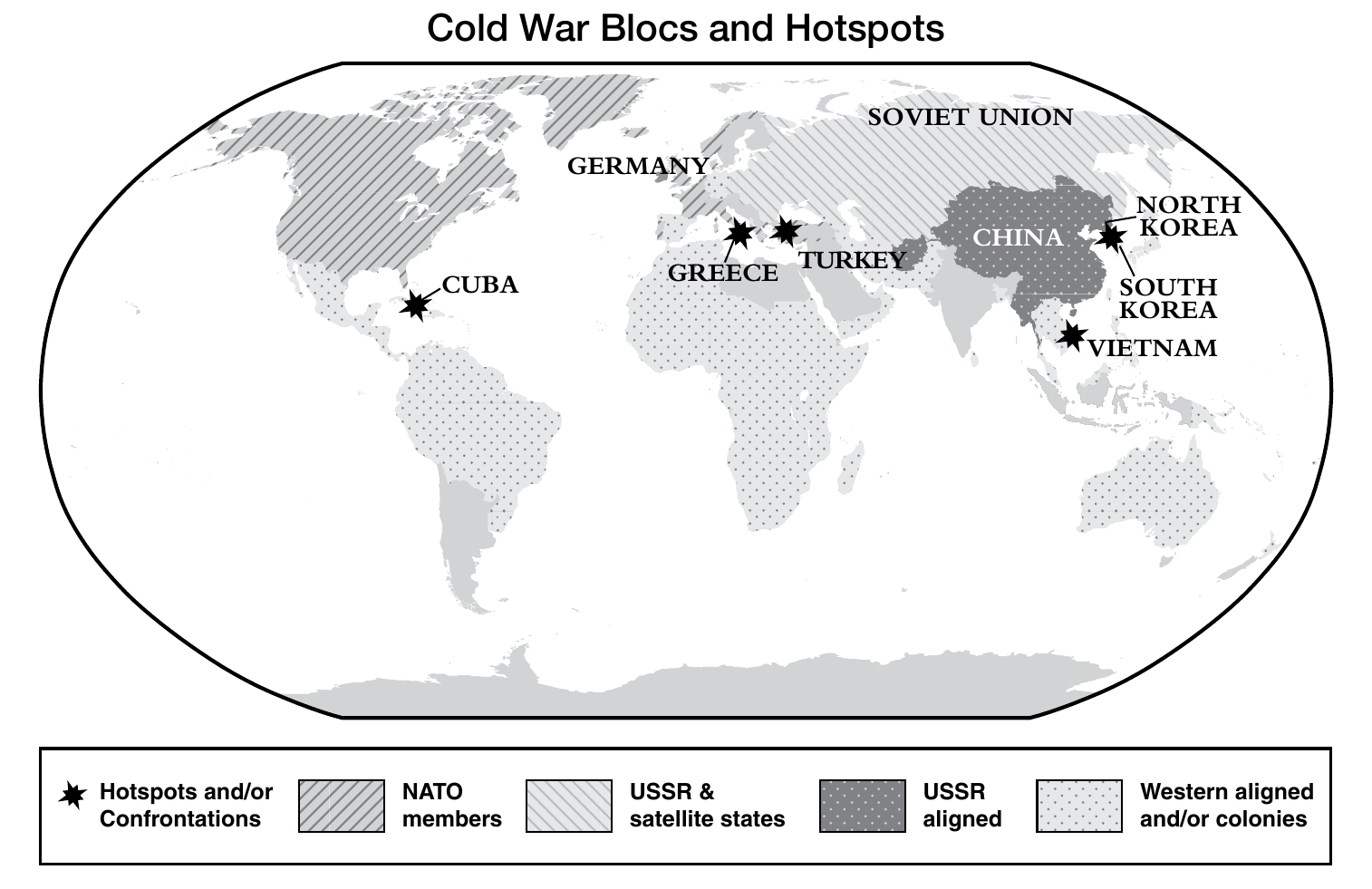
As the map on the previous page shows, the United States was the First World superpower situated in the Western Hemisphere. The dominant superpower in the Second World, the Soviet Union, was in the Eastern Hemisphere. These superpowers represented a geopolitical balance of power. Third World countries were mainly those with colonial pasts; they were in Asia, Africa, and Oceania in the Eastern Hemisphere and Latin America in the Western Hemisphere.