Topic 6 AP Exam Practice
Multiple-Choice Questions
Questions 1-3 refer to the following two sources:
Source A
“The world of the 20th Century, if it is to come to life in any nobility of health and vigor, must be to a significant degree an American Century. . . . Once we cease to distract ourselves with lifeless arguments about isolationism, we shall be amazed to discover that there is already an immense American internationalism. American jazz, Hollywood movies, American slang, American machines and patented products, are in fact the only things that every community in the world, from Zanzibar to Hamburg, recognizes in common.”
Henry Luce, founder of Time and Life magazines, “The
American Century,” Life Magazine, February 17, 1941
Source B
1. In Source A, what was the historical context that caused Henry Luce to advocate for the United States to take a worldwide leadership position and bring about an “American century”?
- (A) Great Britain had no powerful country as an ally in its war against Germany when Luce wrote this.
- (B) America had isolated itself economically from the rest of the world since 1917.
- (C) The United States had entered World War I as soon as Britain and Germany began fighting.
- (D) American culture, including magazines, had little appeal outside the United States.
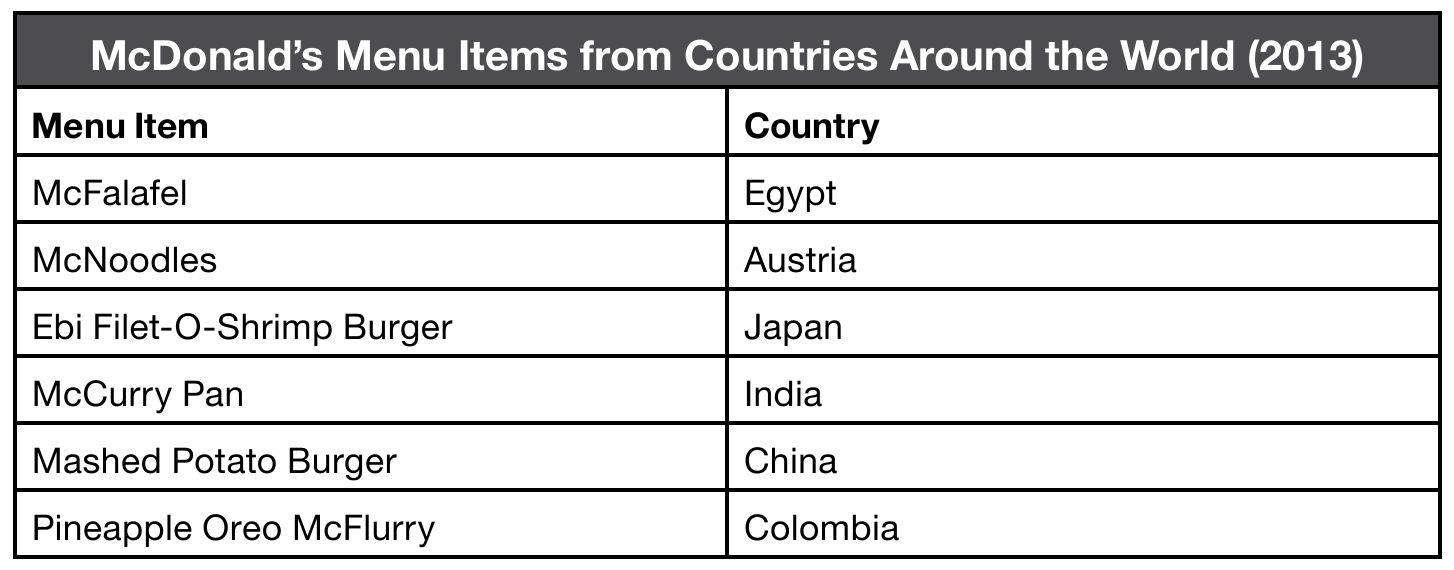
2. In Source B, which of the following conclusions is best supported by the evidence in the chart?
- (A) McDonald’s has exactly the same menu items in every restaurant around the globe.
- (B) Consumers of McDonald’s menu items are not familiar with typical McDonald brand names.
- (C) McDonald’s menu items have been globalized but reflect local tastes and preferences.
- (D) People in China do not like McDonald’s Quarter Pounder hamburgers.
3. Based on both sources, it can be concluded that from the mid-20th century to the early 21st century
- (A) arts, entertainment, and popular culture continued to reflect the influence of a globalized society
- (B) global conflict was the most significant cause of globalization
- (C) localized culture was mostly ignored because of globalized culture
- (D) only American culture underwent globalization during this period
Short-Answer Questions
1. Use the passage below to answer all parts of the question that follows.
“Western leaders exploited the lure of their popular culture during the Cold War. They created radio and television stations such as Radio Free Europe/ Radio Liberty to broadcast as much popular culture material into the Soviet bloc as could be programmed. This programming was done to achieve the very purpose the Soviets accused it of: to westernize the values of those who watched or listened to it. . . .
In using American pop culture as a tool of the Cold War, Western policymakers were exploiting what political scientist Joseph Nye has referred to as ‘soft power.’ The notion of soft power refers to cultural, social, intellectual, and ideological ideas, values, attitudes, and behaviors that influence human life. Nye distinguishes these soft forms of power from ‘hard power,’ which is typically associated with the use of violent, coercive tools of social action like armies and economic sanctions. Soft power is a significant factor in global politics, Nye argues. . . . As such, it provides a way for one people—in the case of the Cold War, people in the political West—to change the attitudes and behaviors of other cultures without resorting to war or other forms of coercion.”
Lane Crothers, Globalization and American Popular Culture, 2013
2. Answer all parts of the question that follows.