Unit 1 AP Exam Practice
Document-Based Questions
1. Develop an argument evaluating the extent to which the kingdoms and empires of the Sub-Saharan region succeeded in making achievements between c. 1200 and c. 1450.
Document 1
Document 1
Source: Egyptian official on Mansa Musa (ruler from Mali) during his royal visit in Cairo during the 14th century
This man, Mansa Musa, spread upon Cairo the flood of his generosity: there was no person, officer of the court, or holder of any office of the Sultanate who did not receive a sum of gold from him.
Document 2
Document 2
Source: Description of Timbuktu by Leo Africanus, a traveler and writer born in Granada, al-Andalus, in the 16th century
Here are many doctors, judges, priests, and other learned men that are well maintained at the king’s costs. Various manuscripts and written books are brought here . . . and sold for more money than other merchandise.
Document 3
Document 3
Source: Travels to the Kingdom of Mali, by Ibn Battuta (mid-14th century)
Among their good qualities is the small amount of injustice amongst them, for of all people they are the furthest from it. Their sultan does not forgive anyone in any matter to do with justice. Among these qualities, there is also the prevalence of peace in their country, the traveler is not afraid in it nor is he who lives there in fear of the thief or of the robber by violence.
Document 4
Document 4
Source: Description of wax process used in making bronze sculpture in Benin by a Hausa artisan, 15th century
In the name of Allah the Compassionate, the Merciful. This account will show how the [Benin] figures are made. This work is one to cause wonder. Now this kind of work is done with clay, and wax, and red metal, and solder and lead, and fire. . . . Next it is set aside to cool, then [the outside cover of clay] is broken off. Then you see beautiful figure.
Document 5
Document 5
Source: Ubaydallah al-Bakri, resident of al-Andalus (Córdoba, Spain), who never travelled to Africa but based these observations on interviews with travelers, 1068
The city of Ghana consists of two towns situated on a plain. One of these towns, which is inhabited by Muslims, is large and possesses twelve mosques. . . . In the environs are wells with sweet water, from which they drink and with which they grow vegetables. The king’s town is six miles distant from this one and bears the name of Al-Ghaba. Between these two towns there are continuous habitations. The houses of the inhabitants are of stone and acacia wood.
Document 6
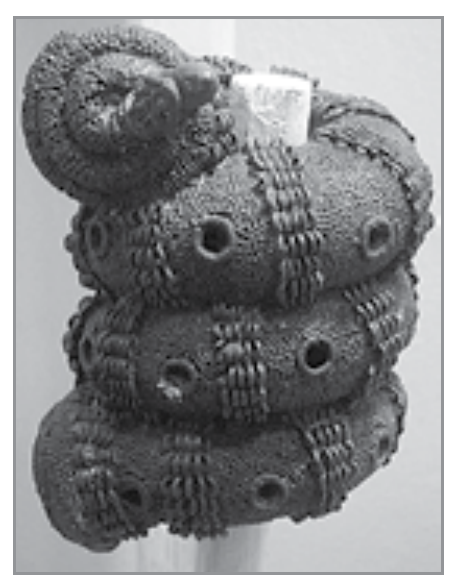
Document 6
Source: Bronze head for a staff in the shape of a coiled snake, from the Igbo-Ukwu people in Nigeria (9th century)
Document 7
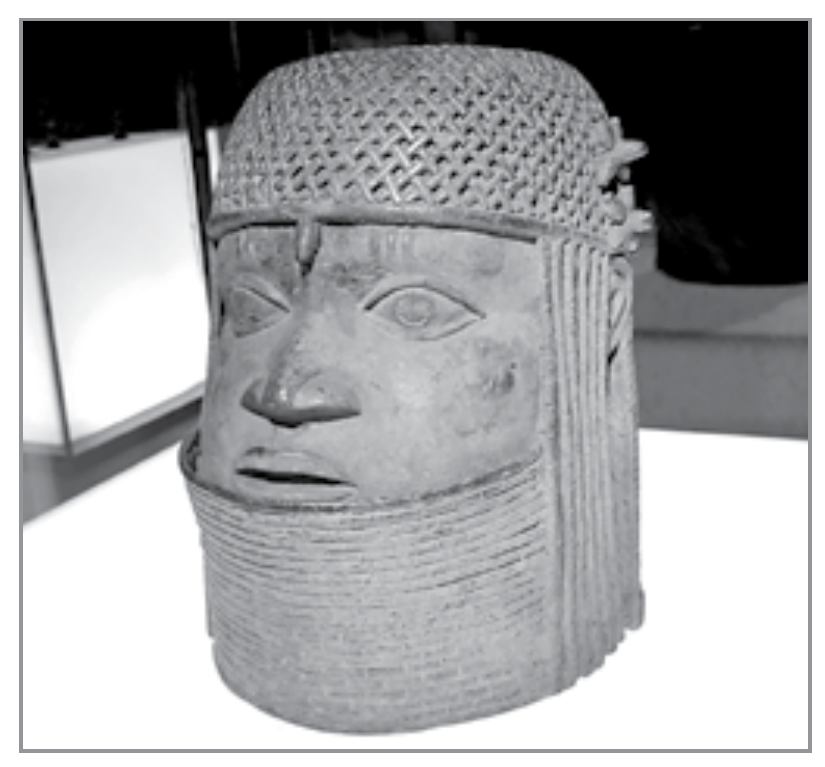
Document 7
Source: Benin bronze head, (West Africa) 16th century
Long Essay Questions
1. By the 14th century, Islam, Hinduism, and Confucianism each included movements within them that placed greater emphasis on either emotion or reason. Develop an argument that evaluates the extent to which two religious or ethical systems of thought were similar or different up through the 15th century.
2. Because of its size, wealth, and cultural innovations, China had a significant influence on its East Asian neighbors in the years 1200 to 1450—whether those neighbors were friendly or hostile. Develop an argument that evaluates the extent to which Chinese cultural traditions led to political or social change in other East Asian societies in that time period.
3. Abundant natural resources and the rise of powerful centralized governments affected African states between the 12th and the 15th centuries. Develop an argument that evaluates the extent to which change or continuity over time occurred in the economics and politics during that time period in one African state.
4. Abundant natural resources and the rise of powerful centralized governments affected American states between the 12th and the 15th centuries. Develop an argument that evaluates the extent to which change or continuity over time occurred in the economics and politics during that time period in one American state.