Casualties of World War II
Because of the widespread fighting, advances in the technology of destruction, and its impact on the economies and civilian life of so many nations, the effects of World War II were unprecedented. Although exact casualty figures have been impossible to determine, total deaths probably numbered 40 million to 50 million. Maybe half of those were citizens of the Soviet Union, and millions of others were from Germany, Poland, China, and Japan. Losses among U.S. troops were fewer, but still considerable: about 290,000 soldiers killed and more than 600,000 wounded. Civilian casualties from attacks on land, air, and sea; from government executions based on political rationales, including genocide; and from disease and starvation caused by the war likely exceeded military casualties.
The Nazis During the war, the world gradually learned about Nazi brutality. In its pursuit of territory, Germany forcefully removed many Slavic peoples, including one million Poles, and Roma, also known as Gypsies, from their homes. Heinrich Himmler, the leader of the Nazi special police, the SS, oversaw these policies. In addition, more than 7 million residents of conquered territories were forced to work in labor camps or in jobs that supported the German war effort. The Nazis sent political opponents, people with disabilities, and gay people to the camps. But the largest single group the Nazis targeted were the Jews. When Hitler became chancellor, he instituted many policies that reflected these extreme anti-Semitic views, such as the Nuremberg Laws of 1935 that banned Jews from certain professions and certain schools. Jews were forced to live in sections of cities called ghettos.
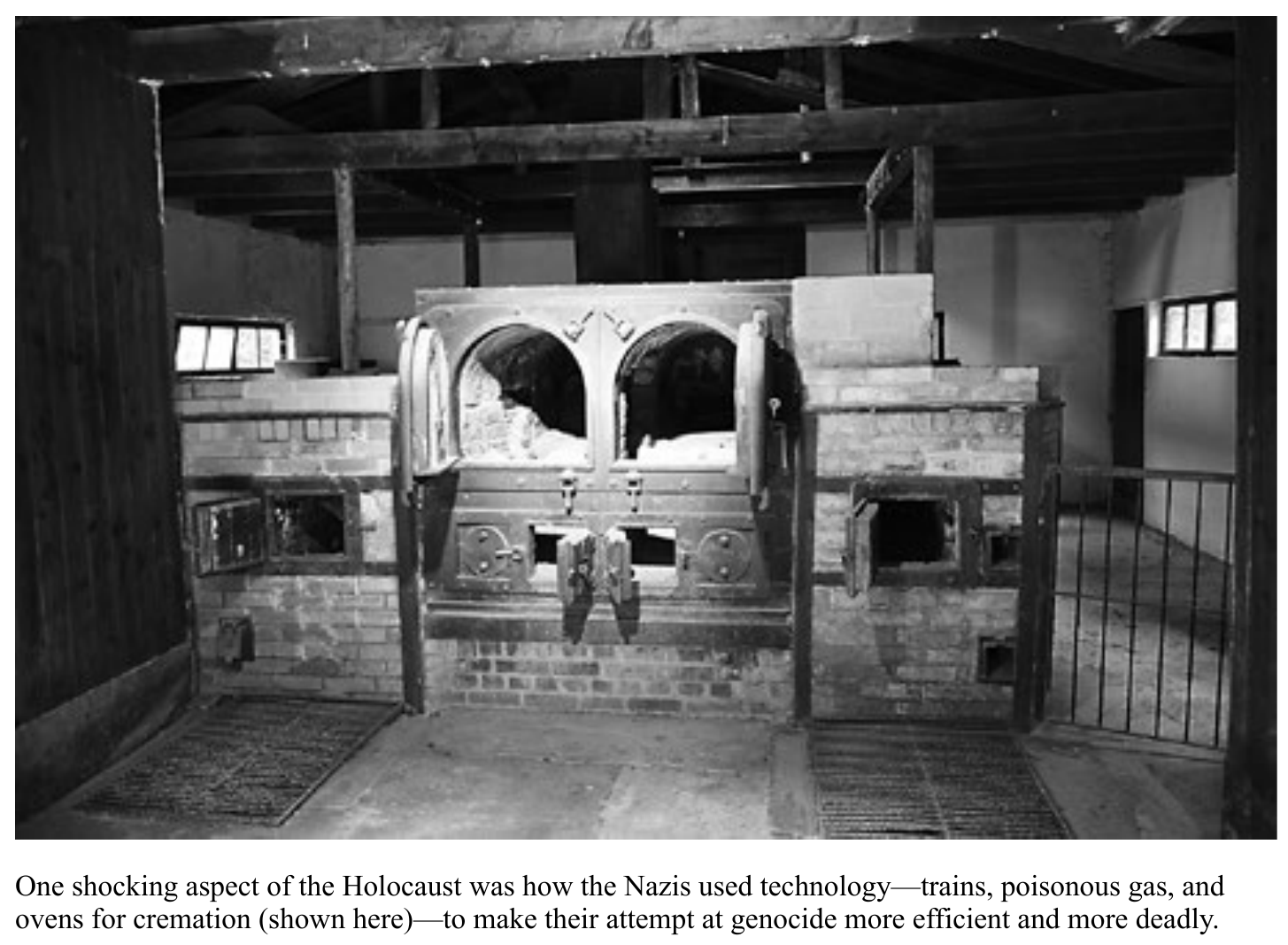
In 1942, the Nazi persecution of Jews turned into mass murder. They began a campaign led by the SS to kill all Jews in Europe, a plan they called the “Final Solution.” Initially, Nazi killing units moved from place to place, shooting Jews and burying them in mass graves. Later the SS began rounding up Jews and shipping them to death camps, where Nazis gassed them. Auschwitz and Treblinka in Poland and Dachau in Germany were some of the largest camps. By the end of the war, the Nazis had killed about six million Jews, an act of genocide known as the Holocaust. The Nazis killed another five million people who belonged to other persecuted groups or were Soviet prisoners of war. The Nazis worked many to death in labor camps and massacred others.
The Japanese During the Second Sino-Japanese War in 1937, Japanese soldiers killed at least 100,000 Chinese soldiers and civilians in what was called the Rape of Nanking. During World War II, although the Japanese did not carry out a dedicated policy of genocide that paralleled the Holocaust, millions of people died as a result of their policies. Under the program “Asia for Asiatics,” Japan forced people they had conquered into labor programs. These included service in the military, on public works projects, and on farms to reduce the food shortage in Japan. The Japanese army forced women in Korea, China, and other occupied countries to become “comfort women,” prostitutes for Japanese soldiers. Because of these harsh programs, more than a million civilians died in Vietnam alone. Perhaps an equal number of Allied prisoners of war and local workers perished while doing forced labor for Japan.
The Allies Air warfare carried out by the United States and the other Allies brought a new type of deadly combat to civilians. The Allies’ firebombing of German cities, particularly Hamburg in 1943 and Dresden in 1945, caused large casualties. The number of deaths in Hamburg was about 50,000. Dresden had fewer casualties, maybe 25,000 deaths, as 15 square miles of its historic city center were destroyed. The United States also used firebombing in Tokyo.
The final two air attacks in the war, Hiroshima and Nagasaki, produced not only high casualties, but tremendous fear about the destructiveness of a future war fought with nuclear weapons. These weapons had been developed by an international group of scientists working in the United States. The scientific achievement was impressive, but it also required developments in other areas to have military use. For example, to deliver the nuclear weapons required improvements in airplane design to allow long flights carrying heavy loads. There is a great difference between the planes used in World War II and those used in World War I. In addition, the widespread use of the aircraft carrier by several powers extended the airplanes’ reach. Using these developments in planes and ships, countries could carry out air attacks anywhere in the world.