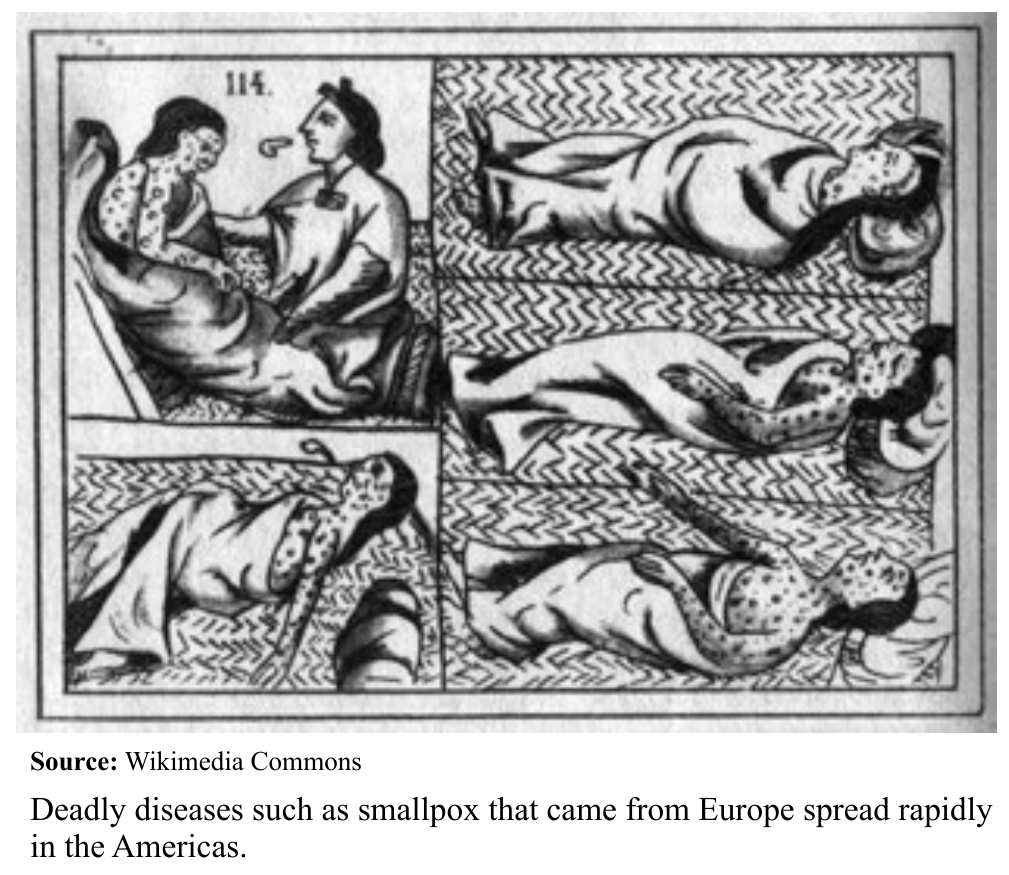
Diseases and Population Catastrophe
Until the arrival of Columbus, the peoples of the Western and Eastern Hemispheres had been almost completely isolated from each other. For that reason, the indigenous people of the Americas had no exposure—and therefore no immunity—to the germs and diseases brought by Europeans. Although European horses, gunpowder, and metal weapons helped conquer indigenous Americans, disease was responsible for the majority of deaths.
Spanish soldiers, called conquistadores, such as Francisco Pizarro and Hernán Cortés, brought smallpox with them. Smallpox pathogens are spread through the respiratory system. When Europeans, who were largely immune after millennia of exposure in Afro-Eurasia, had face-to-face contact with indigenous populations, they infected these populations with the deadly disease.
As colonists began to settle in the Americas, so did insects, rats, and other disease-carrying animals. Measles, influenza, and malaria, in addition to smallpox, also killed many native peoples of the Americas.
The indigenous population of the Americas fell by more than 50 percent through disease alone in less than a century. Some American lands lost up to 90 percent of their original populations. It was one of the greatest population disasters in human history.