UNIT 4: Transoceanic Interconnections from c. 1450 to c. 1750
Context
Understand the Context
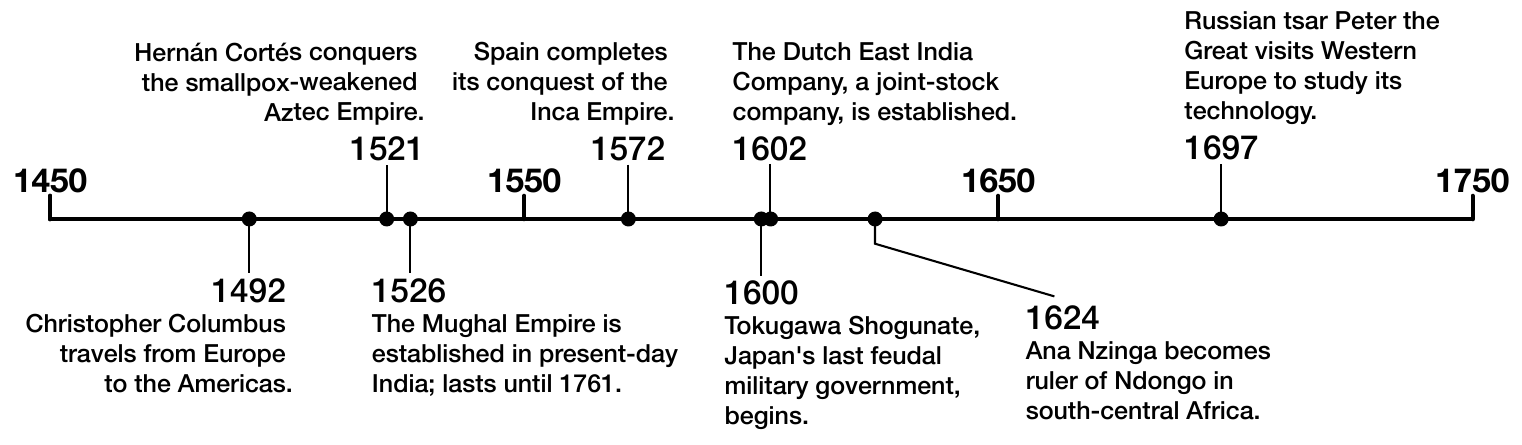
The voyage by Christopher Columbus in 1492 that connected the Eastern and Western hemispheres led to the first global trade networks. They provided the framework for historical events for the following centuries.
Establishment of Maritime Empires Between 1450 and 1750, European states, starting with the Portuguese and Spanish, sought a transoceanic route to Asia. Europeans established trading post empires in the Indian Ocean that inadvertently brought them into contact with the Americas.
Global Exchanges Trans-Atlantic trade linked the Americas, Europe, and Africa for the first time. European colonists who wanted sugar and other crops to sell in the global market developed plantations in the Americas. Their desire for laborers fueled the trade in enslaved Africans. Trans-Pacific trade flourished as well. Silver mined in Latin America was the major commodity.
Over time, the transfer of crops, animals, and disease between the Eastern and Western hemispheres, known as the Columbian Exchange, altered life everywhere. The introduction of potatoes, corn, and tomatoes to Europe led to population growth. The introduction of deadly pathogens, such as small pox and measles, devastated the populations of the Americas.
Change and Continuity Within the context of increasing European influence, regional commerce and established states in Afro-Eurasia continued to flourish. The Mughal, Ottoman, and Qing Empires expanded, creating ethnically diverse states. Across the globe, peasant and artisan labor intensified as the demand for goods and food increased. These developments set the stage for the revolutions that defined the period after 1750.
Topics
Technological Innovations
2 Sections
Exploration: Causes and Events
3 Sections
Columbian Exchange
5 Sections
Maritime Empires Link Regions
3 Sections
Maritime Empires Develop
4 Sections
Internal and External Challenges to State Power
5 Sections
Changing Social Hierarchies
5 Sections
Continuity and Change from c. 1450 to c. 1750
4 Sections
Historical Perspectives: HISTORICAL PERSPECTIVES: HOW HARSH WERE THE SPANISH?
Read more →
Write As Historian: WRITE AS A HISTORIAN: GATHER AND ORGANIZE EvIDENCE
Read more →
AP Exam Practice
Start Practice →