Economic Imperialism in Africa
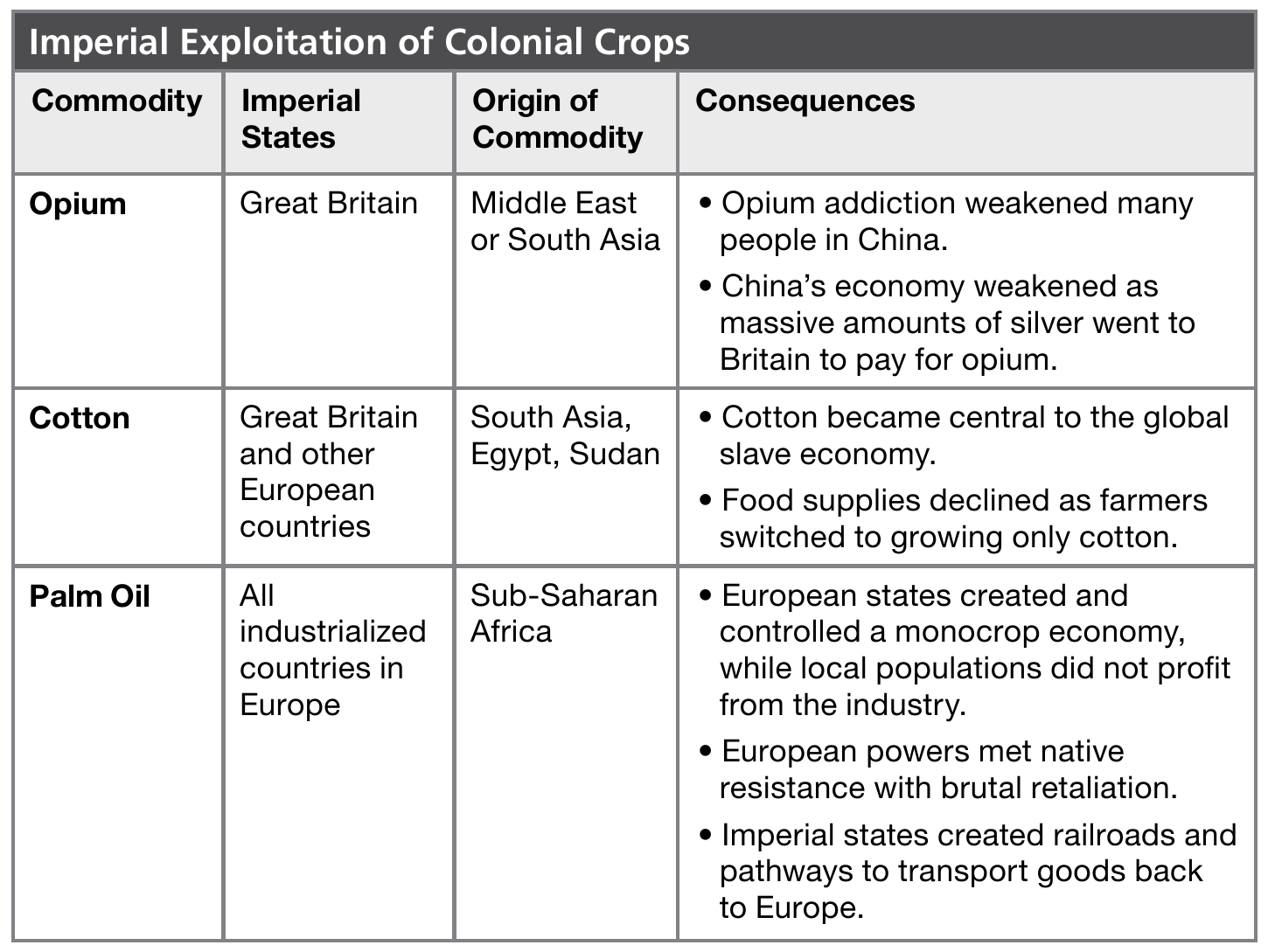
Before colonization, most farming in Africa was to raise food crops. After colonization, land that had been devoted to growing food was converted to cash crop production to provide raw materials for European industries and goods for European markets. In exchange, the Africans received cotton textiles, canned food, and alcoholic beverages. This unequal trade structure made the colonies economically dependent on the imperial powers.
Reliance on a single cash crop, one grown to be sold, in a country or region left many Africans vulnerable during periods of drought, economic decline, or falling world prices. Food production declined as farmers chose to plant cash crops such as cotton, which would increase the value of their land. Food shortages, even famines, could arise because the most arable land was devoted to growing crops for export.
Egypt had embraced cotton as a cash crop before the American Civil War and more than doubled production between 1861 and 1863. By the end of the century, cotton accounted for 93 percent of Egypt’s exports. It was also the leading cash crop in Sudan, where the Plantation Syndicate, a group of British weaving companies, dictated land use to farmers. When the British colonized Uganda, they encouraged cotton as a cash crop there as well, and it soon replaced enslaved people and ivory as the chief export.
In Kenya, most native peoples were herders. Groups like the Kikuyu were moved to reserves with poor soil and bad climates. In the fertile Rift Valley, the colonial government gave the land to white settlers, forcing most Africans to relocate. Those who remained were forced to provide cheap labor for white farmers. African farmers were also forbidden to participate in export of any cash crops, and prohibited from growing some cash crops, such as coffee and tea.
After missionaries introduced it to the area in the 1880s, cocoa became the major cash crop on the Gold Coast. This region soon became the largest cocoa producer in the world. Cocoa was also an important cash crop in the Ivory Coast, Nigeria, and the Portuguese colonies of São Tomé and Angola.
Palm oil, palm kernels, and peanuts (also called groundnuts) were already major exports from West Africa before colonization. It was a valuable raw material because it was used as a lubricant for the machines of the industrial revolution in Europe.
Slavery in Africa Slavery was outlawed in British colonies in 1833, but it persisted elsewhere in Africa. The French army often used enslaved people as payment for its African soldiers, and French colonial administrators relied on enslaved people for many of their staff. It was not until 1912 that slave raiding and trading was suppressed in most of Africa. Slavery was not abolished by law throughout Africa until the first quarter of the 20th century.
Slave labor was used to produce many of the cash crops, especially oil palms (which produced palm kernels as well as palm oil), coffee, and cocoa. Some companies felt a moral responsibility to oppose the use of enslaved people in the production of the raw materials they used. For example, cash crop production in French-ruled colonies in Africa came about as a result of the end of the slave trade in the French Empire in 1848, along with the economic transformations brought about in France by the Industrial Revolution. Quaker- owned Cadbury’s, for example, stopped buying slave-grown cocoa from Portuguese African colonies in 1908 after the slave trade was exposed.