Civilizations of Western Eurasia and Christianity
In western Eurasia between 600 B.C.E. and 600 C.E., strong civilizations developed in Persia, Greece, and Rome. Trade, war, and the flow of ideas connected these civilizations to one another. Each civilization prospered through a combination of trade and military strength.
Persia Around 559 B.C.E., a large empire developed in Persia (modern- day Iran) under the leadership of Cyrus the Great. The Persian Empire included most of the lands from the Aegean Sea in the west to the border of India in the east. The empire also became known as the Achaemenid Empire.
With a strong centralized government, efficient bureaucracy, and network of roads, the Persian empire promoted trade, prosperity, and stability. The vast empire was ethnically and religiously diverse, which the government recognized by practicing religious toleration.
Greece While Persia was a vast but united empire, Greece was divided into approximately 1,000 city-states. The numerous islands and mountainous terrain made unifying the Grecian region under one leader very difficult.
One cultural trait shared by Greeks was religion. Unlike the monotheistic Hebrews who worshipped a single all-powerful God, the Greeks believed in many deities and each possessed human frailties. These frailties help explain why Greeks developed a feeling that they controlled their own destiny.
Two of the largest city-states, Athens and Sparta, reflected the great variety among Greece’s many city-states.
• Spartans organized their society around a powerful military. Women, the elderly, and enslaved people all filled roles that allowed free men to train as soldiers and fight when needed.
• Athenians made impressive advances in architecture, literature, theater, and philosophy. Many of these came during its Golden Age in the late 400s B.C.E. Athens also developed the concept of democracy, a system of government in which a large part of the population runs the government. Athens allowed free adult males the ability to participate directly in making political decisions.
In the 300s B.C.E., the army of Alexander the Great spread Greek culture into Egypt, across Persia, and east to India. This region became known as the Hellenistic world.
Rome According to legend, Rome was founded in 753 B.C.E. Roman culture borrowed heavily from the Greeks. The Romans incorporated the Greek gods into their pantheon of deities, relied on slavery, and made advances in government that continue to have lasting influence on governments today. Romans developed the practice of a representative government and of the judicial concept “innocent until proven guilty.” To protect individual rights, the Romans publicly displayed written laws known as the Twelve Tables. Spreading awareness of laws provided a check on abuses of government power, a concept that would be built into numerous constitutions in the future.
Like Greece, Rome had a patriarchal society. However, compared to Greek women, Roman women gained more rights, including the right to own and inherit property and the right to initiate divorce proceedings.
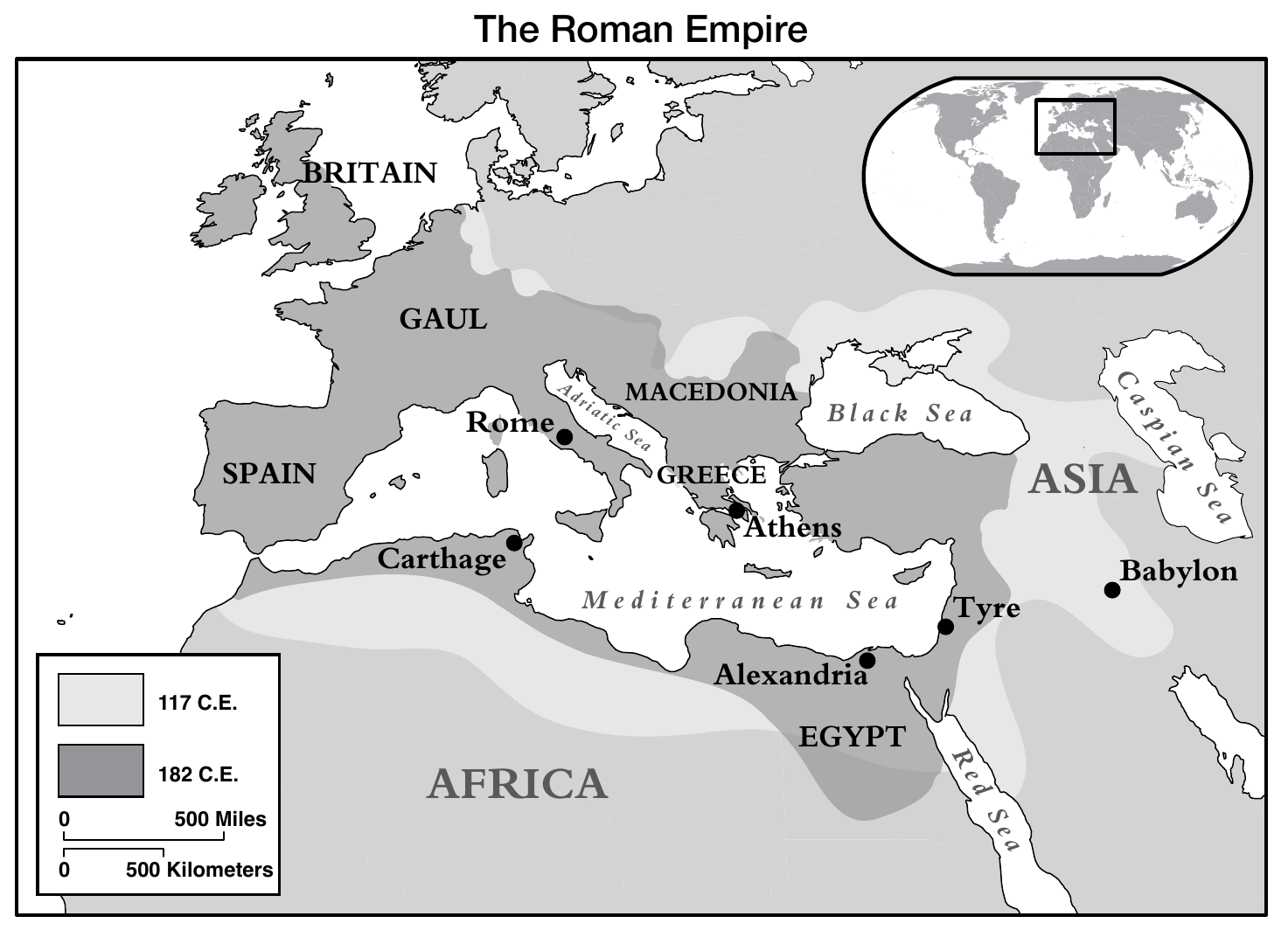
While the Greek city-states remained small, Rome expanded outward in all directions, turning the Mediterranean Sea into “a Roman lake.” At the peak of its power, the Roman Empire ruled territory from Scotland to northern Africa to the Middle East. In the large size of its territory, Rome was more like Persia. Both Rome and Persia were land-based empires under a strong central government. Both fostered trade and prosperity with well-maintained roads and strong militaries to protect travelers. Rome was also famous for other publicly funded projects, such as aqueducts, which were systems to transport water to cities, and large stadiums for public entertainment.
Despite Rome’s wealth and power, it faced many challenges. Roman leaders over-extended the Roman military, were often corrupt, and failed to deal with devastating epidemics caused by smallpox and the bubonic plague. Gradually, trade and urban populations declined. As a result, Roman lands suffered economically. Rome’s decline was made worse by invasions from groups such as the Huns, Ostrogoths, Visigoths, and Vandals. By 476 C.E., the empire was so weak that a non-Roman became emperor for the first time in more than a thousand years.
The Development of Christianity Rome’s most enduring legacy was not in its military or its engineering achievements. It was in religion. Rome generally tolerated all faiths as long as subjects agreed to accept the divine nature of the emperor. People with polytheistic beliefs could do this easily.
However, monotheists could not. In particular, Jews living the Middle East refused to recognize any deity but their own. Roman persecution of Jews living in the Middle East contributed to the diaspora, or spreading, of Jews to lands throughout northern Africa and Europe as they looked for places to worship freely.
One leader who emerged from the Jewish community was Jesus. For his teachings, he was executed by the Romans. Since the followers of his teachings considered him the Christ, or savior of humanity sent by God, they became known as Christians. Despite persecution by the Romans, Jesus’s disciples continued to spread his teachings. By the end of the 1st century C.E., Christians were practicing their faith throughout the empire.
This new faith was particularly attractive to the poor because it taught that people could have a better life after death if they believed in Jesus. Despite continued persecution, Christianity grew stronger. In the 4th century, under the emperor Constantine, Christianity became legal and was accepted as the official religion of the empire.
Constantine’s endorsement of Christianity accelerated its growth. Like Buddhism, Christianity was a universalizing religion, meaning it actively sought converts and it was easily adaptable to areas outside its place of origin. It also offered monastic lifestyles for men (monks) and women (nuns) to devote their lives to practicing the faith. This new monotheistic faith would have far-reaching impact on future civilizations.
Byzantine By the middle of the 4th century, the eastern half of the Roman Empire had become wealthier and politically more powerful than the western half. For this reason, in 330, Emperor Constantine moved the capital of the empire eastward to Byzantium and renamed the city Constantinople (Istanbul today). In 395, the Roman Empire was divided into two distinct entities. Rome became the capital in the west, and Constantinople became the capital in the east.
Constantinople quickly became a political and economic hub. Geography aided its rise to prominence as rivers from the north flowed into the nearby Mediterranean and Black seas. As an entrepôt, or coastal trading center, Constantinople prospered as raw goods arrived from northern Europe, cereals came from Egypt, and precious spices and finished products came from the east.
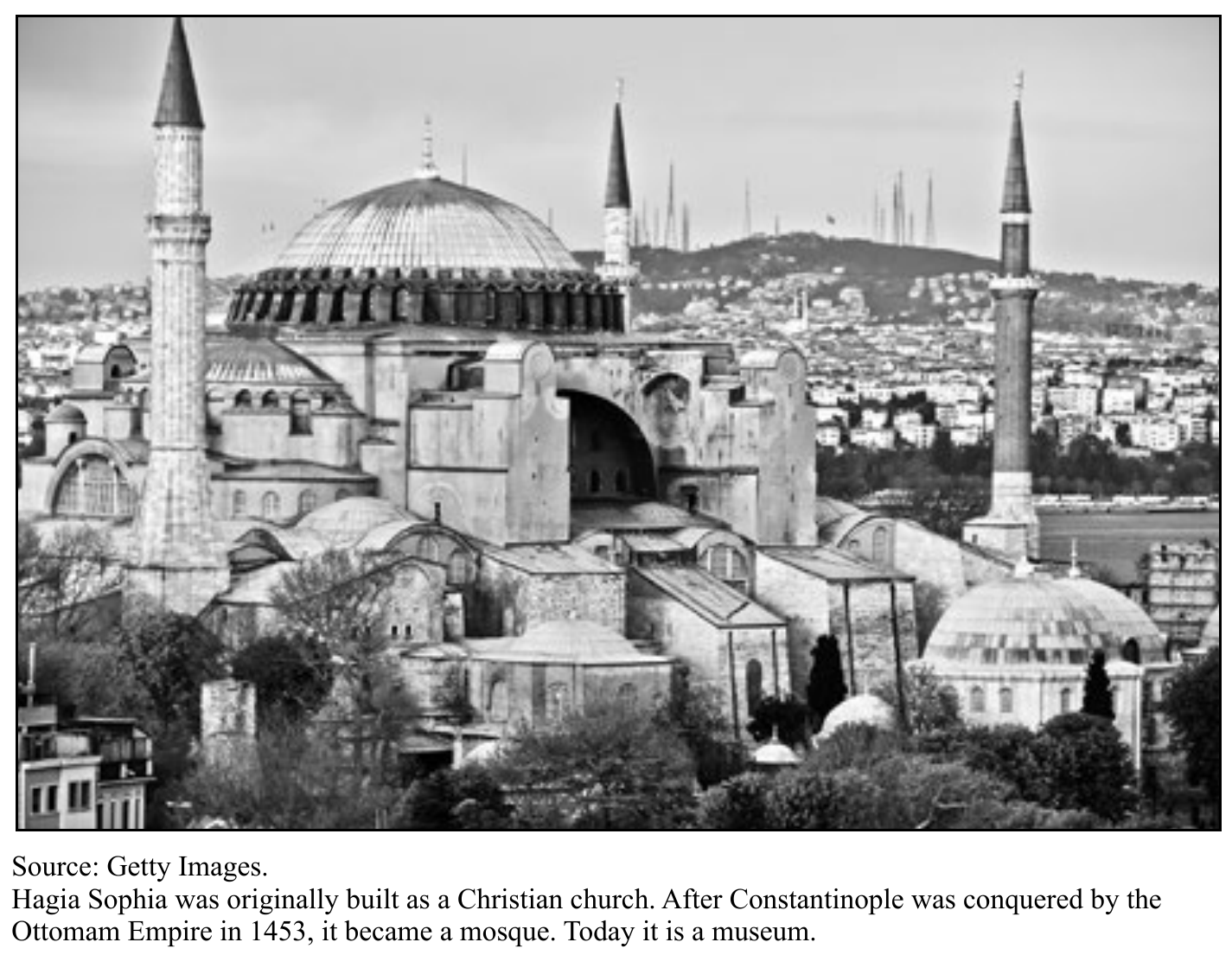
At its height, the Byzantine Empire extended throughout the eastern half of the Mediterranean world. The reign of Justinian the Great (527–565) included great accomplishments. One was the construction of a magnificent church called Hagia Sophia (537). Another was the creation of the Justinian Code. This consolidation of Roman law would serve as the foundation of legal knowledge in Europe into the 19th century. Though constantly threatened by foreign incursion, the Byzantine Empire would survive for another 900 years.