Economic Continuities: Shifting Manufacturing
As the knowledge economy develops in some regions, industrial production and manufacturing in those regions, including in the United States, have declined. Manufacturing plants are increasingly located in Asia and Latin America rather than the United States and Europe. Countries in both Asia and Latin America have become known for their contributions to the textile and apparel industries, though they manufacture many other products. So while it has moved to different regions, manufacturing continues to play a key role in the global economy.
Vietnam and Bangladesh Importers who once purchased
their manufactured goods from China have been finding other options in such Asian countries as Vietnam and Bangladesh, where labor costs tend to be significantly lower than in China (where they are already significantly lower than in the United States and Europe). Both Vietnam and Bangladesh have become known for their exports of clothing. In compounds the size of small villages in some places, garment manufacturers—often funded by foreign investors— churn out the clothes that end up on hangers in stores in developed countries. Clothing accounts for 80 percent of exports from Bangladesh. Phones are the largest export from Vietnam, worth about $45 billion in 2017, with apparel and electronic goods each bringing in $25.9 billion.
Workers in both Vietnam and Bangladesh have mounted strikes in recent years, protesting both low wages and poor working conditions. Their pay has increased slightly as a result, but not enough to keep up with rising costs of living.
Manufacturing in Mexico and Honduras In 1994, the United States, Canada, and Mexico negotiated NAFTA, the North American Free Trade Agreement. This agreement encouraged U.S. and Canadian industries to build maquiladoras (factories) in Mexico that used low-wage Mexican labor to produce tariff-free goods for foreign export. Many factories hired large numbers of young women and exposed them to harsh working conditions.
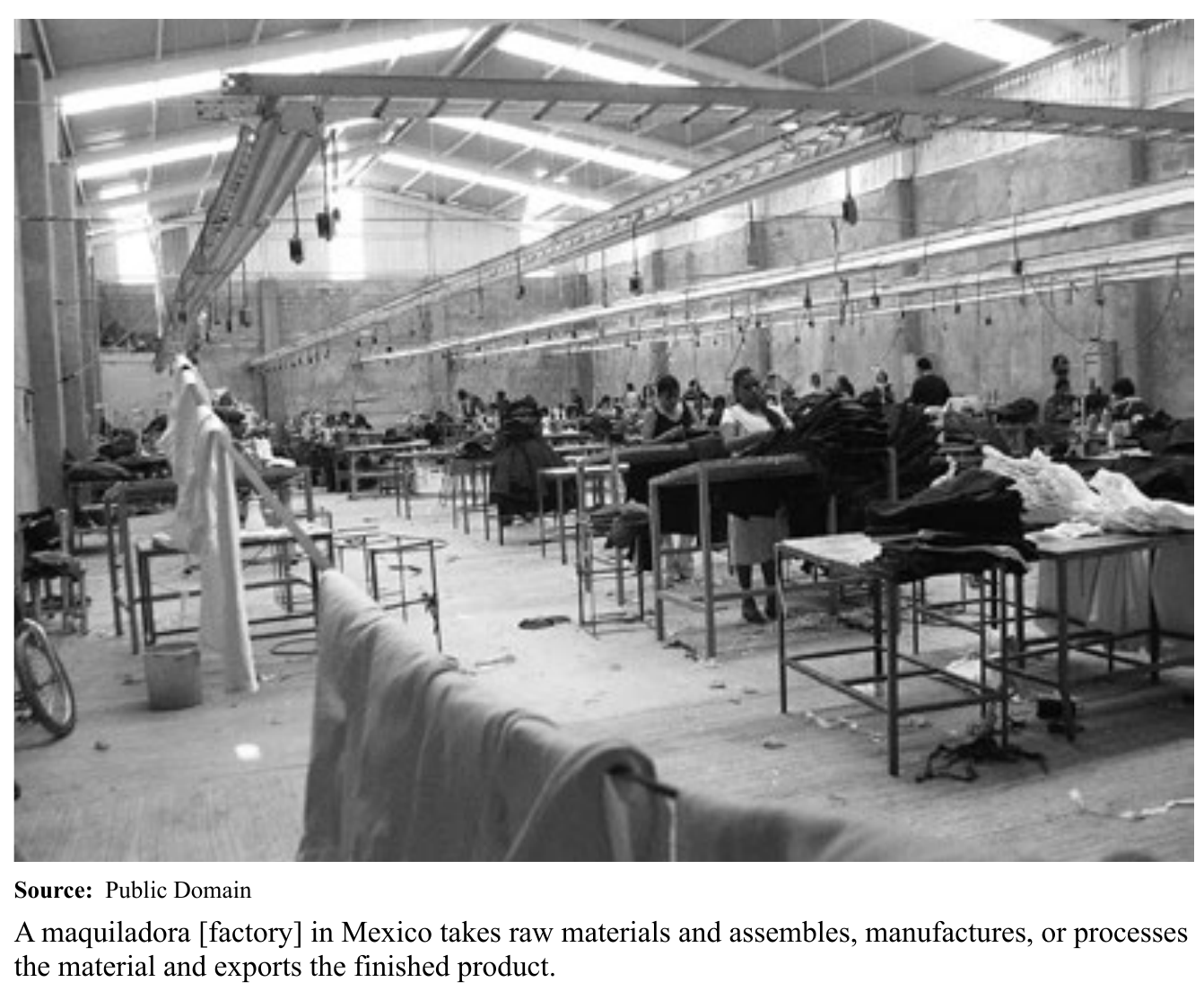
Labor unions in the United States complained that NAFTA led to the export of thousands of U.S. jobs to Mexico, where wages and benefits were lower and safety and environmental standards were weaker.
Honduras in Central America, the second largest exporter of textiles in the Americas, has sought to upgrade its manufacturing using principles of sustainability—recycling or treating its waste materials—and fair labor practices, including housing and education plans for workers, through business- government partnerships. As in Vietnam and Bangladesh, considerable business investment comes from enterprises in South Korea and Taiwan.