Decline of the Gunpowder Empires
The Ottoman, Safavid, and Mughal Empires declined as Western Europe grew in strength economically and militarily—particularly in terms of sea power. Unlike these three Islamic empires, Russia modernized and reorganized its army, modeling it after the armies of England, France, and the Netherlands. The Islamic empires did not modernize and, as a result, Russia remained powerful enough to survive as an independent nation-state, while the other Gunpowder Empires fell.
Decline of the Ottoman Empire In 1571, after Suleiman’s death, a European force made up mostly of Spaniards and Venetians defeated the Ottomans in a great naval conflict known as the Battle of Lepanto. After the reign of Suleiman, the Ottomans fell victim to weak sultans and strong European neighbors. In time, the empire became known as the Sick Man of Europe. Successors to Suleiman were often held hostage to “harem politics,” the efforts of wives and concubines of the sultan to promote their own children
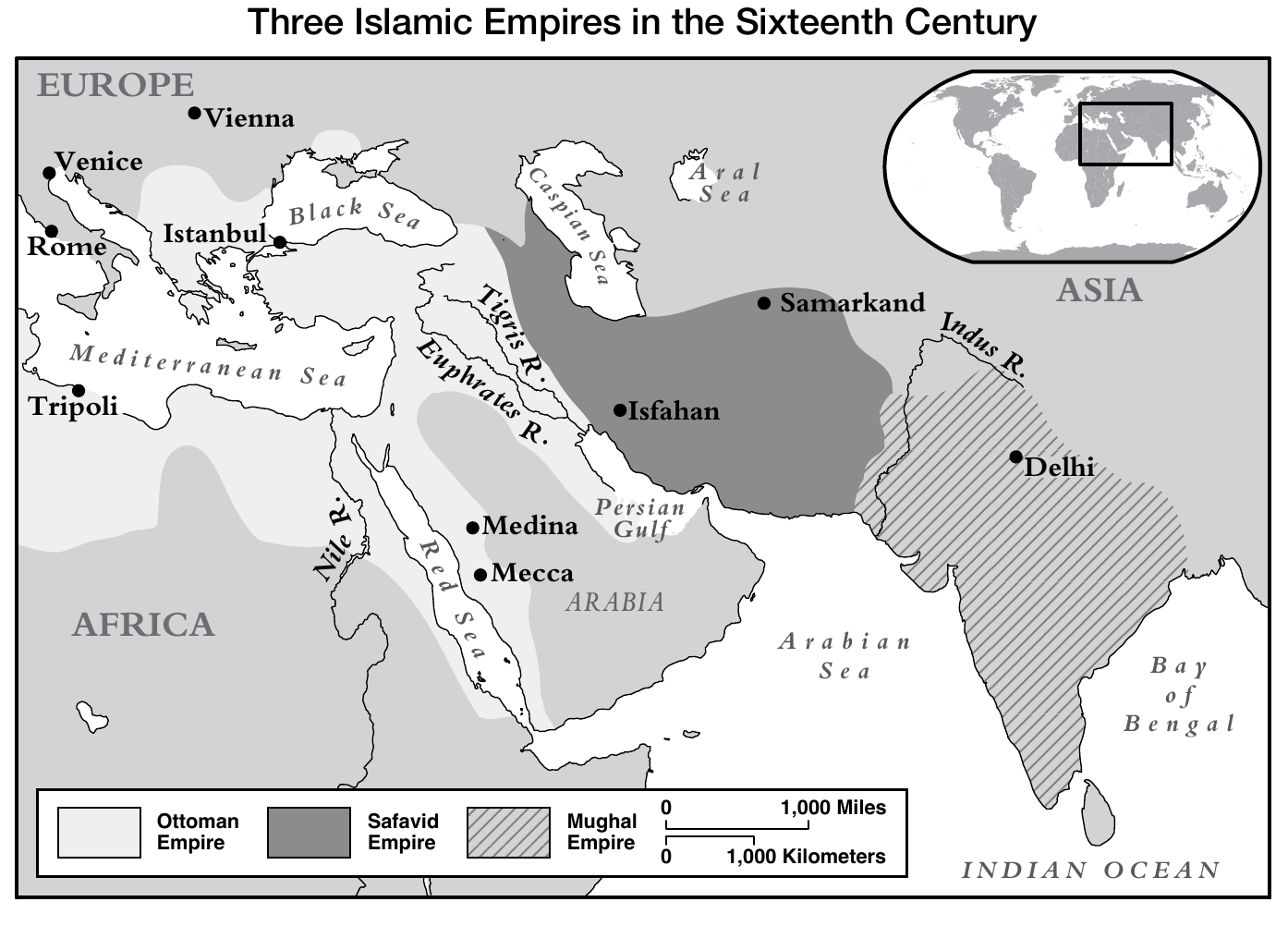
as likely heirs to the throne. In this way, some women became powerful behind the scenes. The failed Siege of Vienna in 1683 marked a turning point in Ottoman domination in Eastern Europe. British and French involvement in the Ottoman territories, Greece’s independence in 1821, and the Russian expansion in the 19th century further weakened the Ottoman Empire.
Safavid Decline The ineffectual leaders who followed Shah Abbas combined lavish lifestyles and military spending with falling revenues, resulting in a weakened economy. In 1722, Safavid forces were not able to quell a rebellion by the heavily oppressed Sunni Pashtuns in present-day Afghanistan. The Afghan forces went on to sack Isfahan, and their leader, Mahmud, declared himself Shah of Persia. While the Safavid Dynasty remained nominally in control, the resulting chaos was an impediment to centralization and tax collection. Taking advantage of the weakened Safavids, the Ottomans and the Russians were able to seize territories. The Safavid Dynasty declined rapidly until it was replaced by the Zand Dynasty in 1760.
Mughal Decline Shah Jahan’s son and successor, Aurangzeb (ruled 1658– 1707), inherited an empire weakened by corruption and the failure to keep up with the military innovations of external enemies. Nevertheless, Aurangzeb hoped to increase the size of the empire and bring all of India under Muslim rule. Additionally, he wanted to rid the empire of its Hindu influences.
In expanding the empire to the south, he drained the empire’s treasury and was unable to put down peasant uprisings. Some of these uprisings were sparked by Aurangzeb’s insistence on an austere and pious Islamic lifestyle and an intolerance of minority religions—Sikhs, Hindus, and others. His policies led to frequent conflicts and rebellions.
There were revolts as well among the Hindu and Islamic princes. The empire grew increasingly unstable after his death, which allowed the British and French to gain more and more economic power in India. The British would take political power away from the Mughals in the 19th century.