The Aztecs
The Aztecs, also known as the Mexicas, were originally hunter-gatherers who migrated to central Mexico from the north in the 1200s. In 1325, they founded their capital Tenochtitlán on the site of what is now Mexico City. Over the next 100 years, they conquered the surrounding peoples and created an empire that stretched from the Gulf of Mexico to the Pacific Ocean.
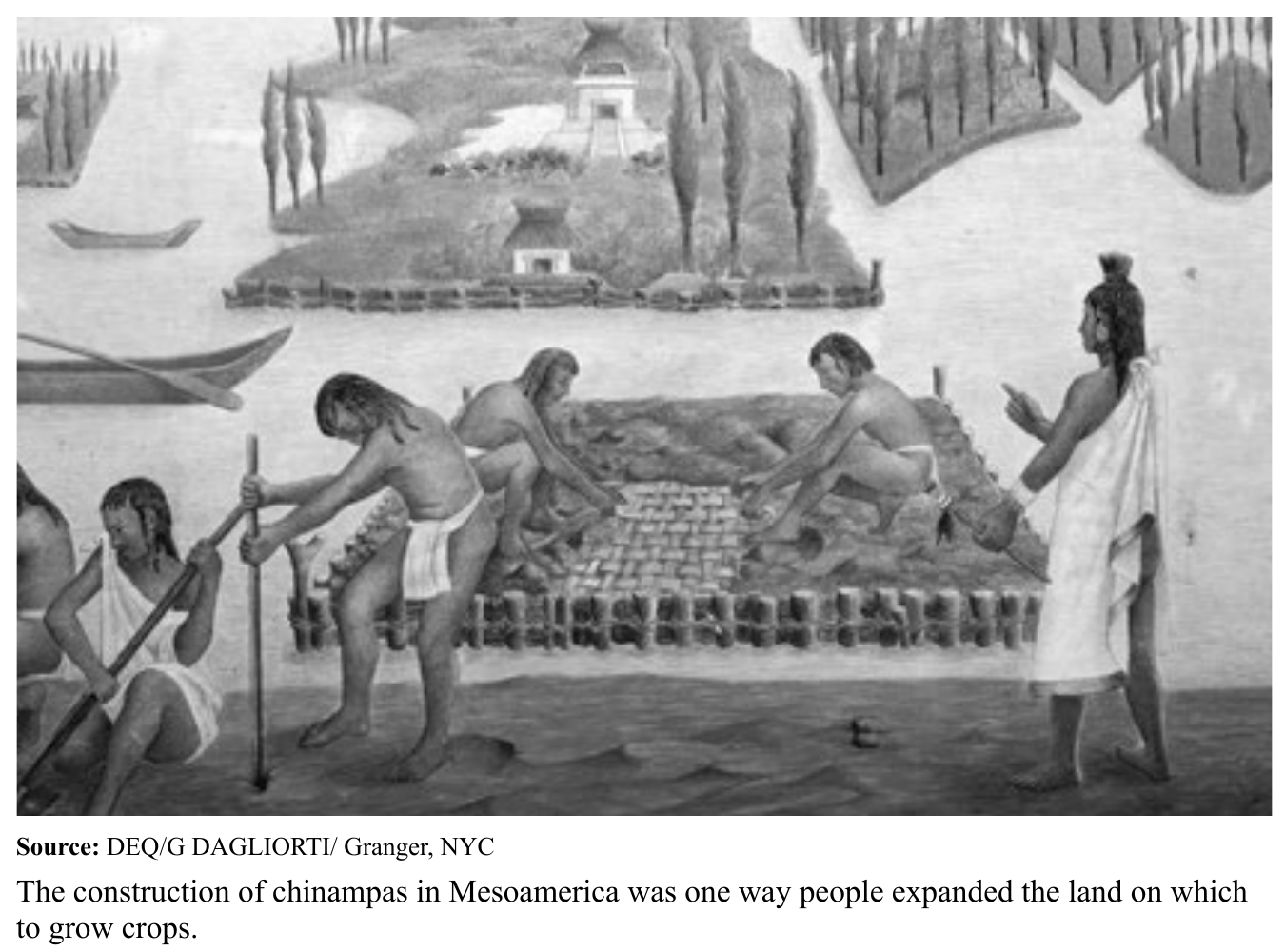
Capital City The Aztecs located Tenochtitlán on an island in the middle of a swampy lake in order to protect it from attacks. Tenochtitlán grew to almost 200,000 people, making it one of the largest cities in the world. To provide water for the city, they built a network of aqueducts. At the center of the city, the Aztecs built a pyramid that rose 150 feet into the air. This Great Pyramid and other pyramids, temples, and palaces were made of stone. On Lake Texcoco, the Aztecs built floating gardens called chinampas to increase the amount of space for food production. The Aztecs dug ditches to use lake water to irrigate their fields and to drain parts of the lake for more land.
Government, Economy, and Society As the Aztecs conquered much of Mesoamerica, they developed a tribute system that insured their dominance. Conquered people were forced to pay tribute, surrender lands, and perform military service. Tribute included practical goods such as food, cloth, and firewood, as well as luxury items such as feathers, beads, and jewelry. The Aztecs allowed local rulers to stay in their positions to serve as tribute collectors. This allowed Aztec political dominance without direct administrative control. In exchange, the conquered people were extended Aztec protection.
To administer the empire, the Aztecs grouped city-states into provinces. They moved warriors and their families to each province’s capital to make sure the province remained under Aztec control. In addition, an Aztec official was stationed in each capital to collect tribute from local officials.
Aztec government was a theocracy, which is rule by religious leaders. At the top was the emperor, known as the Great Speaker, who was the political ruler as well as a divine representative of the gods. Next in the social hierarchy were land-owning nobles, who also formed the majority of Aztec military leadership. Next in rank were scribes and healers, followed by craftspeople and traders. A special merchant class called pochteca traded in luxury goods. Below the traders were the peasants and soldiers. Aztec people could be enslaved as well, usually because they did not pay their debts or were being punished for crimes. Besides being used for labor, enslaved people were also offered up as sacrifices in religious ceremonies.
Religion The intricate and complex religion of the Aztecs was central to their society. They worshipped an ever-evolving pantheon of hundreds of deities, many of whom were considered to have both male and female aspects. Worship among the Aztecs involved a great many rituals and feast days as well as human sacrifices. The Aztecs believed that the gods had sacrificed themselves in order to create the world—thus human sacrifice and blood- letting was a sort of repayment and atonement for human sin. Human sacrifice probably had a political component, in the sense that it demonstrated the great might of the Aztec Empire in dramatic fashion. The number of human sacrifices may never be known. Much of the information about Aztec society comes from Spanish invaders, who may have exaggerated the extent of human sacrifice in order to make the Aztecs seem more deserving of conquest.
Role of Women Women played an important role in the Aztec tribute system since they wove the valuable cloth that local rulers demanded as part of the regular tribute. As the demand for cloth tribute increased, an Aztec husband might obtain more than one wife in order to be able to pay the tribute. While most Aztec women worked in their homes, some became priestesses, midwives, healers, or merchants. A few noblewomen worked as scribes to female members of royal families. Therefore, at least these few women knew how to read and write.
The Decline of the Aztecs By the late 15th century, the Aztec Empire was in decline. The Aztecs’ comparatively low level of technology—such as the lack of wheeled vehicles and pack animals—meant that agriculture was arduous and inefficient. The Aztecs’ commitment to military victory and the constant desire for more human sacrifices induced the leadership to expand the empire beyond what it could reasonably govern. Finally, the extraction from conquered people of tribute and sacrifice victims inspired more resentment than loyalty. Because of this resentment, many tribes ruled by the Aztecs were ready to rebel if they thought they had an opportunity to succeed. This opportunity would come later, when Spaniards arrived in 1519.