Unit 8 AP Exam Practice
Document-Based Questions
1. Develop an argument that evaluates the extent to which decolonization had an impact on the political actions of former colonial powers and newly independent nations during the Cold War.
Document 1
Document 1
Source: President of Indonesia, Sukarno, in a Speech at the Opening of the Bandung Conference, April 18, 1955.
Perhaps now more than at any other moment in the history of the world, society, government, and statesmanship need to be based upon the highest code of morality and ethics. And in political terms, what is the highest code of morality? It is the subordination [placing in a lower rank] of everything to the well-being of mankind. But today we are faced with a situation where the well-being of mankind is not always the primary consideration. Many who are in places of high power think, rather, of controlling the world. Yes, we are living in a world of fear. The life of man today is corroded [destroyed or weakened gradually] and made bitter by fear. Fear of the future, fear of the hydrogen bomb, fear of ideologies. Perhaps this fear is a greater danger than the danger itself, because it is fear which drives men to act foolishly, to act thoughtlessly, to act dangerously . . .
All of us, I am certain, are united by more important things than those which superficially divide us. We are united, for instance, by a common detestation of colonialism in whatever form it appears. We are united by a common detestation of racialism. And we are united by a common determination to preserve and stabilize peace in the world.
Document 2
Document 2
Source: Prime Minister of India, Jawaharlal Nehru, in a Speech to the Bandung Conference Political Committee, 1955.
My country has made mistakes. Every country makes mistakes. I have no doubt we will make mistakes; we will stumble and fall and get up. The mistakes of my country and perhaps the mistakes of other countries here do not make a difference; but the mistakes the Great Powers make do make a difference to the world and may well bring about a terrible catastrophe. I speak with the greatest respect of these Great Powers because they are not only great in military might but in development, in culture, in civilization. But I do submit that greatness sometimes brings quite false values, false standards. When they begin to think in terms of military strength—whether it be the United Kingdom, the Soviet Union or the U.S.A.—then they are going away from the right track and the result of that will be that the overwhelming might of one country will conquer the world . . . If I join any of these big groups I lose my identity . . . If all the world were to be divided up between these two big blocs what would be the result? The inevitable result would be war.
Document 3
Document 3
Source: The Eisenhower Doctrine on the Middle East, presented by President Dwight D. Eisenhower of the United States, before a joint session of Congress on January 5, 1957.
The Middle East has abruptly reached a new and critical stage in its long and important history. In past decades, many of the countries in that area were not fully self-governing. Other nations exercised considerable authority in the area and the security of the region was largely built around their power. But since the First World War there has been a steady evolution toward self-government and independence. This development the United States has welcomed and has encouraged. Our country supports without reservation the full sovereignty [supreme power or authority] and independence of each and every nation of the Middle East. The evolution to independence has in the main been a peaceful process. But the area has been often troubled . . . All this instability has been heightened and, at times, manipulated by International Communism. Russia’s rulers have long sought to dominate the Middle East . . . The Soviet Union has nothing whatsoever to fear from the United States in the Middle East, or anywhere else in the world, so long as its rulers do not themselves first resort to aggression. That statement I make solemnly and emphatically.
Document 4
Document 4
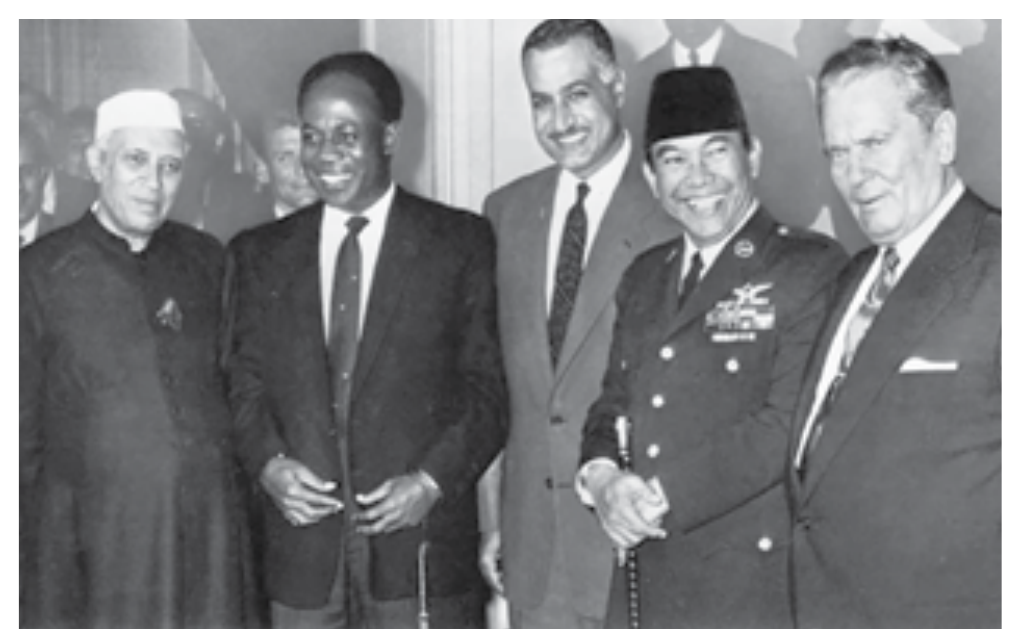
Source: Meeting of Leaders of the Five Key Neutralist (non-aligned) Nations at the Headquarters of the Yugoslav Delegation to the United Nations. From left to right: Indian Prime Minister Nehru, President Kwame Nkrumah of Ghana, President Nasser of the United Arab Republic (Egypt), President Sukarno of Indonesia, and President Tito of Yugoslavia. Associated Press, September 30, 1960.
Document 5
Document 5
Source: Office of the Historian, Bureau of Public Affairs, United States Department of State, Decolonization of Asia and Africa, 1945–1960.
As the Cold War competition with the Soviet Union came to dominate U.S. foreign policy concerns in the late 1940s and 1950s, the Truman and Eisenhower Administrations grew increasingly concerned that as the European powers lost their colonies or granted them independence, Soviet-supported communist parties might achieve power in the new states. This might serve to shift the international balance of power in favor of the Soviet Union and remove access to economic resources from U.S. allies. Events such as the Indonesian struggle for independence from the Netherlands (1945–50), the Vietnamese war against France (1945–54), and the nationalist and professed socialist takeovers of Egypt (1952) and Iran (1951) served to reinforce such fears, even if new governments did not directly link themselves to the Soviet Union. Thus, the United States used aid packages, technical assistance, and sometimes even military intervention to encourage newly independent nations in the Third World to adopt governments that aligned with the West. The Soviet Union deployed similar tactics in an effort to encourage new nations to join the communist bloc. . . . Many of the new nations resisted the pressure to be drawn into the Cold War, joined in the “non-aligned movement.”
Document 6
Document 6
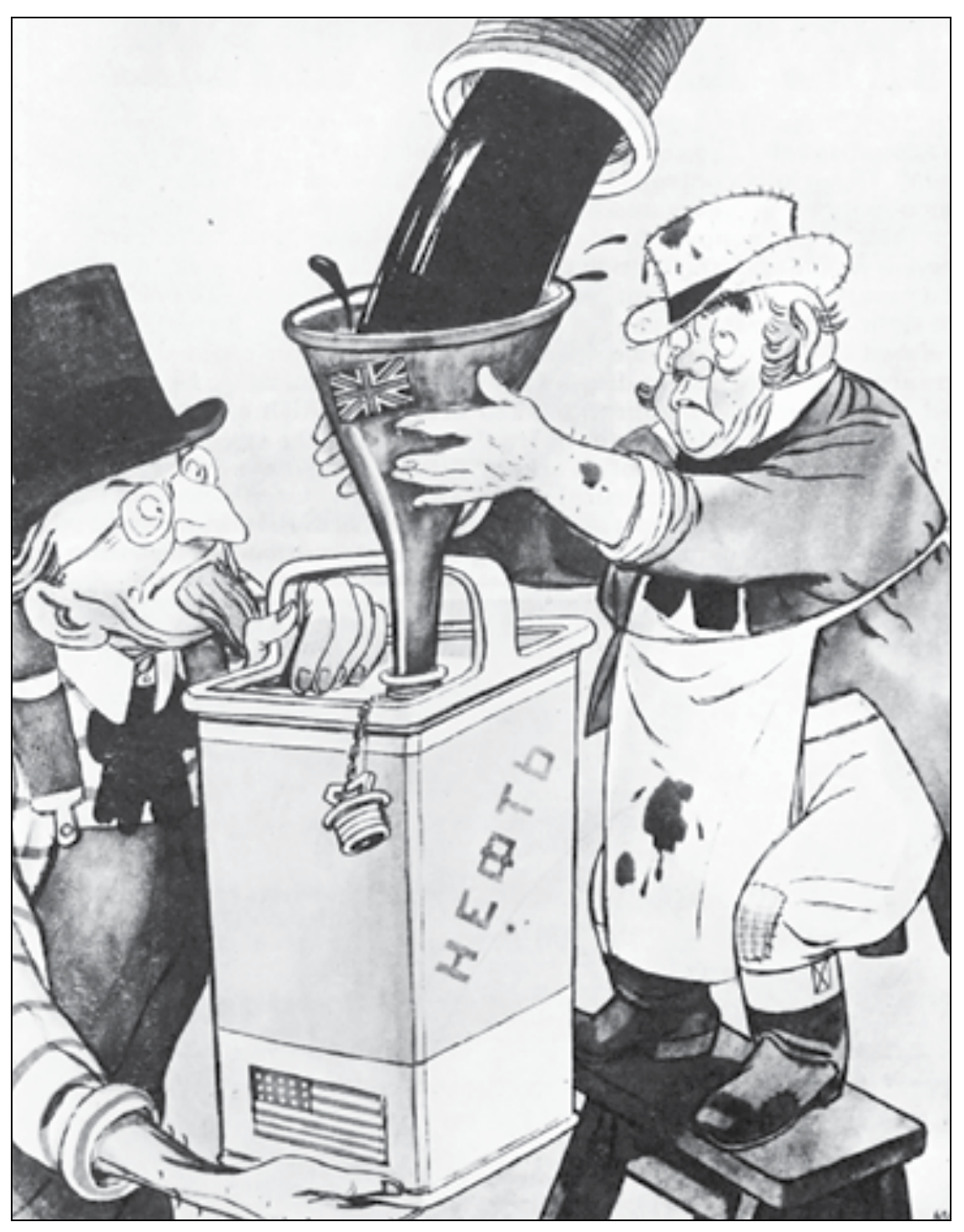
Source: A Soviet cartoon from 1953 shows John Bull (a cartoon personification of England) helping himself to Arab oil on behalf of the British Empire’s new master, Uncle Sam (a cartoon personification of the United States).
Document 7
Document 7
Source: Resolution on Imperialism and Colonialism created by the All- African People’s Conference held in Accra, Ghana, December 5-13, 1958.
Whereas the great bulk of the African continent has been carved out arbitrarily to the detriment of the indigenous African peoples by European Imperialists, namely: Britain, France, Belgium, Spain, Italy, and Portugal . . . Whereas all African peoples everywhere strongly deplore [express strong disapproval of] the economic exploitation of African peoples by imperialist countries thus reducing Africans to poverty in the midst of plenty . . . Whereas imperialists are now coordinating their activities by forming military and economic pacts such as NATO, European Common Market, Free Trade Area, Organization for European Economic Co-operation, Common Organization in Sahara for the purpose of strengthening their imperialist activities in Africa and elsewhere . . . That the political and economic exploitation [the action of using or manipulating in order to benefit from others] of Africans by imperialist Europeans should cease forthwith. That the use of African manpower in the nefarious [extremely wicked] game of power politics by imperialists should be a thing of the past . . .
Long Essay Questions
1. After World War II, Europe weakened and the Soviet Union and the United States emerged as superpowers, creating policies that affected postcolonial states. Develop an argument evaluating the extent to which the effects of the Cold War were similar or different in the Eastern and Western Hemispheres.
2. During the Cold War, the United States and the Soviet Union used technology, military might, and economic power to promote their competing ideologies. Develop an argument that evaluates the extent to which the ways the United States and the Soviet Union sought to maintain influence over the course of the Cold War were similar or different.
3. After 1900, countries in Eurasia, Africa, and Latin America experienced communist revolutions or insurrections, many of which involved land reform. Develop an argument that evaluates the extent to which various causes and effects of movements to redistribute economic resources were significant.
4. From 1900 to the present, colonies in Africa, Latin America, and Asia developed nationalist movements and became independent states. Develop an argument evaluating the extent to which the process of decolonization resulted in economic change or continuity over time.