Effect on Mass Culture
A culture of consumerism as well as of leisure developed among the working and middle classes of society in Great Britain, and for some people, living standards rose. Consumption needed to keep up with production, so producers began to advertise heavily, particularly to the middle class whose members had some disposable income, money that can be spent on nonessential goods.
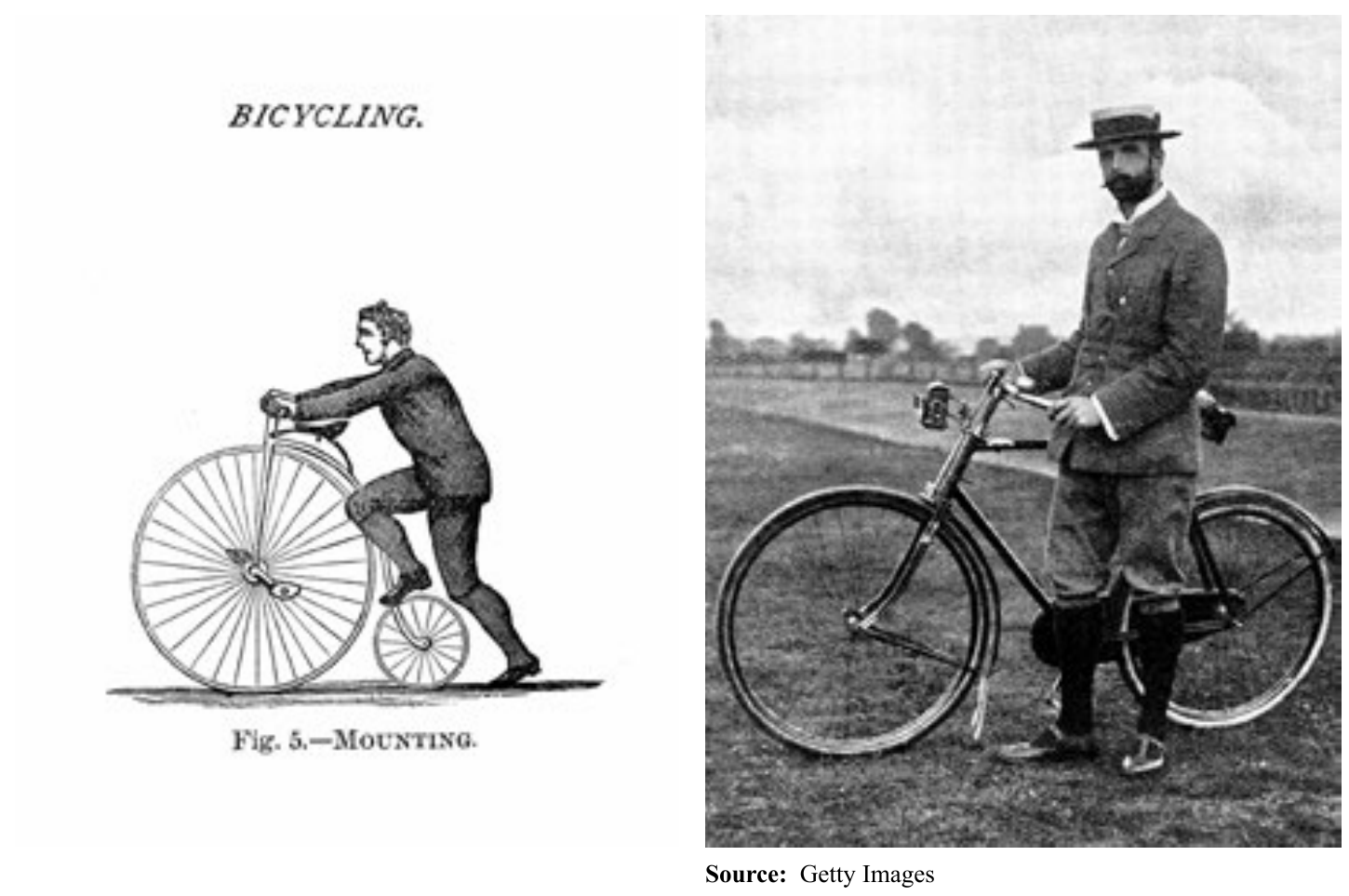
Leisure activities such as biking and boating became popular during the late 1800s. In the 1880s, the penny-farthing bicycle (below left) was replaced by the newer safety bicycle (below right). The older style featured one large wheel and one small one. This allowed riders to travel fast, but the danger of falling over was high. The newer style, by using a chain connecting different sized gears on the wheels, could go the same speed, but with less risk.
Companies encouraged their workers to participate in athletics, because they believed that sports rewarded virtues such as self-discipline and playing by the rules. The sales of athletic equipment also generated business for those who made everything from soccer` balls to sports stadiums.
Perhaps because workers spent most of their waking hours in a bleak industrial environment, material goods and leisure entertainment became important escapes. In Europe, soccer (known there as football), became popular, while baseball dominated sports in the United States. Particular sports developed along class lines: tennis and golf in England, for example, were played by the upper classes, while certain types of rugby were played only by the lower classes.
The commercialization of the demand for public culture was also seen in the construction of music halls and public parks, particularly during the second half of the 19th century. Both the halls and the parks were built to accommodate a wide range of social classes. One aim of this mingling of classes was for the lower classes to see more civilized, rational behavior so that they would be encouraged to emulate it. The manner in which one class may have ultimately influenced the other is difficult to quantify, yet the enduring presence of such public mingling places remains intact.