Anti-Colonialism in South Asia
The setback presented by the Paris Conference inspired anticolonial activists to redouble their efforts. In South Asia, the Indian National Congress formed in the late 19th century to air grievances against the colonial government. By the end of World War I in 1918, it had become a strong voice for independence.
Massacre at Amritsar In the spring of 1919, a group of Indian nationalists gathered in a public garden in Amritsar, Punjab, to protest the arrest of two freedom fighters. The protest took place during a Sikh festival, which had attracted thousands of villagers to the city, which Sikhs considered holy. Although the throngs were peaceful, the British colonial government had recently made such public gatherings illegal. Armed colonial forces fired hundreds of shots into the unarmed crowd, killing an estimated 379 people and wounding 1,200 more.
The Amritsar massacre radicalized many Indians. It convinced moderate members of the Indian National Congress that independence from Britain was the only way forward.
Gandhi By the 1920s, Mohandas Gandhi had brought the congress’s cause to the Indian masses and caught the attention of the world. His satyagraha (“devotion-to-truth”) movement embarked on a campaign of civil disobedience that encouraged Indians to break unjust laws and serve jail time. These actions, he believed, would stir the consciousness of the empire and the international community and expose the injustice of Britain’s imperial system.
Gandhi, who came to be known by Indians as Mahatma, or “the great soul,” led a boycott against British goods. After returning to India from South Africa, Gandhi wore the traditional cotton Hindu dhoti rather than the Western- style suits he had worn as a lawyer in Natal. Wearing homespun clothes was a form of protest against British fabrics made from Indian cotton and sold to Indians at inflated prices.
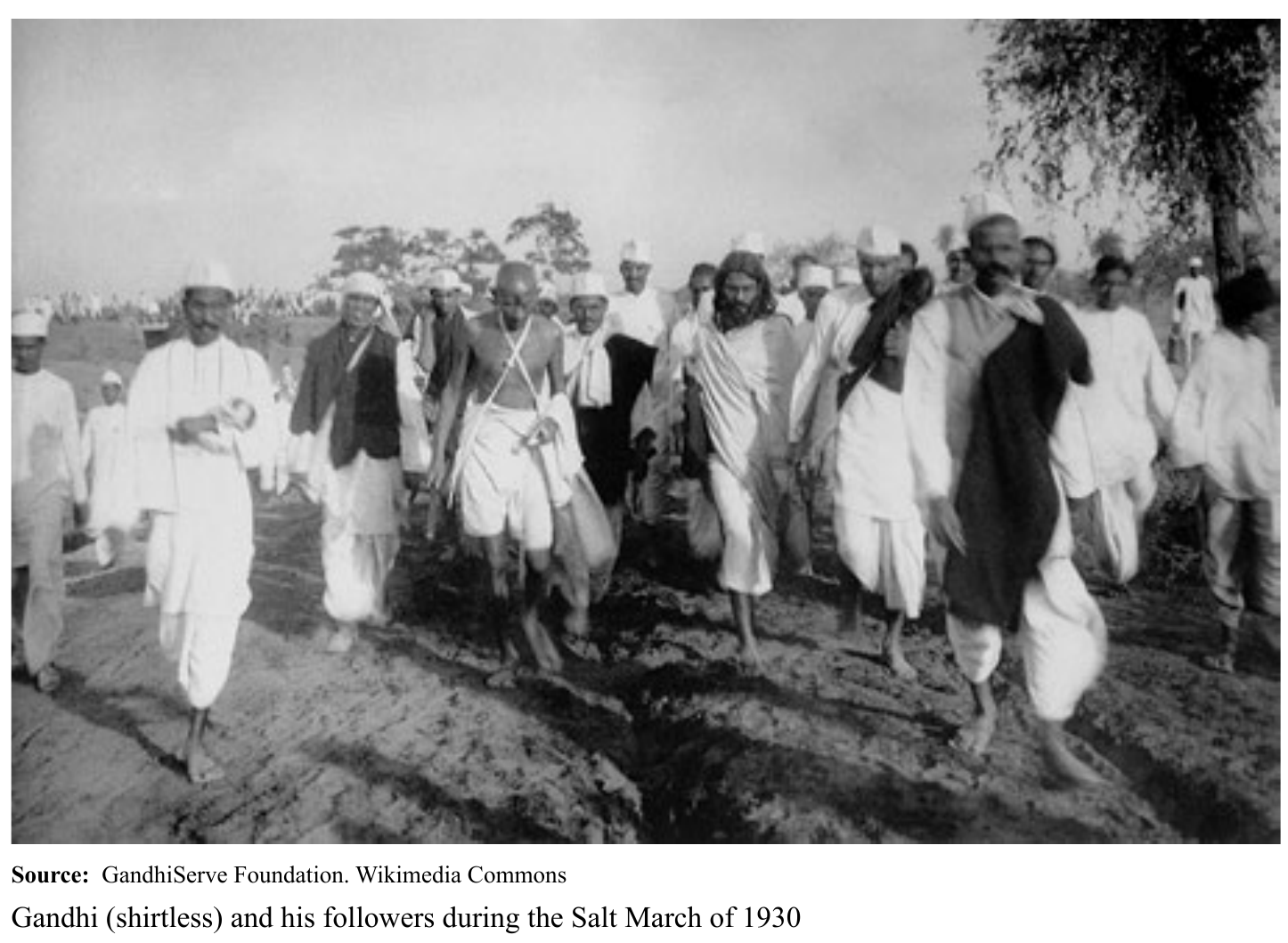
One of Gandhi’s first campaigns became known as the Salt March. British authorities had made it illegal for Indians to produce their own sea salt. The commodity was easy to make in the tropical country, but Britain wanted a monopoly on salt. In 1930, Gandhi led thousands of Indians to the Arabian Sea and simply picked up a few grains of salt, in defiance of Britain’s unjust edict.
The Two-State Solution While anticolonial sentiment was building, leaders of the independence movement disagreed about how India should define its national identity. Muslim leader Muhammad Ali Jinnah, a member of the Muslim minority in the largely Hindu Indian National Congress, originally favored Muslim-Hindu unity but later proposed a two-state plan for South Asian independence. He was concerned that Muslim interests would be overwhelmed by Hindu concerns in an independent India. He proposed creating a separate state, Pakistan, that would include the heavily Muslim western and eastern parts of South Asia. This proposal made several leaders, including Gandhi and Jawaharlal Nehru, who eventually became India’s first prime minister, anxious about the region’s future. Although independence did not come for India and Pakistan until after World War II, the interwar years were critical times for the anticolonial movement. (Connect: Write a paragraph connecting 20th century tensions between Hindus and Muslims in India with India’s earlier religious history. See Topic 1.3.)