Agricultural Effects of Exchange Networks
Along with luxury goods, spices, textiles, and religions, merchants in some places introduced crops where they had not grown before. The new crops often had an impact on land use and population growth and distribution. In some areas, people found ways to sustain abundant production; in others, overuse of the land led to environmental degradation.
Migration of Crops Few crops had as significant an impact as the quick- ripening Champa rice, which was introduced to the Champa states by Vietnam, a Hindu state, and then offered to the Chinese as tribute. Because of the Hindu influence on Champa in present-day central Vietnam, some scholars believe Champa rice may have originated in India. It was drought-resistant, flood- resistant, and capable of yielding two crops a year. It was widely distributed in China to meet the needs of the growing population and in turn contributed to the population growth.
It also had an impact on land use. Through terraced farming in the uplands and paddies in the lowlands, Champa rice was grown in many parts of China where once land was thought unusable for growing rice. Nonetheless, as the population of China grew, people tended to migrate southward to the original rice growing region, contributing to the growth of cities.
Indonesian seafarers traveling across the Indian Ocean had introduced bananas to Sub-Saharan Africa. The nutrition-rich food led to a spike in population. Many Indonesians settled on the island of Madagascar. Bananas allowed the Bantu-speaking peoples (see Prologue) with their metallurgy skills and farming techniques to migrate to places where yams—a traditional food source—did not easily grow. To grow bananas, farmers increased land for cultivation, which enriched diets and led to population growth.
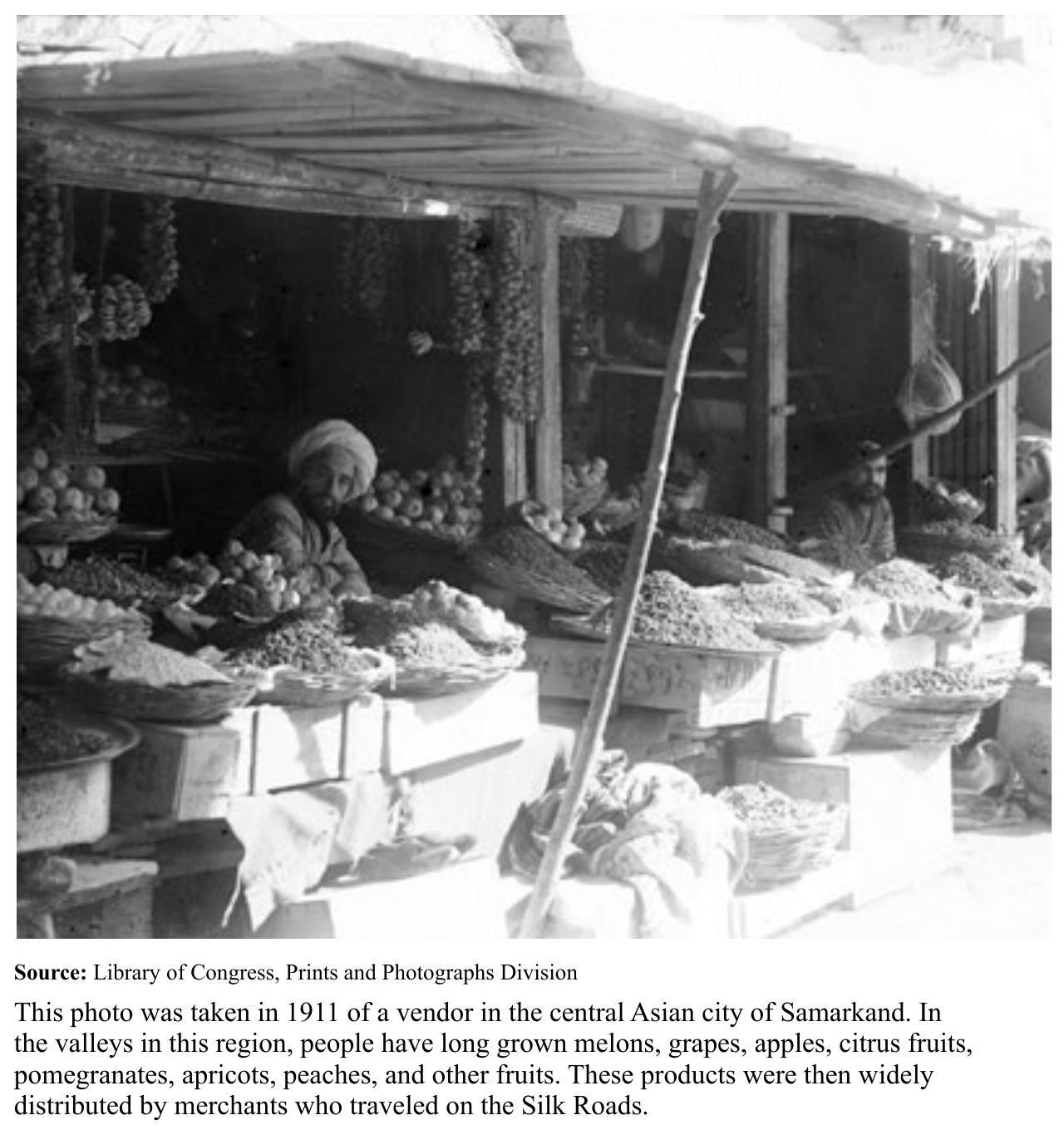
As caliphs conquered lands beyond the Arabian Peninsula, they spread Islam, the Arabic language, and the cultivation of cotton, sugar, and citrus crops. New foods were also available at the markets along the trade routes. The markets of Samarkand, for example, introduced new fruits and vegetables, as well as rice and citrus products from Southwest Asia, to Europe. Europeans’ demand for sugar would become so high that it became a key factor in the massive use of enslaved people in the Americas in the 1500s and after. (Connect: Compare the techniques used by Chinese farmers to raise food products with the techniques of Indonesian or Vietnamese farmers. See Topic 1.1.)
Environmental Degradation Increases in population put pressure on resources. For example, overgrazing outside of Great Zimbabwe was so severe that people had to abandon the city in the late 1400s. (See Topic 1.5.) In feudal Europe, overuse of farm land and deforestation led to soil erosion, reducing agricultural production. The Little Ice Age (c. 1300–c. 1800) also contributed to a decrease in agricultural products. Environmental degradation was a factor in the decline of the Mayans in the Americas as well.