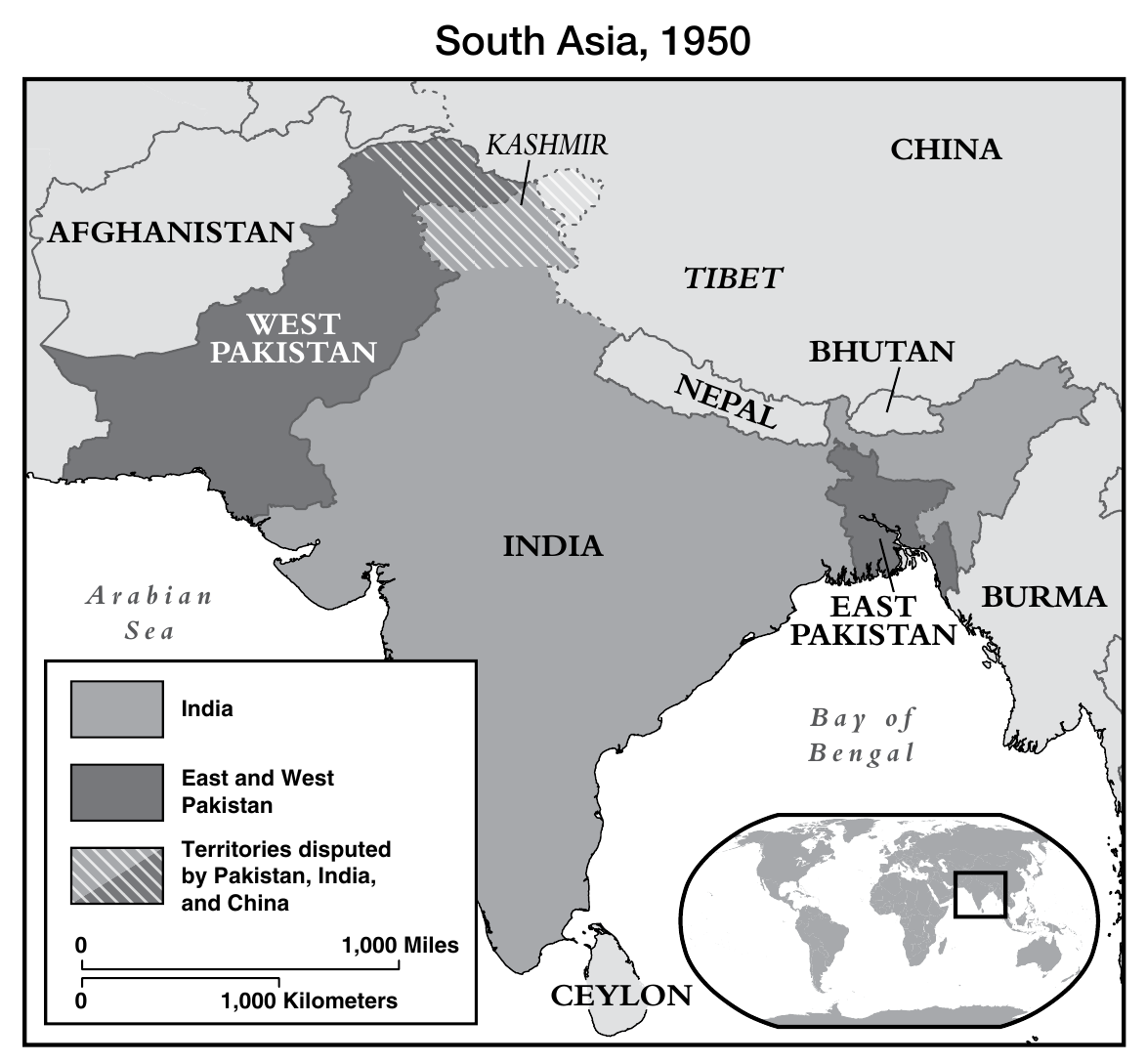
Movements for Autonomy: India and Pakistan
The drive for Indian self-rule began in the 19th century with the foundation of the Indian National Congress. Its leader in 1920 was Mohandas Gandhi. Hindu and Muslim groups, united by their desire to get rid of the British, supported the independence movement in South Asia. The National Congress’s tactics included mass civil disobedience, and it remained a powerful governmental force after Indian independence. The Muslim League, founded in 1906, advocated a separate nation for Indian Muslims.
Not all Indian leaders agreed with Gandhi’s nonviolent, noncooperation movement or his call for unity between Muslims and Hindus. However, they put aside their differences until after World War II. Then leaders again demanded independence.
After the war, Britain grew weaker as India’s fighting abilities grew stronger. When Britain failed to follow through on promises for more rights for Indians, Indian people increased their protests for full independence from British rule. The Royal Indian Navy Revolt in 1946 was instrumental in bringing Britain to the realization it could no longer rule India. As a result of economic pressures from India and from its own sluggish postwar recovery, Britain was ready to negotiate independence in South Asia.
Division and Conflict Muslims feared living in an independent India dominated by Hindus. Distrust between Muslims and Hindus dated back centuries to the 8th century, when Muslims invaded Hindu kingdoms in northern India. Muslims campaigned for an independent Muslim country— Pakistan. India and Pakistan both gained independence in 1947.