The Paris Peace Conference
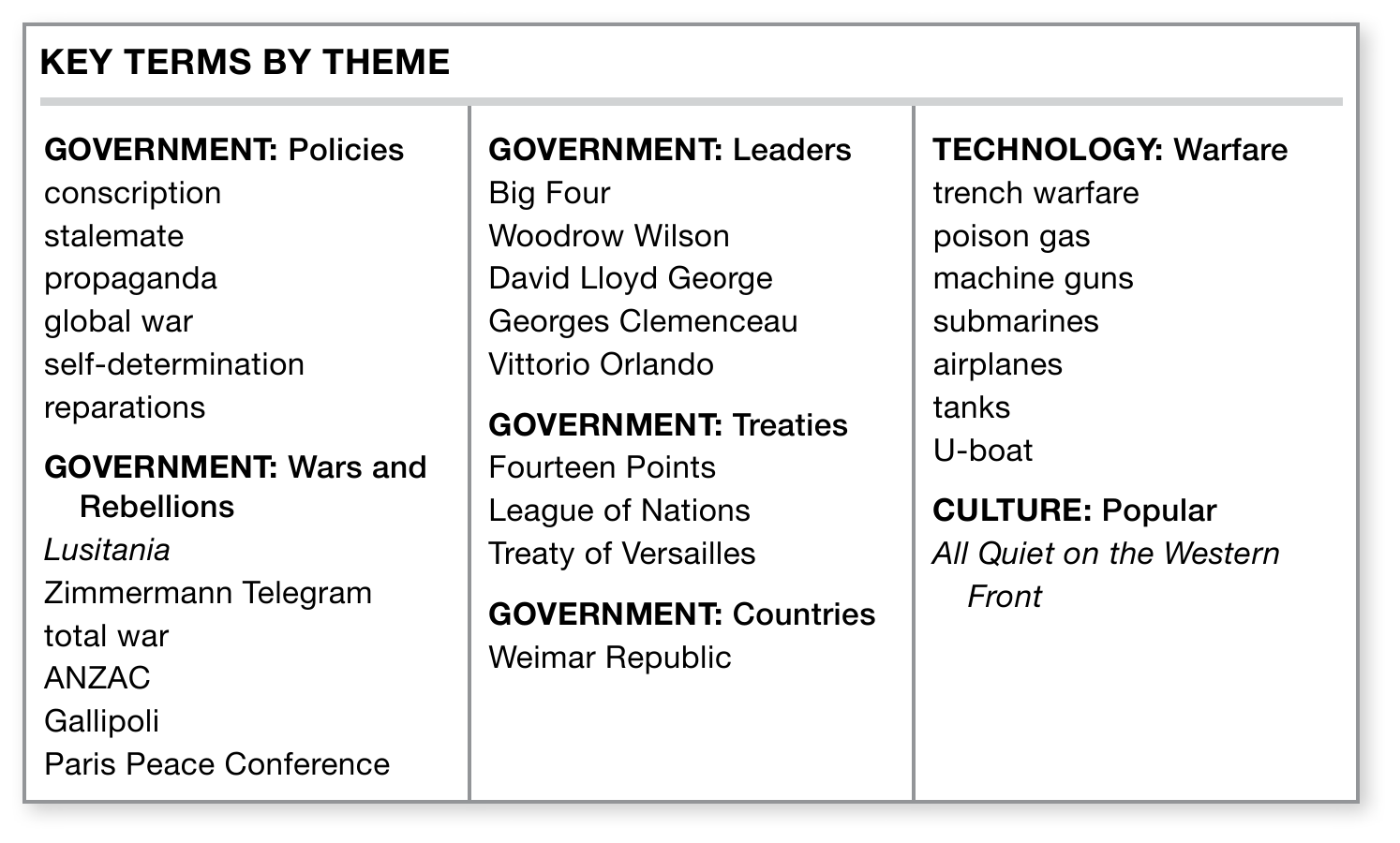
The war itself greatly damaged Europe. However, the peace conference held in its wake would have even more profound effects on the entire world. The leaders of the victorious countries at the Paris Peace Conference became known as the Big Four: Woodrow Wilson (United States), David Lloyd George (Great Britain), Georges Clemenceau (France), and Vittorio Orlando (Italy). The Italians walked out of the peace conference in a rage because Italy would not get Dalmatia and other territories that they had been promised for joining the Allies, including the city of Fiume on the Adriatic Sea. Russia was not invited to the conference because it had undergone a communist revolution. Russia’s Bolshevik leaders refused to honor Russia’s financial debts to the Allies, who in return refused to recognize the Bolshevik government.
The Big Four had different visions of how to settle the peace. President Wilson’s pledge to establish “peace without victory” reflected his belief that no one country should be severely punished or greatly rewarded. France’s Clemenceau rejected this view. He believed that France, out of all the Allies represented at the conference, had suffered the most and thus deserved special considerations to be protected from Germany. He also argued that the victorious powers should seek some sort of revenge on the Central Powers for starting the war. Clemenceau complained that Wilson was an unrealistic idealist who was naive about European relations, even though Wilson had a Ph.D. in history. David Lloyd George tended to support Clemenceau’s ideas, but he often acted as an intermediary between the two differing points of view.
Fourteen Points Despite Clemenceau’s protests, Wilson pushed for his principles, which he outlined in a document called the Fourteen Points. He particularly wanted to create a League of Nations, an organization in which all nations of the world would convene to discuss conflicts openly, as a way to avoid the simmering tensions that had caused World War I. Although the other nations agreed to establish the League, the U.S. Senate voted against joining it and against ratifying the Treaty of Versailles, the 1919 peace treaty with Germany.
Wilson also believed that conquered peoples under the defeated Central Powers deserved the right to self-determination, to decide their own political futures. Instead of the colonies and territories of the Central Powers being snatched up by the Allies, conquered peoples should have the right to decide their own political fate. A number of new nations were created or resurrected in Europe as the Austro-Hungarian and Ottoman empires were broken up: Finland, Estonia, Latvia, Lithuania, Poland, Czechoslovakia, and Yugoslavia. The last three of these were home to Slavic peoples.
The Treaty of Versailles Because Wilson failed to convince France and Britain not to punish Germany, the Treaty of Versailles treated Germany harshly. Most notably, Germany had to pay billions of dollars in reparations for damage caused by the war, give up all of its colonies, and restrict the size of its armed forces. Germans took the entire blame for the war. Signing the treaty was humiliating for German leaders. Moreover, the terms of the treaty caused tremendous hardship to the nation during the decade following World War I. The German economy suffered from sky-high inflation, partly due to the reparations the country was forced to pay. The German people were bitter in the immediate aftermath of the Paris Peace Conference. Resentment toward the Weimar Republic, which had agreed to the terms of the Treaty of Versailles, set the stage for an extreme and militaristic political party known as the Nazis to take power barely 15 years later. (Connect: Compare the forces that led to creation of the Treaty of Versailles and the Peace of Westphalia. See Topic 3.3.)