Immediate Causes of the Great War
World War I, which lasted from 1914 to 1918, was known as the Great War—not because of its positive nature, but because of the immense scale of the fighting. No previous war had involved as many nations from different parts of the world or killed as many soldiers and civilians. However, World War I did more than create an enormous body count. It fundamentally weakened the Western European powers, thus encouraging the growth of nationalism and appeals for self-rule within European colonies in Asia and Africa. Treaties signed at the end of this war helped set the stage for World War II. World War I was one of the most significant events of the 20th century.
A long series of events led up to World War I. The immediate cause was the assassination by Gavrilo Princip of Archduke Franz Ferdinand, the heir to the Austro-Hungarian throne, and his wife, Sophie, on June 28, 1914. Princip, a Serbian, was a member of the Black Hand, a nationalist
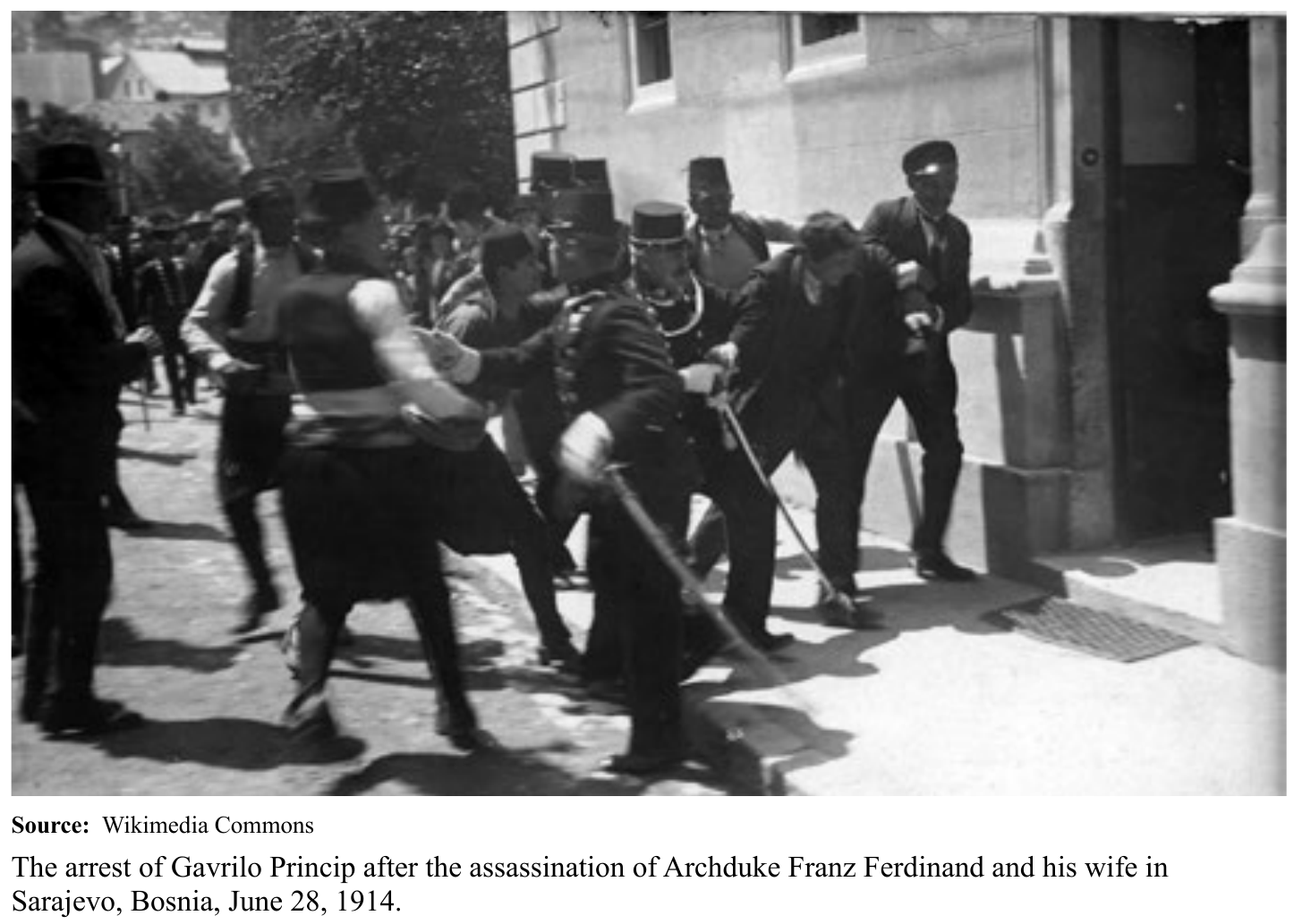
organization devoted to ending Austro-Hungarian presence in the Balkans. From the Austro-Hungarian perspective, however, the Black Hand was a terrorist group.
Immediately after the assassinations, Austria-Hungary sent an ultimatum to the Serbian government, demanding that it end all anti-Austrian agitation in Serbia. When the Serbian government rejected the ultimatum, Austria- Hungary declared war on Serbia on July 28, 1914. Austria-Hungary looked to its ally Germany, a stronger nation with more firepower, for military assistance to punish Serbia. Serbia, populated by ethnic Slavs, looked to other Slavic countries, particularly Russia, for help. On August 1, Germany declared war on Russia, and two days later on France. The following day, Britain declared war on Germany, and on August 6 Austria declared war on Russia. By the end of August 1914, Japan’s entrance into the conflict changed a relatively minor incident into a true world war.