UNIT 6: Consequences of Industrialization from c. 1750 to c. 1900
Context
Understand the Context
Technological change provided the framework for the historical changes between 1750 and 1900. Industrial growth fostered a wider exchange of commodities, the expansion of overseas empires, and new patterns of migration.
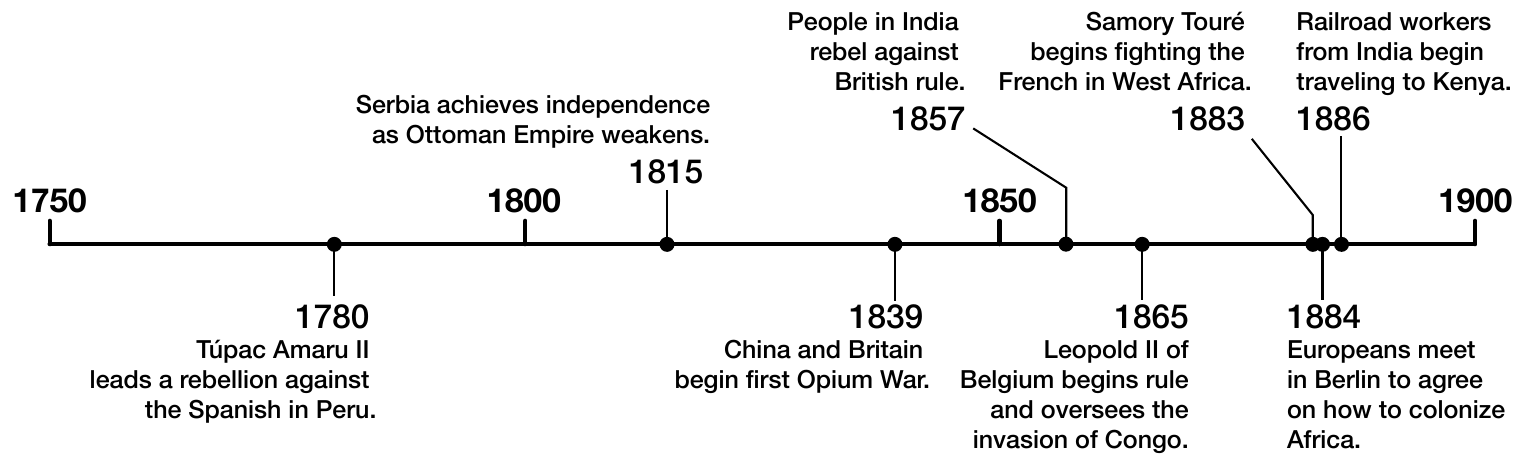
Imperialism Competition among industrializing states increased the desire for colonies. Some states strengthened control over existing colonies, as the British did in India. Empires expanded into new regions, evident in the rapid European colonization of Africa. Economic imperialism emerged in parts of Latin American and Asia. Europeans used Social Darwinism and religious ideologies to justify their control of others. In general, the Portuguese and Spanish declined, the British and French and Russia expanded, and the United States and Japan emerged as new empires.
Resistance to Imperialism In response to imperialism, anticolonial movements developed as part of a larger trend of emerging nationalism. Resistance to imperialism took many forms, including rebellion, the establishment of peripheral states, and religiously influenced responses. These movements set the stage for decolonization in the 20th century.
Migration New means of transportation and the pull of economic opportunity spurred long-distance migration and a larger trend of global urbanization. Although many people chose to migrate, coerced migration was also common, as slavery and indentured servitude continued to play a significant role in the global economy. Increased migration changed the demographics and cultures of both sending and receiving societies.
Topics
Rationales for Imperialism
3 Sections
State Expansion
8 Sections
Indigenous Responses to State Expansion
6 Sections
Global Economic Development
4 Sections
Economic Imperialism
6 Sections
Causes of Migration in an Interconnected World
4 Sections
Effects of Migration
3 Sections
Causation in the Imperial Age
4 Sections
Historical Perspectives: HISTORICAL PERSPECTIVES: HOW DID COLONIZATION PROMOTE EUROPEAN ECONOMIC GROWTH?
Read more →
Write As Historian: WRITE AS A HISTORIAN: WRITE THE INTRODUCTION
Read more →
AP Exam Practice
Start Practice →