Russia
Western Europeans were long unsure what to think of Russia: Was Russia more European in its outlook and character, or was it more Asian? Russia was in a pivotal position for trade. It was able to exchange goods and services with other cultures farther east and west. However, Russia remained tightly linked to Europe. Its capital—whether Kiev, St. Petersburg, or Moscow—was located in Europe. Although a product of Mongol influence from Central Asia to the east, Russia was also a product of Europe as a result of Viking invasions and trading.
When Ivan IV (ruled 1547–1584), called Ivan the Terrible, was crowned tsar in 1547, he immediately set about to expand the Russian border eastward, first by taking control of the khanates of Kazan, Astrakhan, and Siberia held by the descendants of the Golden Horde, the Mongolian conquerors. This expansion came to rely more and more upon the use of gunpowder.
Control of the Volga Wanting to expand east to control the fur trade, Ivan IV allowed the Stroganovs, major Russian landowners, to hire bands of fierce peasant warriors known as Cossacks to fight the local tribes and the Siberian khan. The Stroganovs’ forces were successful, gaining control of the Volga
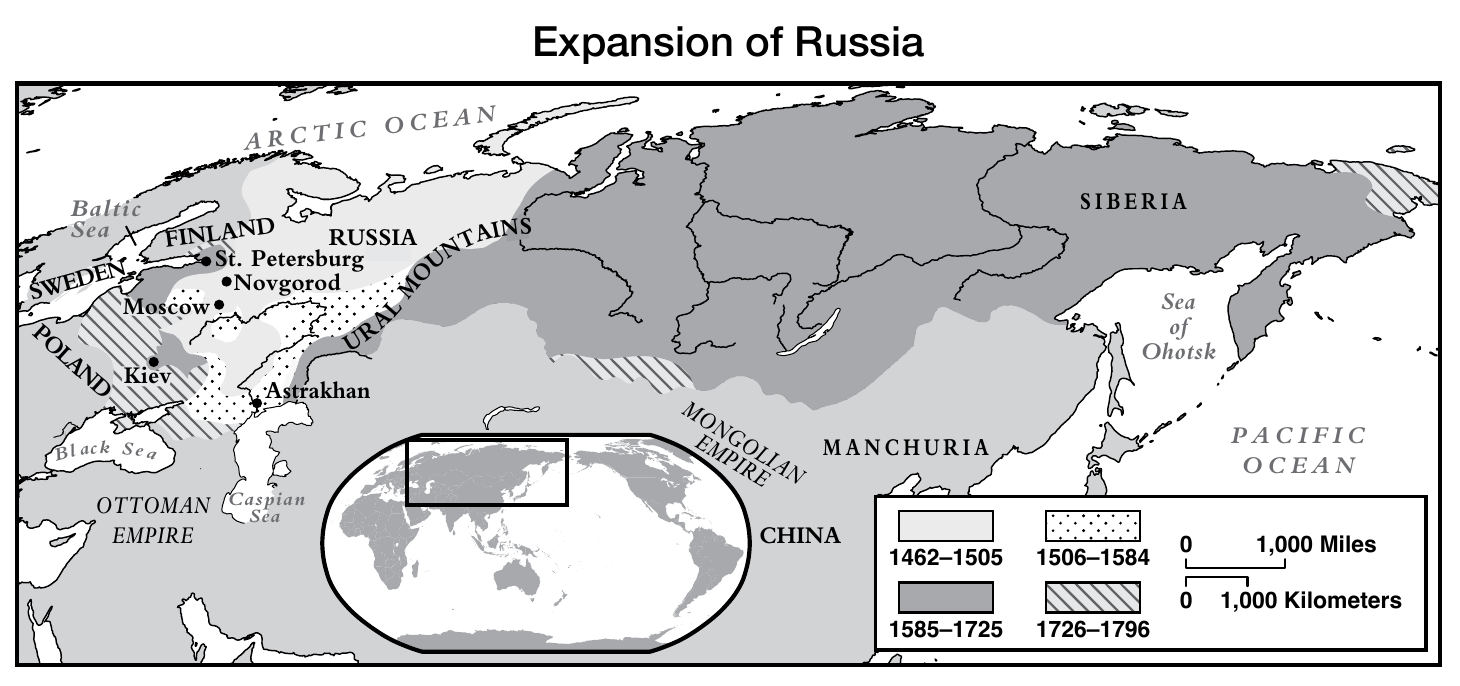
River, which flows into the Caspian Sea. Possessing this outlet to the sea, Moscow could trade directly with Persia and the Ottoman Empire without having to deal with the strong forces of the Crimean Tartars.
To the Pacific Russia continued moving east into Siberia after the reign of Ivan IV. Fur traders and militias defeated one indigenous tribe after another. Missionaries followed, converting many to the Eastern Orthodox faith, although the local shamans, or religious leaders, continued to have influence. By 1639, the Russians had advanced east as far as the Pacific Ocean. Explorations and fur trading expeditions continued across the Pacific to Alaska (1741) and down the coast of North America to California (1814).