Political Continuities and Changes
As during the Enlightenment, philosophers living through the Industrial Revolution era developed new political ideas about the individual and government. During the Industrial Revolution, most people had little to no formal voice in government such as the right to vote, but they demanded the ability to exercise their “natural rights.” Among these were the rights to petition, protest, and rebel against their governments. Sometimes these protests were based on nationalism and the right of people to choose their own governments.
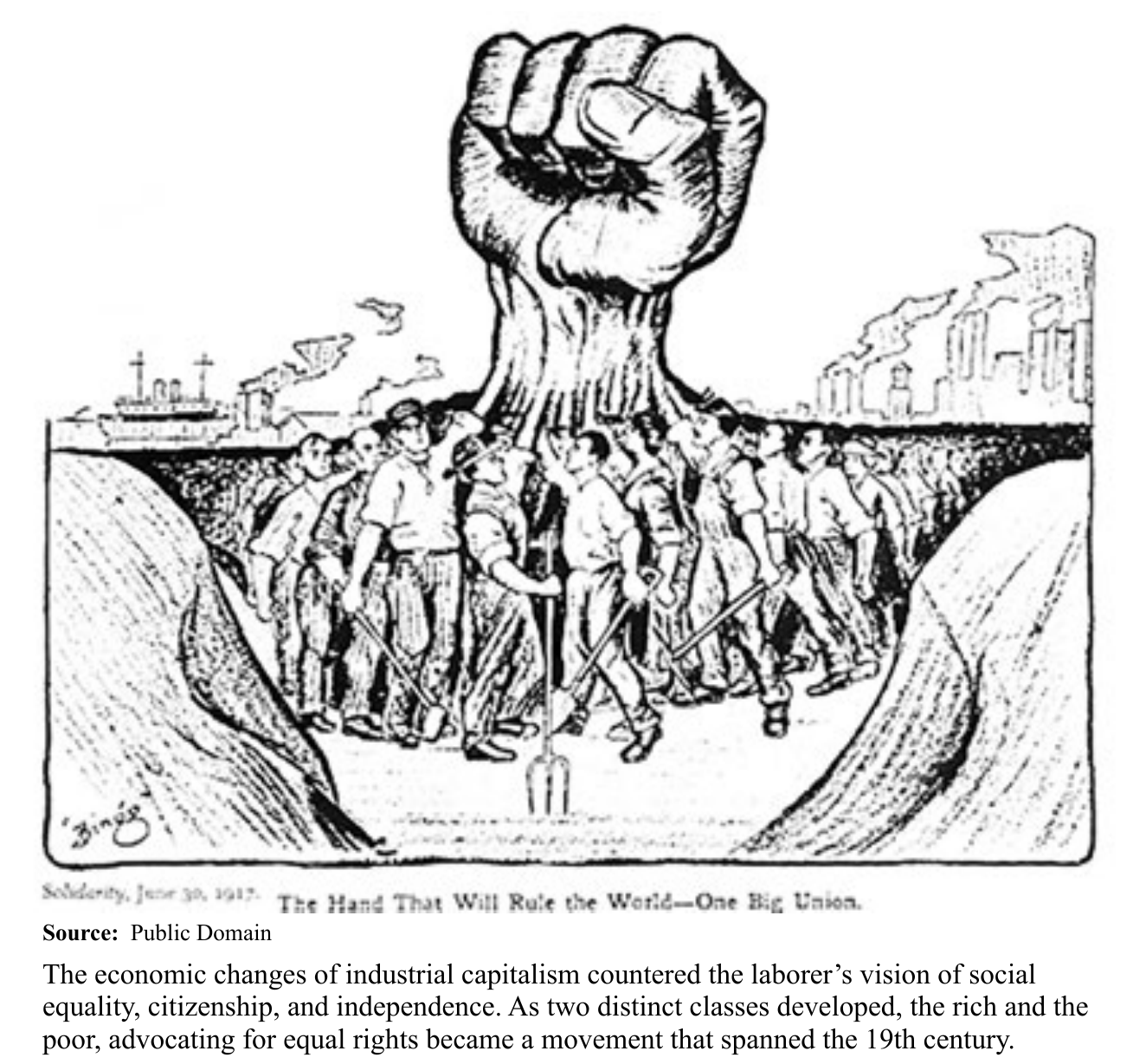
However, political movements of the Industrial Revolution were almost always connected to the interests of the growing middle and working classes. For example, labor leaders advocated formation of international unions so that workers in various countries could unite to demand higher wages. But the vast majority of the protests were for the right to vote and to end aristocratic privileges. A series of uprising throughout European cities in 1848, known as the Revolution of 1848, were a sign of the growing interest in more pluralistic, more democratic governments :
• In Paris , protesters called for greater freedom of the press.
• In Berlin, people wanted a parliament to check the monarch’s power.
• In cities in Hungary, people demanded freedom from Austrian control.
People wanted not just general natural rights, but specific rights recognized by their government.
Voting Rights As the number of wealthy capitalists and the middle class grew, more frequent calls for greater political participation were made. As a result, some political reforms were enacted that included the extension of voting rights to city dwellers, non-landowners, and, eventually, to the working class. However, the voting franchise was extended to male voters only. Women would not gain the right to vote in Western industrial countries until the early 20th century. Sometimes voting rights were extended through the legislative process, as in Great Britain. However, in other instances, protests and revolutions forced governments to enact political reforms.
One factor in all of these political reforms was the size and influence of the middle class. In countries where the middle class was large and economically significant, democracy emerged. However, in regions where the middle class was small or insignificant, dictatorships remained in place.
Protections for Workers Reforms that began in one country often spread. For example, Otto Von Bismarck’s social reforms spread throughout Europe and eventually the world. All industrializing nations grappled with the new challenges that factory life introduced. Among these nations, Germany implemented the most comprehensive set of social reforms to protect industrial workers. Under the leadership of Chancellor Otto von Bismarck, Germany started workers’ accident compensation insurance, unemployment insurance, and old age pensions for employees. Bismarck was concerned that if his government did not address these problems, socialists and more radical citizens would demand stronger government action.
Another effect of the expansion of voting rights was the emergence of political parties that represented the working class. These “labor parties” advocated for minimum wages, shorter work days, paid sick and holiday leave, better working conditions, and health and unemployment insurance.