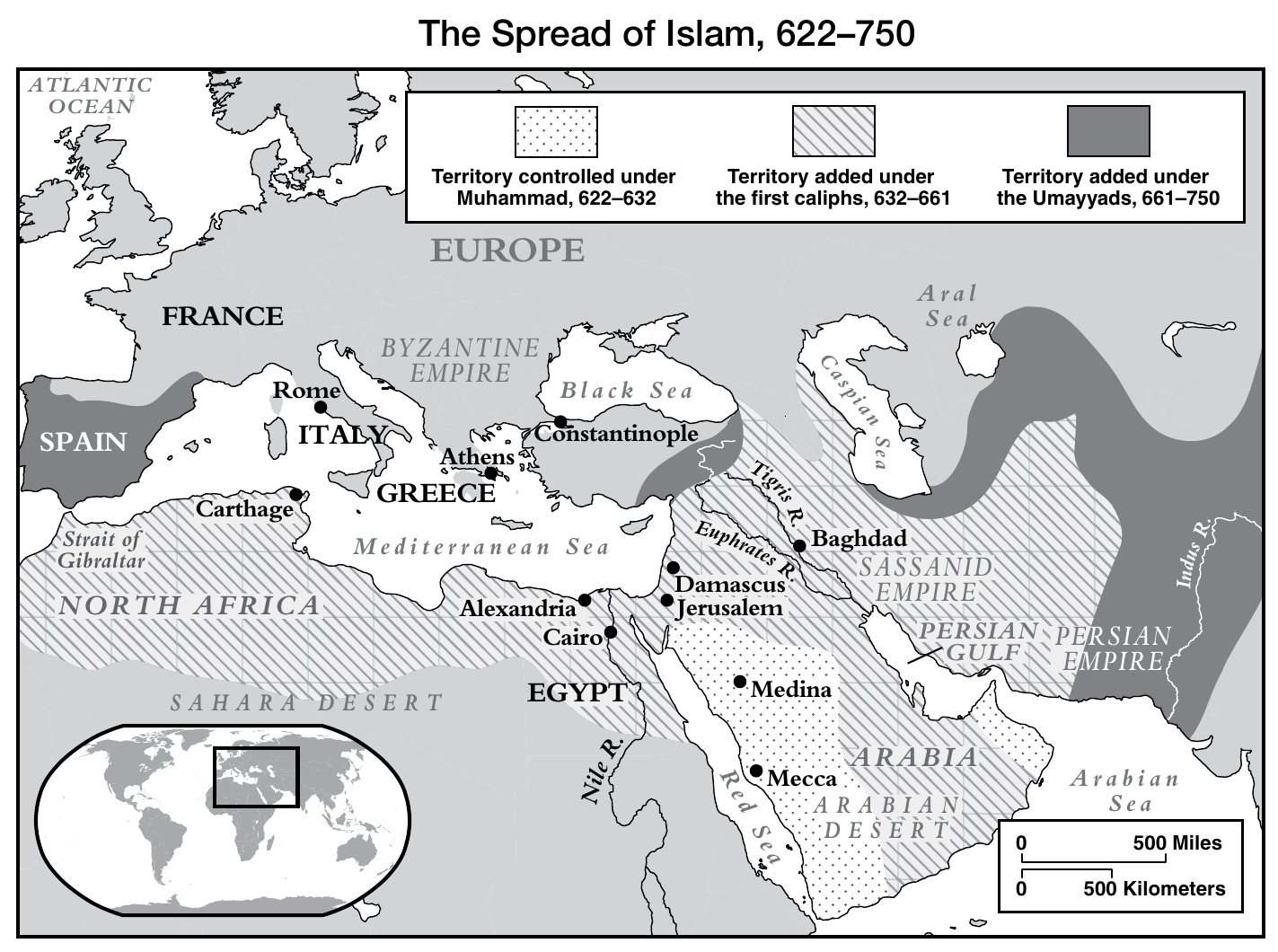
The Spread of Islam
At the beginning of the 7th century, the people of the Middle East were a mixture of animists, Zoroastrians, Jews, Christians, and others. A merchant named Muhammad living on the Arabian Peninsula believed that he had received revelations from God. These revelations were later recorded in the Quran, the sacred scriptures of the religion of Islam. Those who followed the teachings in the Quran became known as Muslims. They believed that Muhammad was last in a line of great prophets that included Abraham, Moses, and Jesus.
The Teachings of Islam The core principles of the Quran became known as the Five Pillars of Islam: a belief in one god called Allah, ritual prayer, almsgiving, fasting, and making a pilgrimage to Mecca. They evolved a law code based on the Quran, called sharia, to regulate Muslim religious and civic behavior. Unlike the laws of the Romans, sharia made no distinction between religious and civil law.
Sunnis and Shi’as Through Muhammad’s leadership, Islam quickly unified and brought peace to the warring tribes of the Arabian Peninsula. However, Islam experienced a crisis upon the death of Muhammad in 632. He had made no provision for a successor. People fell into two warring camps over who should become the political leader, called the caliph, of the Islamic community. This rift, which continues today, created a divide between the two major branches of Islam: Sunni and Shi’a. Sunni Muslims felt that the caliph could be selected from among all leaders in the Islamic community. Shi’a Muslims felt that the caliph should be a blood relative of Muhammad. Today, Sunnis form the majority of Muslims in the world. Shi’a Muslims are strongest in Iran and Iraq.
Expansion of Islam Despite this early division among Muslims, Islam spread rapidly. In less than a century, Islam had united southern Spain, North Africa, the Middle East, and parts of India. This area became known as the House of Islam, or Dar al-Islam.
The Abbasids The most influential rulers in Dar al-Islam were those of the Abbasid Caliphate (750–1258). Under them, Islamic culture experienced a golden age. A stable government allowed trade to once again prosper. The Abbasids helped China, then under the Tang Dynasty, reestablish a booming trade along the Silk Roads. They also facilitated the growth of trans-Saharan trade to West Africa and were major participants in the diffusion of ideas and goods throughout the Indian Ocean.
Islamic society, particularly in the capital in Baghdad, thrived under the Abbasids. The empire became a center of learning where people made advances in medicine, built astronomical observatories, developed algebra, improved the astrolabe, and preserved Greek and Roman texts. The government practiced a degree of religious toleration. Non-Muslims could keep their faith by paying an additional tax called the jizya.
The Abbasids ended female infanticide and strengthened the marriage and property rights of women. The Abbasids continued to support the veiling of women and the right of a man to take up to four wives.