Debates About Global Warming
Air pollutants and greenhouse gases prompted debates about rising temperatures. Scientists, including those on the United Nations’ Intergovernmental Panel on Climate Change, cited data showing that the emissions of carbon dioxide and other greenhouse gases caused by the burning of fossil fuels were causing global warming. This is an increase in the average temperature of the world. Experts advised governments to reduce their countries’ carbon footprint—the amount of carbon dioxide that each person produces. Without a reduced carbon footprint, global warming would contribute to catastrophes: more powerful hurricanes, more severe droughts, and rising sea levels that could flood islands and coastal areas. Some activists argued that the term “global warming” was too mild to express the urgency of action. They said that humanity faced a “climate emergency” or “climate crisis.”
Climate-change skeptics, in contrast, questioned whether global warming was happening and whether human activities had any influence on the climate. In addition, some people in the energy industries resisted the interference of government, arguing that market forces would cause consumers to reduce their carbon footprint if that became necessary. In contrast, other leaders of energy companies began planning for a shift to renewable fuel sources.
Most government leaders, however, agree that global warming requires a global response, but countries disagree on how to reduce carbon emissions.
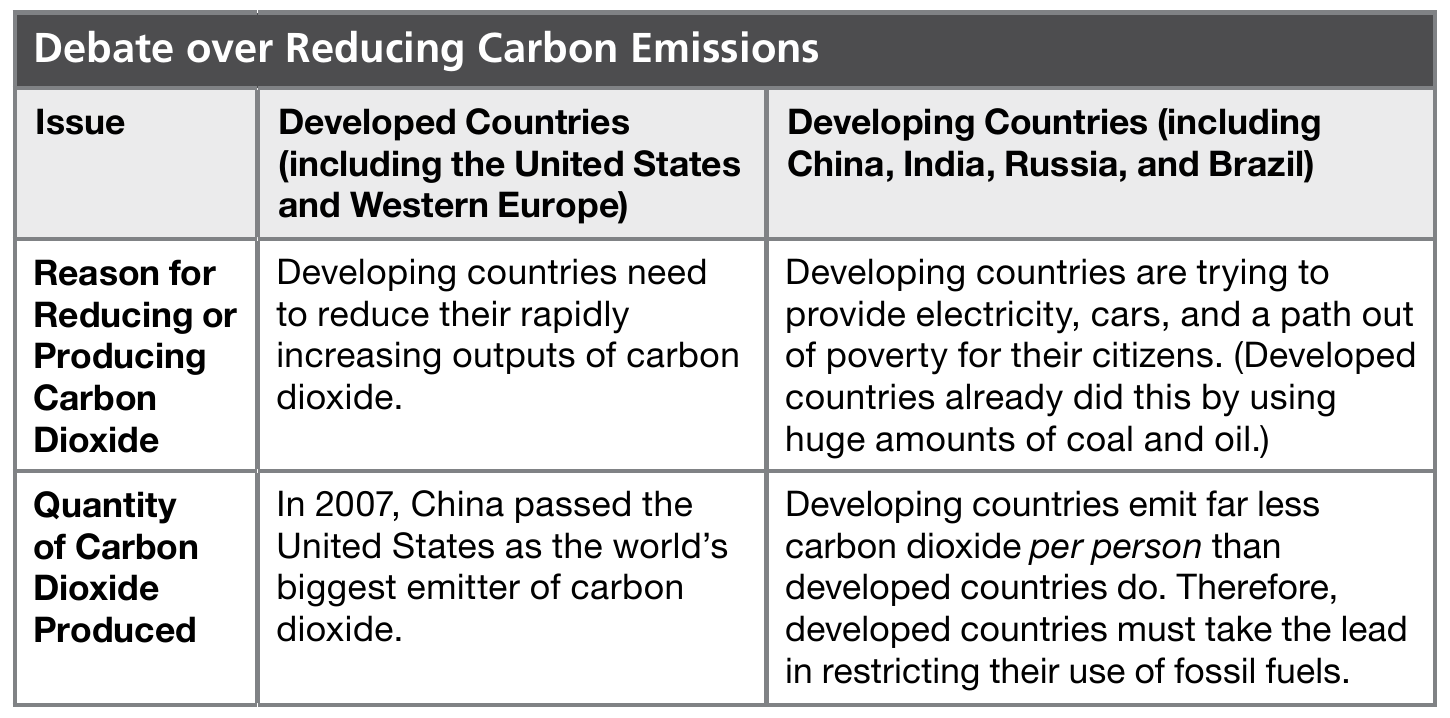
Kyoto The first major international agreement to reduce carbon emissions was the Kyoto Protocol, signed in 1997. Developed nations in Western Europe, along with the United States, argued that developing countries, such as China, India, Russia, and Brazil, needed to curb their rapidly increasing output of carbon dioxide. However, the United States refused to ratify it, and China and India were not required to agree to the strictest terms of the protocol.
Global Action at Paris In 2015, 195 countries signed a deal, the Paris Agreement, that gave new hope for progress against global warming. Leaders of both the United States and China supported this new deal. However, in 2017, President Donald Trump announced that the United States would withdraw from the Paris Agreement.
Climate Activism Increasing global temperatures led to calls to action. “You say you love your children above all else, and yet you are stealing their future in front of their very eyes,” 15-year-old climate activist Greta Thunberg raged in a speech at a United Nations climate conference in 2018. Beginning with a solo protest in her native Sweden, Thunberg eventually led a global climate strike with more than 1.6 million participants in more than 125 countries.
Extinction Rebellion, a climate activist group formed in 2018, engaged in civil disobedience in London, blocking a main bridge and key intersections for more than a week, chaining themselves to the headquarters of big companies, and interrupting “business as usual” in other ways. About a thousand people were arrested, but the group succeeded in having Members of Parliament call a citizens’ assembly to discuss ideas for addressing the climate emergency. Many other citizen groups are pressuring lawmakers in many countries to take necessary steps to avert the worst consequences of continued warming predicted in reports from the UN’s Intergovernmental Panel on Climate Change.