UNIT 7: Global Conflict After 1900
Context
Understand the Context
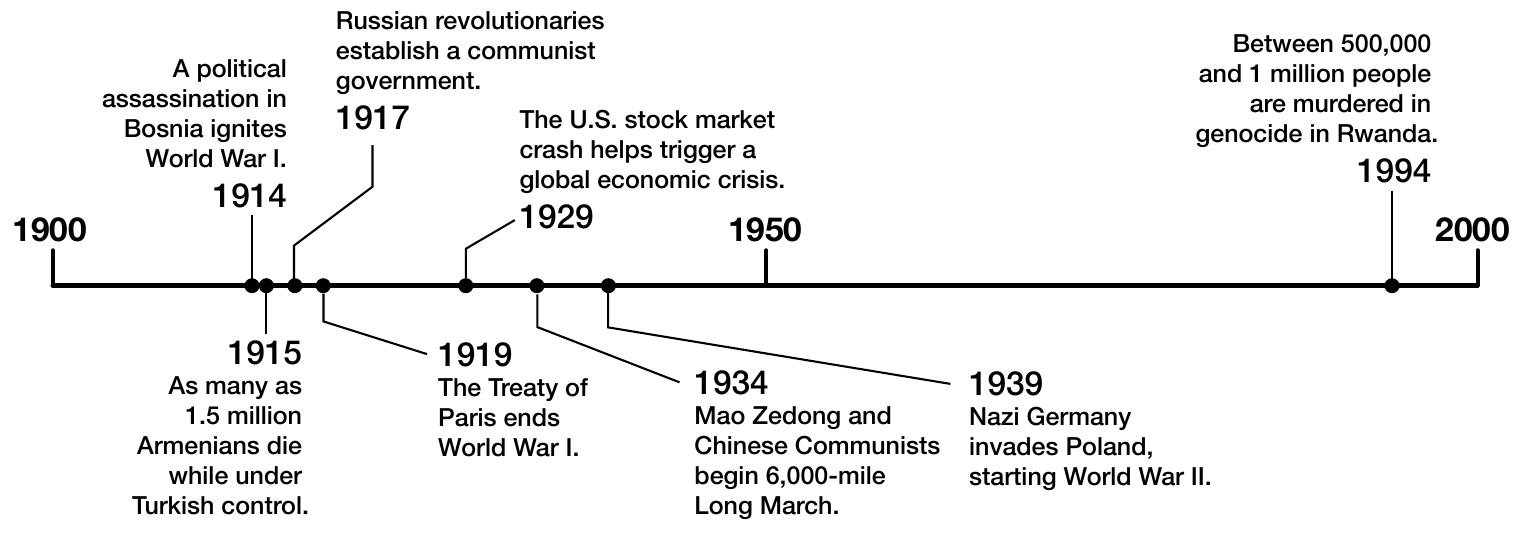
The 20th century was a time of great social and political change, much of which resulted in tension and division. People and states challenged existing political and social orders, while new technologies and scientific advancements both advanced understanding of the universe and enabled the two world wars to be increasingly destructive.
Shifting Powers Challenges to existing states and political establishments set the stage for shifting powers throughout the 20th century. Long-established states such as the Ottoman Empire dissolved, while new political experiments such as communism emerged in Russia, China, and elsewhere. The ongoing power of nationalism and traditional rivalries, combined with economic instability, soon embroiled most of Europe and its colonies, the United States, Japan, and China in the First World War. Though dubbed “the war to end all wars,” it was not. World War II was far larger and bloodier. Additional conflicts occurred as colonized regions fought for independence.
in
technology altered
A Changing World Rapid advances
the understanding of the universe and the natural world in the 20th century. Advancements in communication, transportation, industry, agriculture, and medicine brought people longer lives, greater opportunities to find meaningful work, and better access to information. However, emerging military technologies also made war more deadly. World War I featured advancements such as the aircraft, while World War II enabled the development of the atomic bomb. Mass atrocities were also brought about by the intentional destruction of entire ethnic or religious groups of people, including the Holocaust during World War II. Totalitarian governments, such as the one under Joseph Stalin in the Soviet Union, adopted repressive policies that resulted in the deaths of many millions of people.
Topics
Shifting Power
4 Sections
Causes of World War I
3 Sections
Conducting World War I
5 Sections
Economy in the Interwar Period
3 Sections
Unresolved Tensions After World War I
5 Sections
Causes of World War II
2 Sections
Conducting World War II
8 Sections
Mass Atrocities
5 Sections
Causation in Global Conflict
3 Sections
Historical Perspectives: HISTORICAL PERSPECTIVES: WHAT CAUSED TOTALITARIANISM?
Read more →
Write As Historian: WRITE AS A HISTORIAN: WRITE THE SUPPORTING PARAGRAPHS
Read more →
AP Exam Practice
Start Practice →