Unit 3 AP Exam Practice
Document-Based Questions
1. Using the documents and your knowledge of world history, evaluate the extent to which Peter the Great took steps during his reign (1682–1725) to modernize Russia and transform it into a major European power.
• Use evidence to corroborate, qualify, or modify an argument that addresses the prompt.
Document 1
Document 1
Source: Bishop Burnet of England describing Peter the Great, 1698.
He was desirous to understand our doctrine, but he did not seem disposed to mend matters in [the Russian empire]. He was, indeed, resolved to encourage learning and to polish his people by sending some of them to travel in other countries and to draw strangers to come and live among them. He seemed apprehensive still of his sister’s intrigues. There was a mixture both of passion and severity in his temper. He is resolute, but understands little of war, and seemed not at all inquisitive that way.
Document 2
Document 2
Source: Peter I, Decree on Compulsory Education of the Russian Nobility, 1714.
Send to every [region] some persons from mathematical schools to teach the children of the nobility—except those of freeholders and government clerks—mathematics and geometry; as a penalty . . . no one will be allowed to marry unless he learns these [subjects].
Document 3
Document 3
Source: Peter I, Decree on the Invitation of Foreigners, 1702.
Since our accession to the throne all our efforts and intentions have tended to govern this realm in such a way that all of our subjects should, through our care for the general good, become more and more prosperous. For this end we have always tried to maintain internal order, to defend the state against invasion, and in every possible way to improve and to extend trade. With this purpose we have been compelled to make some necessary and salutary changes in the administration, in order that our subjects might more easily gain a knowledge of matters of which they were before ignorant, and become more skillful in their commercial relations. We have therefore given orders, made dispositions, and founded institutions indispensable for increasing our trade with foreigners, and shall do the same in the future. . . . To attain these worthy aims, we have endeavored to improve our military forces, which are the protection of our State, so that our troops may consist of well-drilled men, maintained in perfect order and discipline. In order to obtain greater improvement in this respect, and to encourage foreigners, who are able to assist us in this way, as well as artisans profitable to the State, to come in numbers to our country, we have issued this manifesto.
Document 4
Document 4
Source: Peter I, Decree on Western Dress, 1701.
Western dress shall be worn by all the boyars, members of our councils and of our court . . . gentry of Moscow, secretaries . . . provincial gentry, gosti [merchants], government officials, streltsy, members of the guilds purveying for our household, citizens of Moscow of all ranks, and residents of provincial cities . . . excepting the clergy and peasant tillers of the soil. The upper dress shall be of French or Saxon cut, and the lower dress . . . —waistcoat, trousers, boots, shoes, and hats—shall be of the German type. They shall also ride German saddles. Likewise the womenfolk of all ranks, including the priests’, deacons’, and church attendants’ wives, the wives of the dragoons, the soldiers, and the streltsy, and their children, shall wear Western dresses, hats, jackets, and underwear—undervests and petticoats—and shoes. From now on no one of the above mentioned is to wear Russian dress or Circassian coats, sheepskin coats, or Russian peasant coats, trousers, boots, and shoes. It is also forbidden to ride Russian saddles, and the craftsmen shall not manufacture them or sell them at the marketplaces.
Document 5
Document 5
Source: Statute for the College of Manufactures, 1723.
His Imperial Majesty is diligently striving to establish and develop in the Russian Empire such manufacturing plants and factories as are found in other states, for the general welfare and prosperity of his subjects. He [therefore] most graciously charges the College of Manufactures to exert itself in devising the means to introduce, with the least expense, and to spread in the Russian Empire these and other ingenious arts, and especially those for which materials can be found within the empire. . . . His Imperial Majesty gives permission to everyone, without distinction of rank or condition, to open factories wherever he may find suitable. . . .
Factory owners must be closely supervised, in order that they have at their plants good and experienced [foreign] master craftsmen, who are able to train Russians in such a way that these, in turn, may themselves become masters, so that their produce may bring glory to the Russian manufactures.
Document 6
Document 6
Source: Jean Rousset de Missy, Life of Peter the Great, c. 1730.
The tsar labored at the reform of fashions, or, more properly speaking, of dress. Until that time the Russians had always worn long beards, which they cherished and preserved with much care, allowing them to hang down on their bosoms, without even cutting the moustache. With these long beards they wore the hair very short, except the ecclesiastics, who, to distinguish themselves, wore it very long. The tsar, in order to reform that custom, ordered that gentlemen, merchants, and other subjects, except priests and peasants, should each pay a tax of one hundred rubles a year if they wished to keep their beards; the commoners had to pay one kopek each. Officials were stationed at the gates of the towns to collect that tax, which the Russians regarded as an enormous sin on the part of the tsar and as a thing which tended to the abolition of their religion.
These insinuations, which came from the priests, occasioned the publication of many pamphlets in Moscow, where for that reason alone the tsar was regarded as a tyrant and a pagan; and there were many old Russians who, after having their beards shaved off, saved them preciously, in order to have them placed in their coffins, fearing that they would not be allowed to enter heaven without their beards. As for the young men, they followed the new custom with the more readiness as it made them appear more agreeable to the fair sex.
Document 7
Document 7
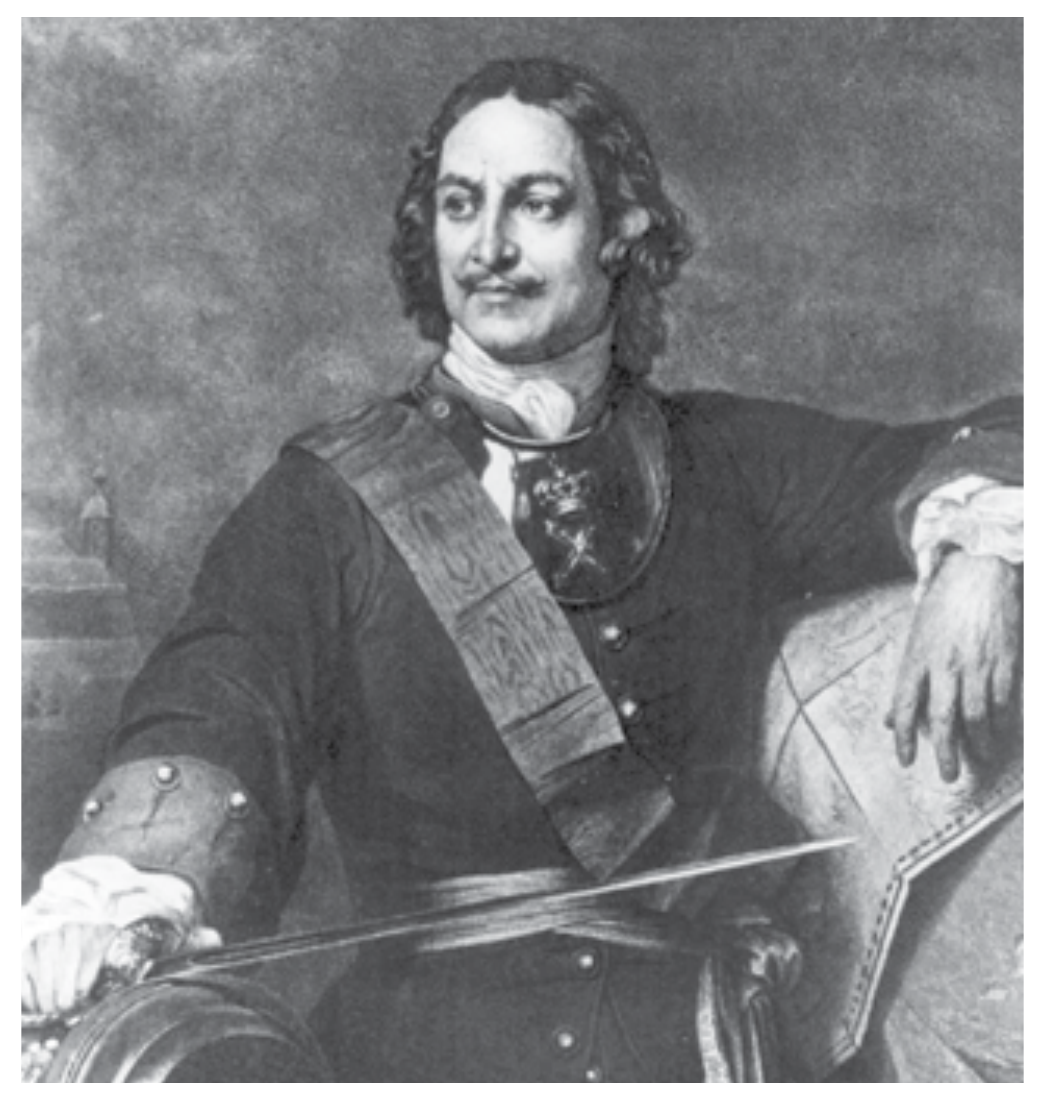
Source: Portrait of Peter the Great. Library of Congress.
Long Essay Questions
1. In Africa and Eurasia from 1450 to 1750, various forms of Islam and Christianity were key factors in the expansion of empires.
Develop an argument that evaluates the extent to which the various belief systems showed continuity or change over time during the period from 1450 to 1750.
2. Rulers of empires in Africa and Eurasia from 1450 to 1750 developed new methods of governing to solidify their authority over their citizens.
Develop an argument that evaluates the extent to which changes in government caused the consolidation of power in empires in the period 1450 to 1750.
3. New technology, including gunpowder weapons, shaped empires in throughout southern and southwestern Asia from 1450 to 1750.
Develop an argument that evaluates the extent to which various land- based empires in southern and southwestern Asia developed in similar ways from 1450 to 1750.
4. New technology, including gunpowder weapons, shaped empires in Russia and China from 1450 to 1750.
Develop an argument that evaluates the extent to which various land- based empires in Russia and China developed in similar ways from 1450 to 1750.