Overseas Expansion
As more countries industrialized and the capacity to produce goods increased, overproduction became a serious economic issue. Domestic markets could no longer consume the amount of goods being produced. As a result, international trade transformed industrial economies from mercantilist to capitalist systems. Industrialized economies looked to increase exports of their products. The desire to increase exports, however, caused both economic and political rivalries among industrialized countries as businesses sought out new international customers and enlisted their government’s assistance to help open previously closed or inaccessible markets.
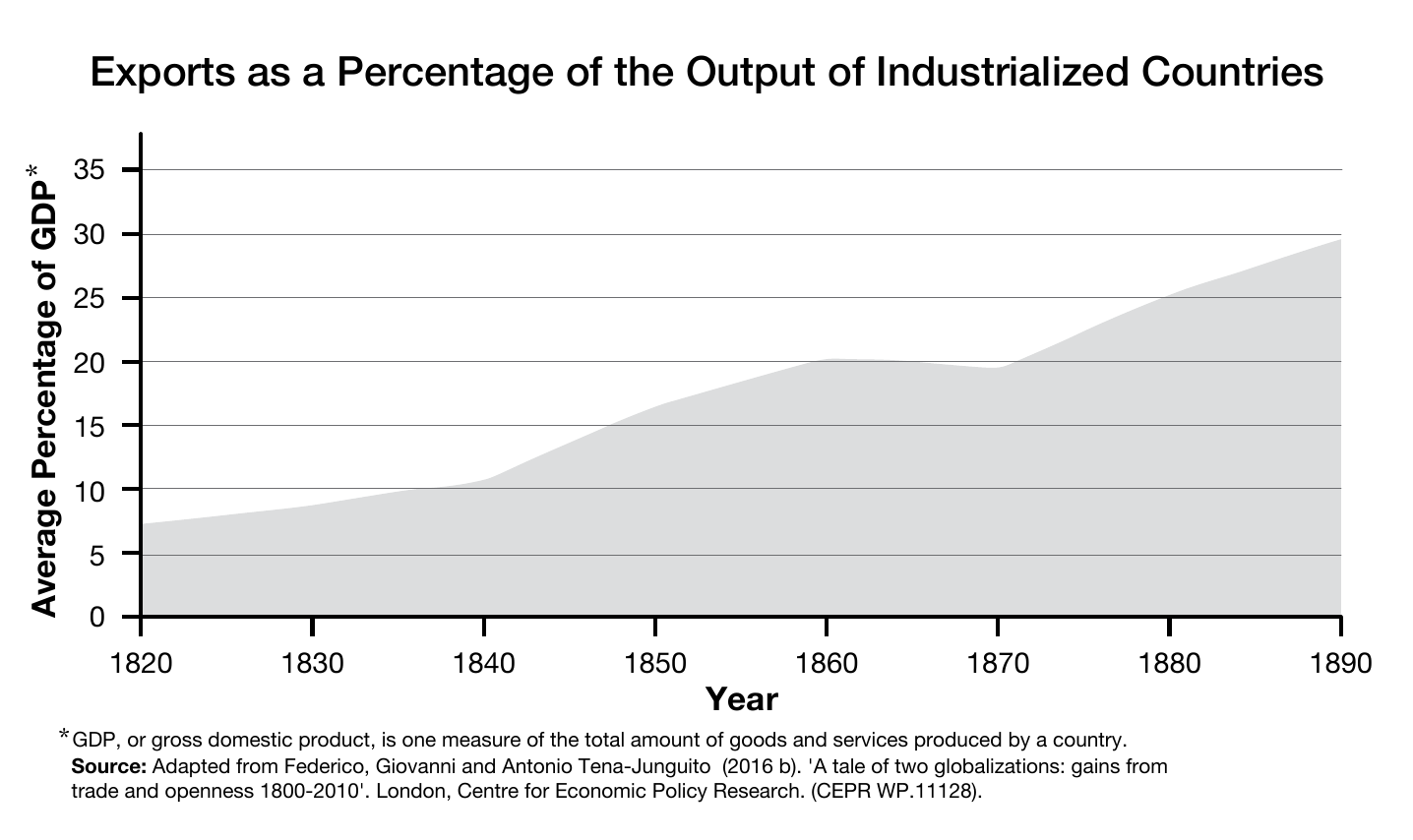
As production increased, new and greater amounts of natural resources were required by industrial economies. In addition, such common industrial resources as coal and iron, tin, bauxite, rubber, and copper were also imported from sources in Africa, Southeast Asia, and Latin America. A key effect of industrial capitalism, therefore, was the expansion of imperialism in the 19th century. Industrialized countries, especially those in Western Europe, the U.S., and Japan, saw the benefits of controlling trade and resources of other areas of the world. This trend was a continuation from the previous era during which European countries created colonies in the Western Hemisphere and in the Indian Ocean.
In contrast, the dependent colonial economies that provided raw material to and markets for the imperial powers often saw little economic development from participation in the world economy. Reliance on the cash crops introduced by imperial powers often left them vulnerable to natural disasters and volatile markets.
In this era, however, states and people in regions that had previously been able to resist European colonization found themselves increasingly dominated by Western powers. Most areas of Africa came under the direct control of European colonizers. Large portions of South Asia and Southeast Asia were colonized, mainly by Great Britain and France, respectively. Even China, the most dynamic civilization in previous eras, succumbed to the domination of Western and Japanese imperialists. Western powers were able to achieve this level of dominance because of the technological advances associated with the Industrial Revolution. Advances in military technology, ship building, and medicine helped Western European nations assert control over these other regions.