Topic 3 AP Exam Practice
Multiple-Choice Questions
Questions 1 to 3 refer to the map below.
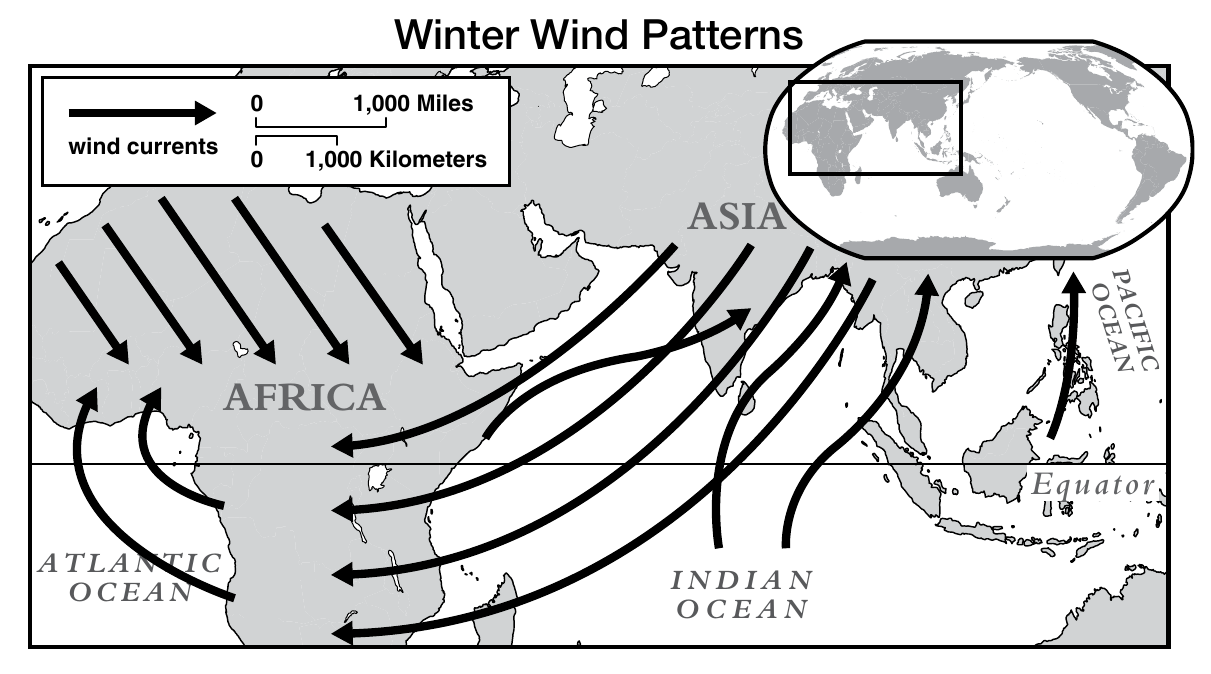
1. The map helps explain why South Asian merchants preferred to travel
- (A) to Africa in the winter months
- (B) to Southeast Asia in the winter months
- (C) to China in the summer months
- (D) to the Middle East in the summer months
2. Since merchants were often delayed in foreign ports for lengthy periods of time, they frequently
- (A) became involved in local political affairs
- (B) married wives who often converted to their religion
- (C) lost their connection to the culture of their homeland
- (D) settled in the foreign port and converted to the local faith
3. The coastal cities of Mombasa, Sofala, and Mogadishu often exported
- (A) silks and porcelain.
- (B) cotton and steel.
- (C) horses, figs, and dates.
- (D) enslaved people, ivory, and gold.
Short-Answer Questions
1. Use the passage below to answer all parts of the question that follows.
“Merchants boast that their wisdom and ability are such as to give them a free hand in affairs. They believe that they know all the possible transformations in the universe and therefore can calculate all the changes in the human world, and that the rise and fall of prices are under their command. These merchants do not know how insignificant their wisdom and ability really are . . . . If farmers do not work, there will be an insufficiency of food; if craftsmen do not work, there will be an insufficiency of tools; if merchants do not work, circulation of the three necessities will be cut off, which will cause food and materials to be insufficient . . . . As to the foreigners in the Southeast, their goods are useful to us just as ours are to them. To use what one has to exchange for what one does not have is what trade is all about . . . . Foreigners are recalcitrant [uncooperative] and their greed knows no bounds.” Chang Han, Ming official, the 15th century
2. Answer all parts of the question that follows.