U.S. Imperialism in Latin America and the Pacific
During the 19th century, the United States continued taking land from indigenous peoples, as Europeans had done since Columbus arrived. One notorious episode was the forced relocation of Eastern Woodlands peoples from the Southeast to a new Indian Territory in what is now Oklahoma. So many Native Americans died from exposure, malnutrition, disease, and exhaustion that this forced migration became known as the Trail of Tears.
In 1823, President James Monroe issued the Monroe Doctrine, which stated that European nations should not intervene in the affairs of the countries in the Western Hemisphere. Implied in the doctrine was a desire to be an imperial power in the Americas. This desire played out in the U.S. war with Mexico (1845–1848), through which the United States gained vast territories in the Southwest from Mexico.
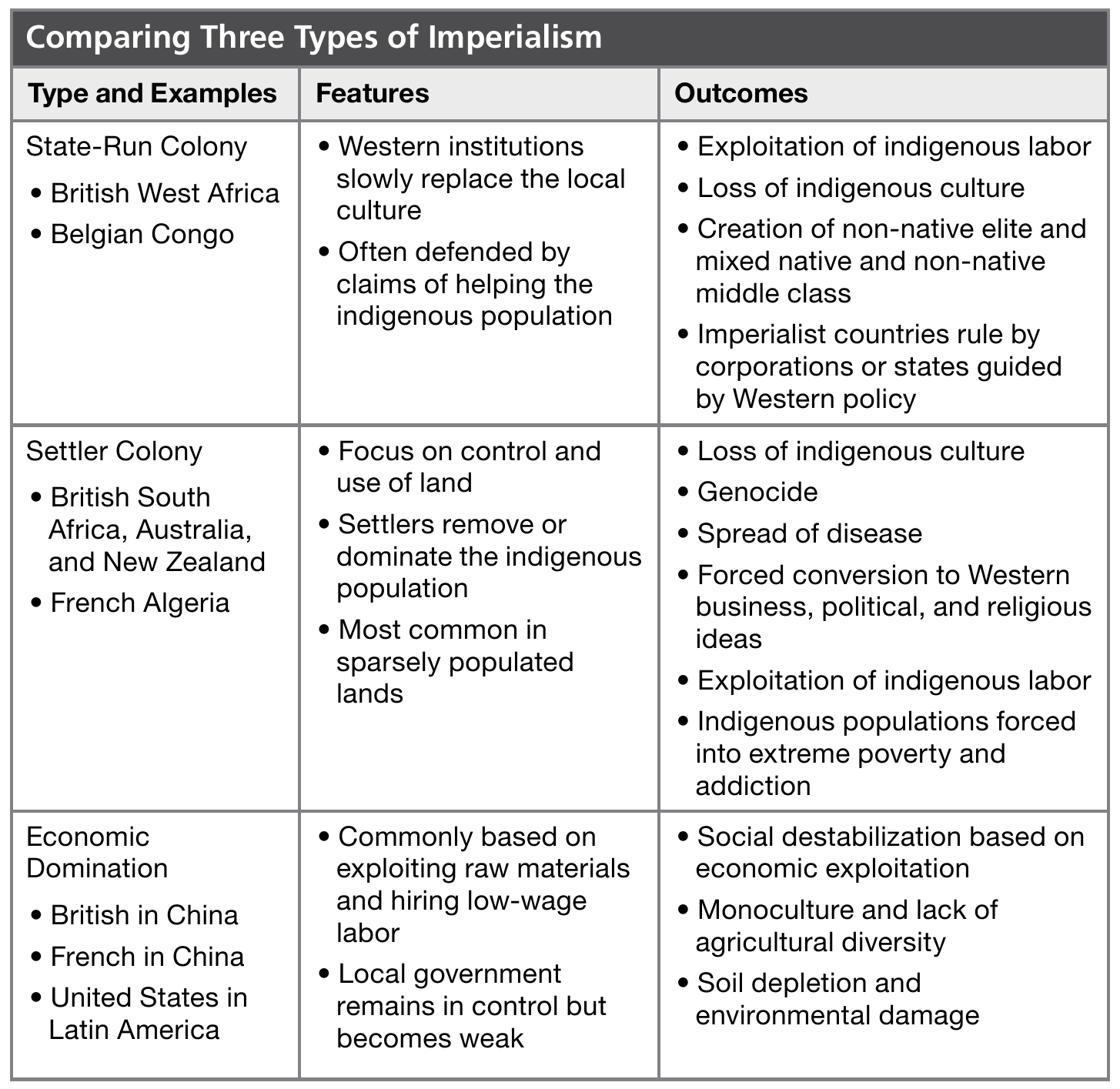
Expansion on Land White Americans believed that they had a Manifest Destiny—a natural and inevitable right to expand to the Pacific Ocean. The United States bought Alaska from Russia in 1867. Two years later, in 1869, the completion of a transcontinental railway spurred development of the American West. As white settlers moved westward to take advantage of offers of free land, Native Americans were forced onto reservations. By 1893, the U.S. Bureau of the Census declared that the western frontier was now closed.
Expansion Overseas The United States turned its focus to lands overseas. The United States was not a global power for most of the 19th century. The Second Industrial Revolution brought newfound prosperity to the young republic. Economic considerations, as well as feelings of nationalism and cultural superiority, drove Americans’ desire for territorial conquest. A group of American planters overthrew Hawaii’s constitutional monarchy in 1895, but the islands did not become a U.S. territory until 1900. In the meantime, the U.S. victory in the Spanish-American War in 1898 brought Guam, Cuba, Puerto Rico, and the Philippines under U.S. control. President Theodore Roosevelt, a proponent of Social Darwinism, was especially eager to expand U.S. influence throughout the Western Hemisphere. The 1904 Roosevelt Corollary to the Monroe Doctrine stated that if countries in Latin America demonstrated “instability,” the United States would intervene. It did several times. For example, in 1904 Roosevelt sent U.S. troops to occupy a Caribbean island nation, the Dominican Republic, until it repaid its foreign debts.