Topic 1 AP Exam Practice
Multiple-Choice Questions
Questions 1 to 3 refer to the table below.
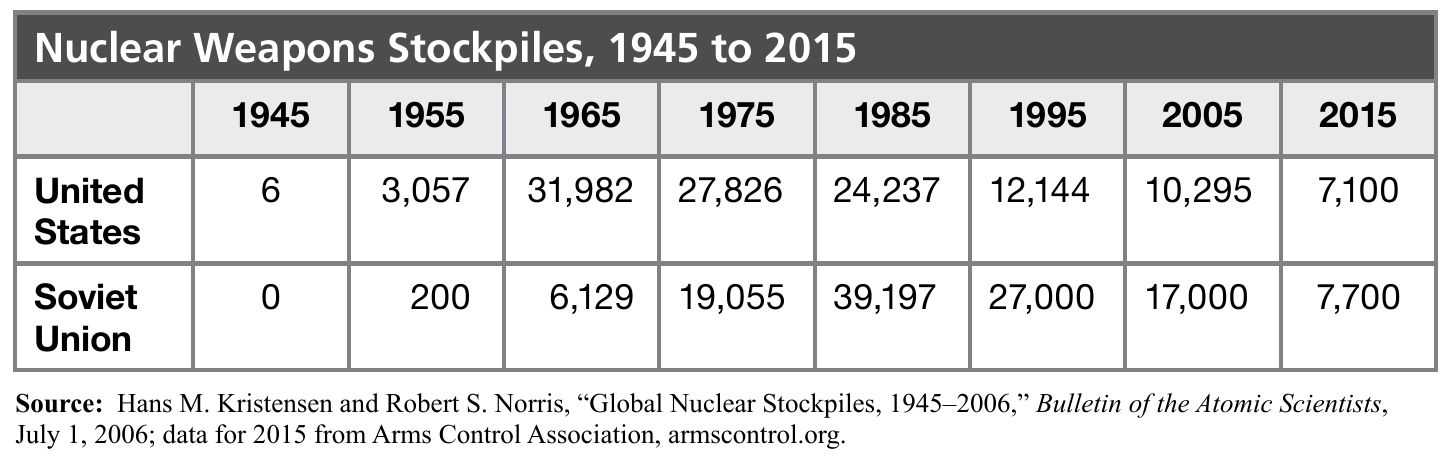
1. The data in the chart best supports which of the following claims?
- (A) The Soviet Union was primarily responsible for the escalation of the arms race in the 1950s and 1960.
- (B) The Soviet Union and the United States usually had about the same number of nuclear weapons.
- (C) The Soviet Union was behind in stockpiling weapons until about 1980, when it overtook the United State in the number of weapons.
- (D) The Soviet Union conceded defeat in the arms race when the United States had a large enough lead in the number of weapons.
2. Who predicted that increases in weapons stockpiles in the Soviet Union and the United States would have significant political and economic consequences?
- (A) President Franklin Roosevelt at the Yalta Conference
- (B) Several leaders of anti-colonial movements after World War II
- (C) President Dwight Eisenhower, who described a military-industrial complex
- (D) President Harry Truman, who insisted on free elections for Eastern European countries
3. Which accurately describes an effect of the changes shown in the table?
- (A) Both countries saw little change in their leadership as a result of the increase in the number of nuclear weapons during this period.
- (B) People around the world supported the buildup of nuclear weapons and agreed it was the best way to ensure peace.
- (C) The stockpiling of nuclear weapons actually strengthened the economies of both the United States and the Soviet Union.
- (D) The arms race was distressing to many around the world, and a strong antinuclear movement was established.
Short-Answer Questions
1. Use the passage below to answer all parts of the question that follows.
“On November 1, 1952, the United States successfully detonated “Mike,” the world’s first hydrogen bomb, on the Elugelab Atoll in the Pacific Marshall Islands. The 10.4-megaton thermonuclear device, built upon the Teller-Ulam principles of staged radiation implosion, instantly vaporized an entire island and left behind a crater more than a mile wide. The incredible explosive force of Mike was also apparent from the sheer magnitude of its mushroom cloud. . . . Half an hour after the test, the mushroom stretched 60 miles across, with the base of the head joining the stem at 45,000 feet.
Three years later, on November 22, 1955, the Soviet Union detonated its first hydrogen bomb on the same principle of radiation implosion. Both superpowers were now in possession of the ‘hell bomb,’ as it was known by many Americans, and the world lived under the threat of thermonuclear war for the first time in history.”
History.com, United States Tests First Hydrogen Bomb, 2018
2. Answer all parts of the question that follows.