The Age of New Ideas Continues
In Europe and America, Enlightenment thinkers reacted to the social ills caused by increasing urbanization and industrialization. Poverty in the cities increased. Poor workers lived in slums without proper sanitation and without political representation. Various writers proposed solutions to the observable problems. Some wanted more government regulations and programs, and many Christians called for greater private charity. But some conservatives blamed the poor themselves and called on them to change. Conservatism is a belief in traditional institutions, favoring reliance on practical experience over ideological theories, such as that of human perfectability.
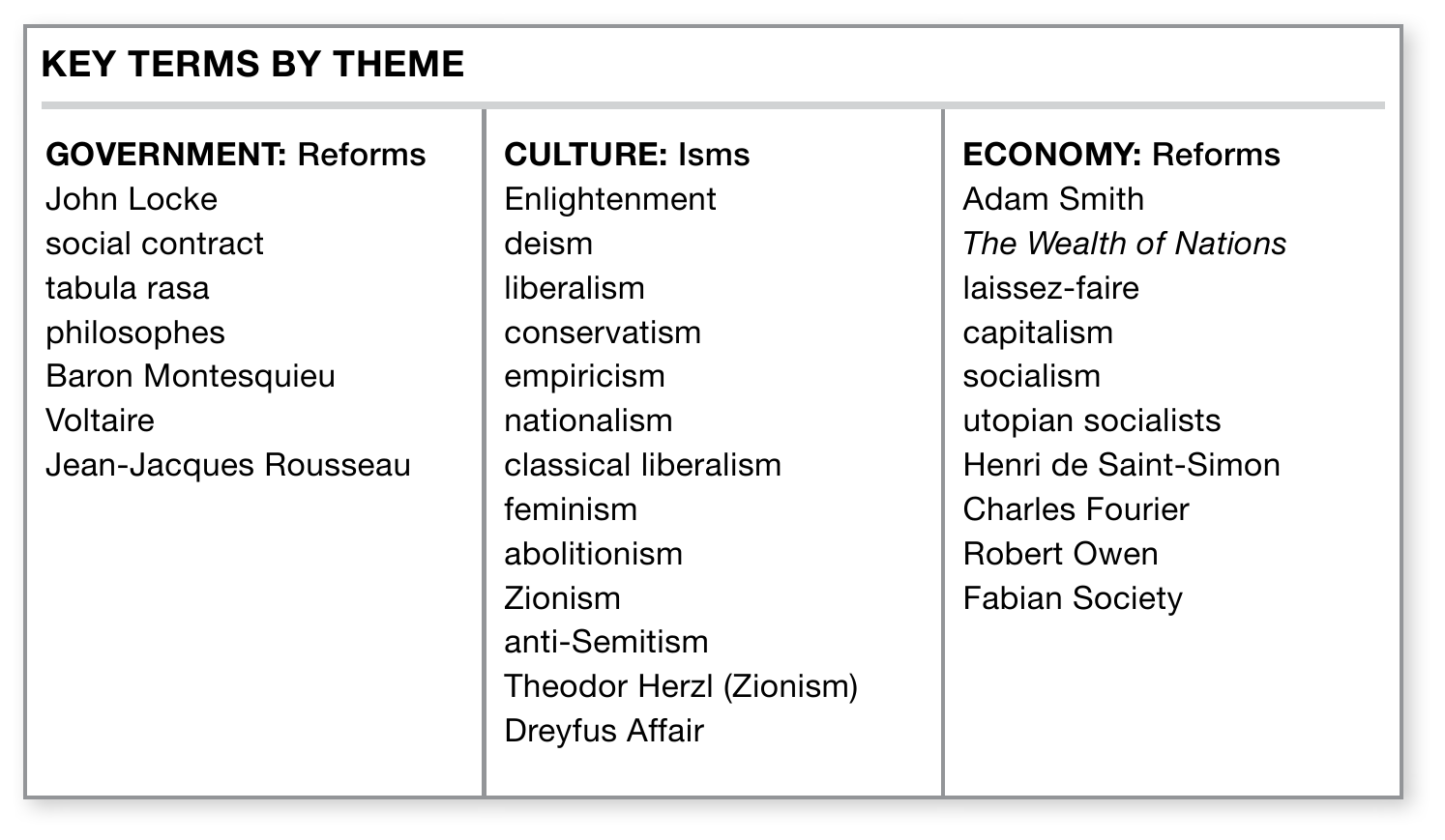
Utopian Socialism The economic and political theory of socialism refers to a system of public or direct worker ownership of the means of production such as the mills to make cloth or the machinery and land needed to mine coal. Various branches of socialism developed in the 19th century, providing alternative visions of the social and economic future. Those who felt that society could be channeled in positive directions by setting up ideal communities were often called utopian socialists:
• Henri de Saint-Simon, of France, believed that scientists and engineers, working together with businesses, could operate clean, efficient, beautiful places to work that produced things useful to society. He also advocated for public works that would provide employment. He proposed building the Suez Canal in Egypt, a project that the French government later undertook and which opened in 1869.
• Charles Fourier identified some 810 passions that, when encouraged, would make work more enjoyable and workers less tired. Like other utopian socialists, Fourier believed that a fundamental principle of utopia was harmonious living in communities rather than the class struggle that was basic to the thinking of Karl Marx.
• Robert Owen was born in Great Britain. He established intentional communities—small societies governed by the principles of utopian socialism—in New Lanark, Scotland, and New Harmony, Indiana. He believed in education for children who worked, communal ownership of property, and community rules to govern work, education, and leisure time.
In the later 19th century, socialist groups such as the Fabian Society formed in England. The Fabians were gradual socialists: they favored reforming society by parliamentary means. Writers H. G. Wells, Virginia Woolf, and George Bernard Shaw were prominent Fabians. By the mid-20th century, socialist principles would influence most of Western Europe.
Classical Liberalism Others advocated classical liberalism, a belief in natural rights, constitutional government, laissez-faire economics, and reduced spending on armies and established churches. Most classical liberals were professionals, writers, or academics. In Britain they pursued changes in Parliament to reflect changing population patterns so that new industrial cities would have equal parliamentary representation. Classical liberals backed the Reform Bills of 1832, 1867, and 1884, all of which broadened male suffrage.
Feminism This period saw the emergence of the movement for women’s rights and equality based on Enlightenment ideas. The French writer Olympe de Gouges fought for these rights in the era of the French Revolution. In 1789, France had adopted the “Declaration of the Rights of Man and of the (Male) Citizen,” a pioneering document in the history of human rights. In 1791, de Gouges published a “Declaration of the Rights of Woman and of the (Female) Citizen,” to point out that women’s rights had not been addressed.
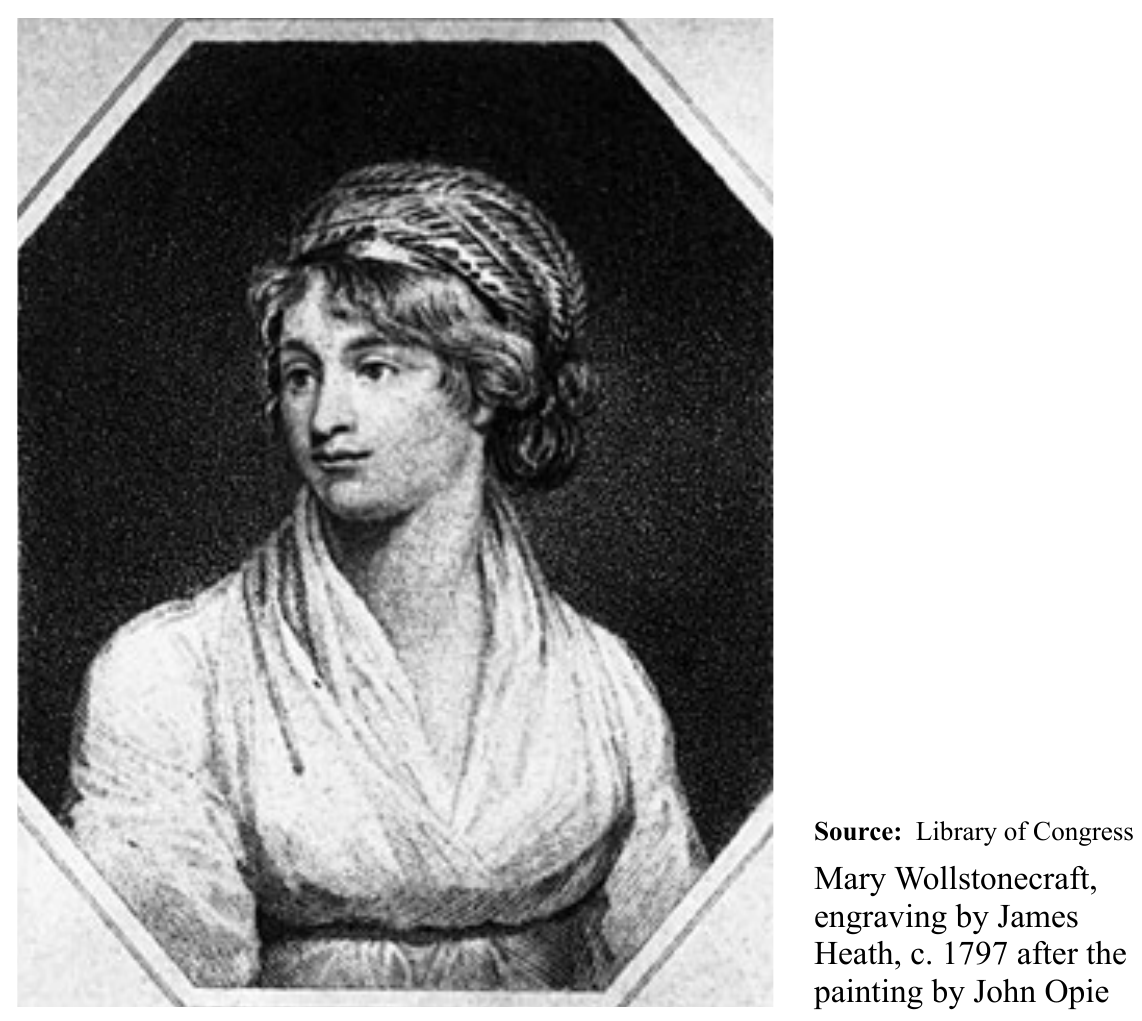
In 1792 in England, the pioneering writer Mary Wollstonecraft published A Vindication of the Rights of Women. In it, she argued that females should receive the same education as males. Universal education, she argued, would prepare women to participate in political and professional society, enabling them to support themselves rather than relying on men. Wollstonecraft’s ultimate goal was for women to gain the same rights and abilities as men through the application of reason. Women won the full right to vote in 1928.
In 1848 in Seneca Falls, New York, activists gathered to promote women’s rights and suffrage (the ability to vote). In the convention’s “Declaration of Sentiments,” organizers Lucretia Mott and Elizabeth Cady Stanton declared, “All men and women are created equal.” They demanded women deserved the right to vote and hold office, hold property and manage their own incomes, and be the legal guardians of their children. The Seneca Falls Convention was a landmark in the history of the women’s rights movement.
Abolitionism Reform movements to provide rights and equality extended to freedom for enslaved people and the end of serfdom. Abolitionism, the movement to end the Atlantic slave trade and free all enslaved people, gained followers in the 18th century. Slave trading was banned earlier than slavery itself. The first states to ban the slave trade were with Denmark in 1803, Great Britain in 1807, and the United States in 1808. In most countries, the slave system depended on a steady supply of new enslaved people in order to function. As a result, as soon as the slave trade stopped, slavery began to decline. In most parts of the Americas, slavery was abolished within 30 years of the end of the slave trade. The United States was the rare country where numbers increased after the importation of enslaved people ended. The last country in the Americas to end slavery was Brazil, in 1888.
The End of Serfdom Serfdom in Europe had been declining as the economy changed from agrarian to industrial. Peasant revolts pushed leaders toward reform. Queen Elizabeth I abolished serfdom in 1574. The French government abolished all feudal rights of the nobility in 1789. Alexander II of Russia abolished serfdom in 1861. The Russian emancipation of 23 million serfs was the largest single emancipation of people in bondage in human history.
Zionism Yet another “ism” in the late 19th century was the emergence of Zionism—the desire of Jews to reestablish an independent homeland where their ancestors had lived in the Middle East. After centuries of battling anti- Semitism, hostility toward Jews, and pogroms—violent attacks against Jewish communities—many European Jews had concluded that living in peace and security was not a realistic hope. To be safe, Jews needed to control their own land. Leading the movement was an Austro-Hungarian Jew, Theodor Herzl.
Support for Zionism increased after a scandal in France known as the Dreyfus Affair. In 1894, Alfred Dreyfus, a military officer who was Jewish, was convicted of treason against the French government. However, the conviction had been based on forged documents by people promoting anti- Semitism. Dreyfus was ultimately pardoned after time in prison, but the case illustrated how widespread anti-Semitism was in France, one of the countries where Jews seemed least oppressed.
Zionists faced many obstacles. The land they wanted was controlled by the Ottoman Empire, and Palestinian Arabs were already living in the region. Both the Ottomans and the Palestinians were predominantly Muslim, which added a religious aspect to the conflict. However, the Zionist movement grew in strength until 1948, when the modern country of Israel was founded.